How to play Donkey Kong online
- Run left and right: left and right arrow keys
- Climb a ladder: up and down arrow keys while standing at a ladder
- Jump (and grab the hammer): Space bar
- Start a new game: F12 (the console’s Reset switch), or Space right after the game loads
- Save and load your progress: Ctrl + 0–9 saves to a slot, Alt + 0–9 loads it
Gameplay
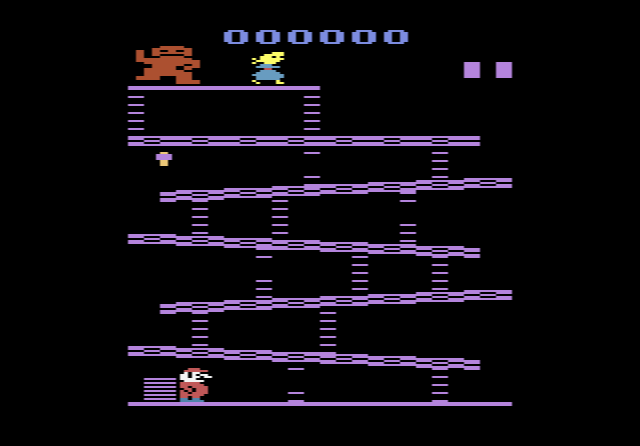
The game switches between two screens. On the barrel screen, Donkey Kong stands at the top and rolls barrels down a stack of slanted ramps. You climb from the bottom to the top, using the ladders and jumping over the barrels as they roll towards you. A hammer hangs above one of the ramps: jump up to grab it and you can smash barrels for extra points for a short time, but you cannot climb while holding it.
On the rivet screen, the girders are held together by rivets. Run or jump over each rivet to remove it while you keep away from the fireballs. After the rivet screen the game goes back to the barrels, and every round is harder than the last. You get three Marios per game.
Each screen starts with a bonus of 5,000 points that counts down as you play. Finish the screen and whatever is left is added to your score. If the bonus reaches zero, you lose a Mario.
| Action | Points |
|---|---|
| Jumping a barrel or fireball | 100 |
| Removing a rivet | 100 |
| Smashing a barrel or fireball with the hammer | 800 |
| Bonus at the start of each screen | 5,000 (counts down) |
Tips
- Don’t stop to fight. The bonus timer is worth far more than anything you score on the way, so head for the top as quickly as you safely can.
- Use the hammer carefully. Smashing is worth eight times as much as jumping, but you are stuck on one ramp until it wears off.
- Jump for points when it is safe. Every barrel or fireball you clear is worth 100 points, so a well-timed jump both keeps you alive and adds to your score.
- Remember the pattern. The game only has two screens, which alternate. Learn where the fireballs usually go on the rivet screen, because each new round is faster.
The story behind 2600 Donkey Kong
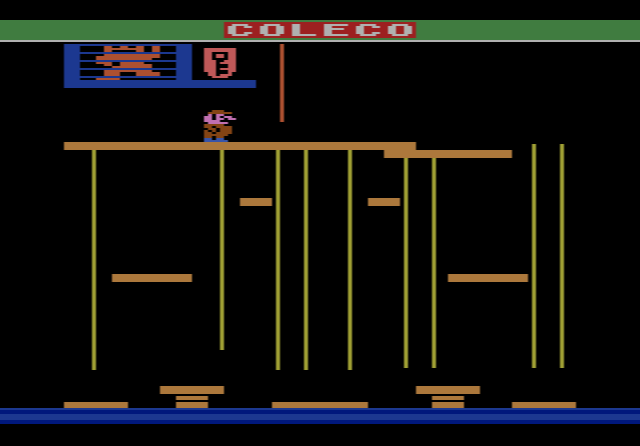
Coleco held the rights to bring Donkey Kong to home consoles, and it hired Garry Kitchen to make the 2600 version. He had roughly 90 days and a 4 KB cartridge to work with. A larger cartridge would have left room for more of the arcade game, but it would also have cost more to manufacture, so two of the arcade screens were left out. Even so, Kitchen managed slanted ramps and flicker-free characters, which were hard to do on the 2600.
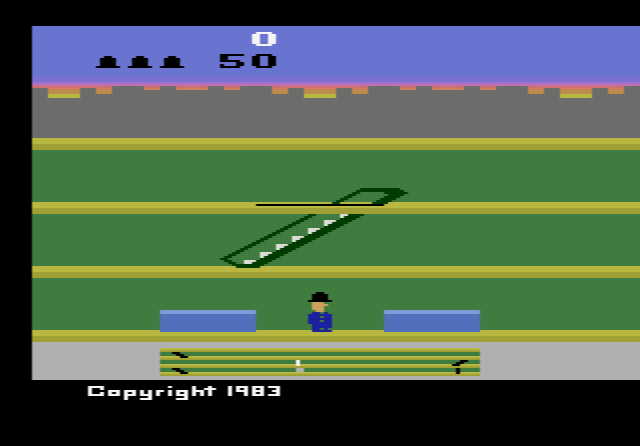
Some players have long believed that Coleco made the Atari version weak on purpose, to make its own ColecoVision console look better. Kitchen has firmly denied it, and the technical effort that went into the cartridge does not suggest a deliberately weak game. The cartridge sold very well, and Atari later reissued Coleco’s game under its own label. Kitchen went on to join Activision, where he made Keystone Kapers.