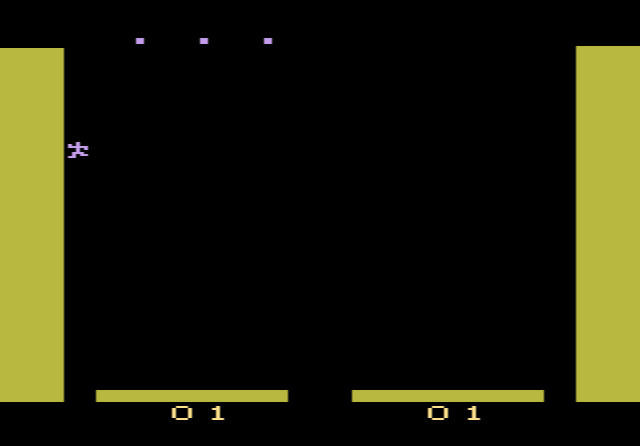
How to play Entombed online
- Move through the maze: arrow keys
- Use a make-break: hold an arrow key in the direction you want and press Space
- Player 2 (Game 2): T/F/G/H to move, A for the make-break
- Choose Game 1 (one player) or Game 2 (two players): F11 (the console’s Select switch)
- Start a new game: F12 (the console’s Reset switch)
- Difficulty switches: F4 (Player 1) and F9 (Player 2)
- Save and load your progress: Ctrl + 0–9 saves to a slot, Alt + 0–9 loads it
Gameplay
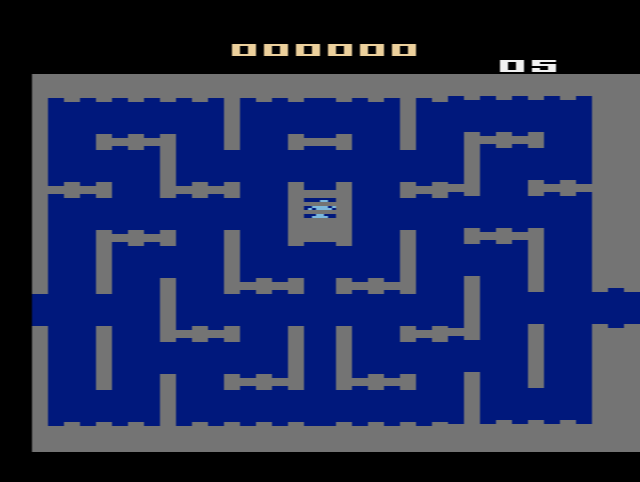
The maze is symmetrical, left to right, and it keeps scrolling upward. You have to keep finding a way through it. If the scrolling carries you off the screen, or a zombie touches you, you lose an archaeologist. You start with three, shown as small squares on the screen. A warning sound tells you zombies are near. Blue zombies stay in the corridors, but orange ones can pass straight through walls.
The make-break is your only tool. Used in a direction, it knocks out the wall in front of you, or fills in an open gap to put a wall between you and a zombie. You start with just one. Touch a blinking block to collect more: each block gives three with the difficulty switch on B and two on A. In the one-player game your score is the number of maze sections you get through. The two-player game has no score. Both players share the same maze, and you can either help each other out of tight spots or block your rival’s path and grab all the make-breaks.
Tips
- Don’t rush early on. The first mazes scroll slowly, so take time to read the corridors ahead.
- Look ahead for dead ends. Pick routes that stay open further down, so you don’t need a make-break at all.
- Save a make-break for emergencies. Use it only when you are really boxed in, or to wall off a zombie that is closing in.
- Watch the orange zombies. Walls will not stop them, so a wall you build only protects you from the blue ones.
The mystery of the maze
The 2600 has far too little memory to store a maze that goes on forever, so Entombed builds each new row as it scrolls into view. In 2019 John Aycock and Tara Copplestone published a study of how it works. Each new square depends on five neighbouring squares, which are looked up in a small table of values that seem to have been chosen by hand, and the researchers could not work out how anyone had come up with them. The story reached a wider audience that year through a BBC article.
The paper credits the maze routine to Paul Allen Newell and Duncan Muirhead. Sidley remembered that it came from a colleague who was “drunk and whacked out of his brain”; Newell recalled it as a problem he and Muirhead solved after going out for a beer. In 2021 León Mächler and David Naccache published an explanation of the algorithm and extended it to 3D mazes, and in 2022 Newell co-authored his own first-hand account of how the game was made.