How to play Football online
- Player 1 (orange team): arrow keys to choose a play and move, Space bar for the button
- Player 2 (white team): T/F/G/H to choose a play and move, A for the button
- Start a new game: F12 (the console’s Reset switch)
- Choose game 1, 2 or 3: F11 (the console’s Select switch)
- Handicap: F4 and F9 set each player’s difficulty switch
Gameplay
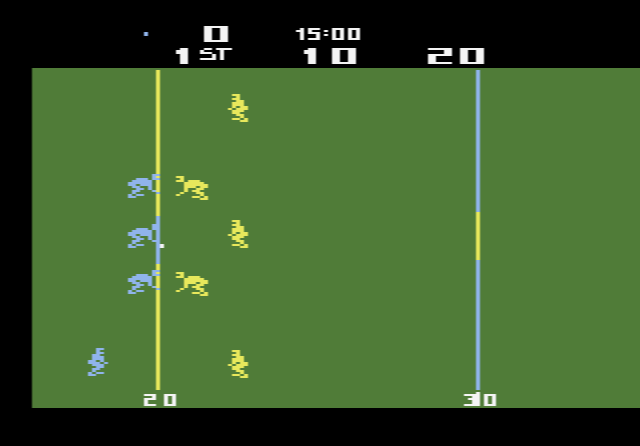
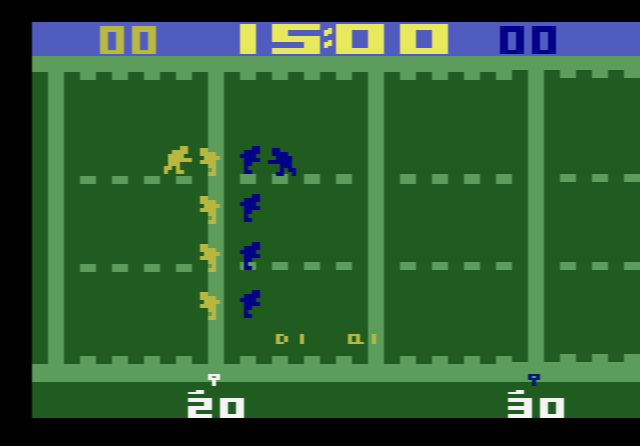
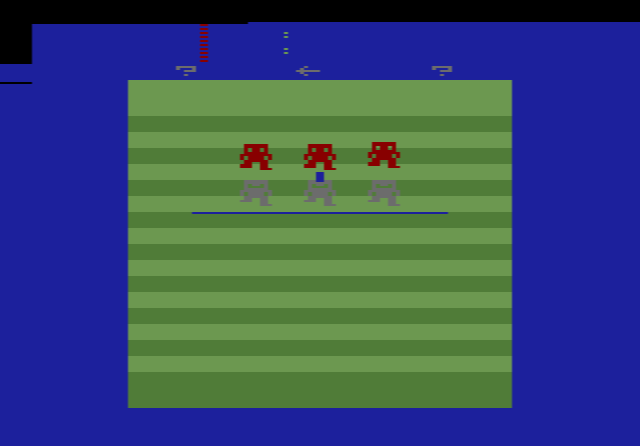
The field is shown from above, orange team against white, and orange starts on offence. Before each play both players pick a formation with the joystick; the offence can press the button to choose a punt. The play starts as soon as both sides have chosen.
In games 1 and 2 you then take over. On offence you control the ball carrier and press the button to pass (or kick, on a punt). On defence you control your lineman, or your defensive back while you hold the button down. You tackle by moving a player into the ball carrier’s path. Passes must be thrown from behind the line of scrimmage, and you can steer a pass or punt left or right while it is in the air.
The offence has four downs to cross the first-down line. A touchdown is worth 7 points, and tackling the ball carrier behind his own goal line is a safety, worth 2 points plus possession. The clock starts at 5:00 and only runs during plays. When it reaches zero, the higher score wins.
Game variations and switches
- Game 1: players you are not controlling follow the chosen play loosely, with some randomness.
- Game 2: players you are not controlling follow the play exactly, so reading your opponent’s call matters more.
- Game 3: both sides only call plays and the computer runs them. The offence can still press the button to pass or punt.
Setting a difficulty switch to A (expert) makes that player’s team slower at moving sideways, a handicap for the stronger player. On a black-and-white TV setting, the white team’s score can disappear at the end of the game, so leave the TV type on colour.
Tips
- Mix up your calls. If you run the same play every time, your friend will learn it quickly, especially in game 2.
- Steer your passes. A pass that is drifting towards a defender can often be nudged back to your receiver.
- Use your defensive back on punts. Only he can catch and return a punt, so hold the button to take control of him when the kick goes up.
- Throw away from the crowd. Any player can catch a pass, including a defender, so aim for open space.
History
Football uses a display routine similar to Whitehead’s earlier Home Run. The console could show only a few moving objects, so he repeated player graphics across the screen and made them flicker, drawing different players on alternate frames. That trick fields two teams of four. The cartridge is usually dated 1978, while Atari Archive places its release in March 1979.
According to an internal Atari sales document cited by Atari Archive, it was the 12th best-selling game for the system, with 248,502 copies sold in 1980 alone. It should not be confused with Atari’s 1978 arcade Football, a different game played with a trackball. Atari followed it with RealSports Football in 1982.