How to play Keystone Kapers online
- Run left and right: left and right arrow keys
- Jump: Space bar (press it while running for a running jump)
- Duck: down arrow key
- Step into the elevator: up arrow key; press down to step out again
- Start a new game: F12 (the console’s Reset switch)
- Save and load your progress: Ctrl + 0–9 saves to a slot, Alt + 0–9 loads it
Gameplay
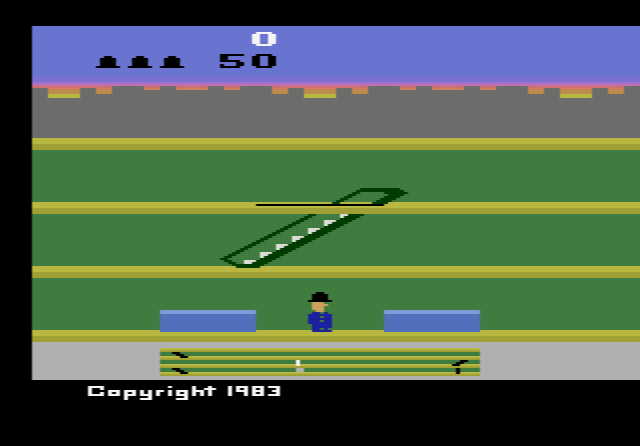
The store is seen from the side and is much wider than the screen, so the view scrolls as Kelly runs. Harry Hooligan heads upwards through the floors towards the roof. A security display at the bottom of the screen shows the whole building and where you both are.
Kelly rides up an escalator just by touching it, and the escalators are the only way onto the roof. The elevator in the middle of the store can take him up or down to any floor except the roof, but it moves on its own, so you have to time your entry. Along the way you meet shopping carts, beach balls and old cathedral radios, which you jump over. Bumping into one costs you nine seconds on the timer. On later rounds toy biplanes fly through the aisles; you duck under those, because touching one costs a life.
You lose one of your Kops (lives) if the timer runs out, if you hit a biplane, or if Harry gets away off the roof. The game ends when all your Kops are gone. Catching Harry scores points based on the time left, and moneybags and suitcases are worth 50 points each. Every 10,000 points gives you an extra Kop, up to three in reserve.
| Krook number | Points for the capture |
|---|---|
| 1–8 | 100 × time left |
| 9–16 | 200 × time left |
| 17 and later | 300 × time left |
| Moneybag or suitcase | 50 |
Tips
- Don’t get stuck on the roof. The designer’s own warning in the manual. The elevator cannot reach the roof, so if Harry doubles back while you are up there, you will struggle to get down in time.
- Watch the security display. It tells you which floor Harry is on and which way he is heading, so you can decide between the escalator and the elevator before you reach them.
- Find the rhythm. Obstacles roll towards you at a regular pace. Mixing running steps and jumps in time with them, which Kitchen calls the “Keystone Strut”, keeps you moving without losing seconds.
The story behind Keystone Kapers
Garry Kitchen had already made Space Jockey and a 2600 conversion of Donkey Kong when he joined Activision’s satellite office in Glen Rock, New Jersey, in June 1982. His new game was code-named “Cop”. The Keystone Cops theme, borrowed from the silent comedy films, suited the 2600 well: bowler hats, uniforms and billy clubs were easy to read in chunky graphics and set a light, comic tone.
Kitchen first planned a vertical layout like Donkey Kong, but David Crane suggested a sideways-scrolling store, closer to his own Pitfall!. Everything had to fit in 4 kilobytes, and Kitchen had to cut a Model T car and a television to make room. Reviewers of the time praised the animation in particular, and the game received a Certificate of Merit at the 1984 Arkie Awards. It was later converted to the ColecoVision and the Atari 5200. Players who scored 35,000 points or more could send Activision a photo to join the “Billy Club” and receive a patch.