How to play Seaquest online
- Move the submarine: arrow keys (up to rise, down to dive, left and right to turn and move)
- Fire torpedoes: Space bar (hold it down for continuous fire)
- Start a new game: F12 (the console’s Reset switch)
- Choose one or two players: F11 (the console’s Select switch)
- Change the rate of continuous fire: F4 toggles the Player 1 difficulty switch (F9 for Player 2)
- Save and load your progress: Ctrl + 0–9 saves to a slot, Alt + 0–9 loads it
Gameplay
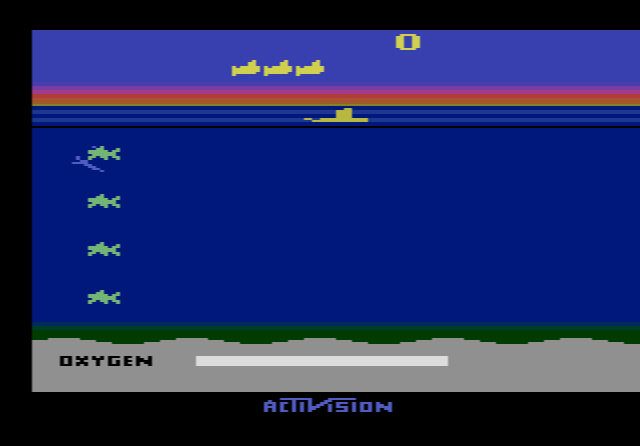
Sharks and enemy submarines cross the screen in lanes at different depths, and the enemy subs fire torpedoes. Divers swim among them; touch one and your sub picks them up. You can carry six at a time. Meanwhile the oxygen gauge drains steadily, and when it gets close to empty the game starts beeping at you. If it runs out before you reach the surface, you lose your sub.
Surfacing is where the game’s rules bite. Come up with six divers and you score them all, plus a bonus for the oxygen you have left. Come up with fewer than six and you lose one of them. Come up with none and you lose a sub. Each full rescue also makes the next round faster and more dangerous, and an enemy patrol sub eventually starts cruising along the surface, so even refilling your tank becomes risky.
According to the manual, sharks and enemy subs start at 20 points each and go up by 10 every time you surface with six divers, to a maximum of 90. Rescued divers start at 50 points each and also rise as the game goes on. You begin with four subs and earn another one every 10,000 points. Game 1 is for one player; Game 2 is for two players taking turns.
Tips
- Never surface empty. If oxygen is low and you have no divers, grab one first, even if it means taking a risk. Surfacing with nobody on board costs a sub.
- Collect all six before going up. Only a full load pays the big bonus and raises the value of enemies, so partial trips cost you both points and a diver.
- Clear a lane before crossing it. The enemies move in fixed rows. Shoot the ones in the row you need to pass through instead of trying to slip between them.
- Watch for the patrol sub after a full rescue. It moves along the surface, and while you refill your oxygen you cannot move away.
The story behind Seaquest
Steve Cartwright later described Seaquest as essentially a reskin of the 1981 arcade game Defender, and has said the 2600 was well suited to adapting arcade ideas. Activision released it in 1983, the same year Cartwright’s Frostbite came out. Like many Activision games of the time, it offered a reward for skilled players: anyone who reached 50,000 points and sent in a photo of the screen could join the “Sub Club” and receive a patch.
Reviewers of the time liked the graphics and sound, and some said the controls really gave a feeling of moving through water. Others found it too slow or not varied enough for experienced players. The name also led to a court case: a salvage company sued Activision over it, and Activision won.