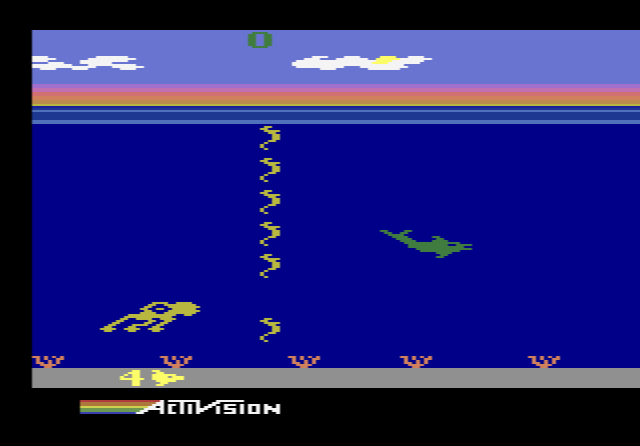
How to play Dolphin online
- Swim up and down: up and down arrow keys
- Swim left and right: left and right arrow keys
- Start the action: F12 (the console’s Reset switch), then Space
- Choose a game variation: F11 (the console’s Select switch)
- Time to catch the squid after touching the seagull: F4 toggles the Player 1 difficulty switch (F9 for Player 2)
- Player 2 (games 2, 4, 6 and 8): T/F/G/H, fire = A
Turn the sound on. This game is much harder to play with the sound muted.
Gameplay
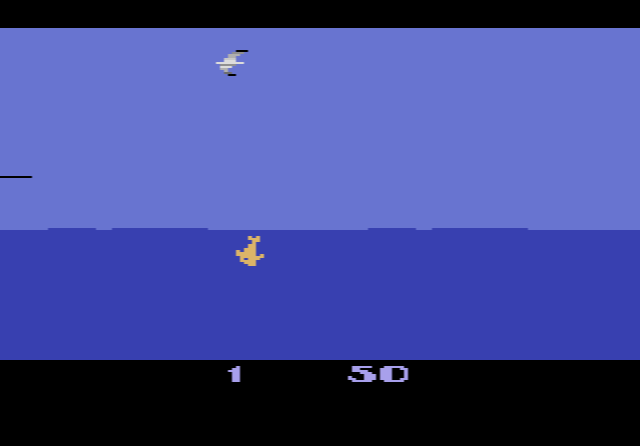
The squid is always right behind you. Ahead are schools of seahorses, each with one opening to swim through. Before each school, the dolphin’s sonar sounds a tone: the higher the tone, the higher the opening. There are five tones to learn. Bump into the seahorses and you slow down, letting the squid gain on you.
Currents appear as arrows. A “good wave” runs the same way as the dolphin and speeds her up, while a “bad wave” comes head-on and slows her down. Waves affect the squid too, so lead it into bad ones.
Now and then a seagull flies overhead, and the squid changes colour just before it comes. Leap up and touch the seagull, and for a few seconds the dolphin can turn and ram the squid. This earns the most points and moves the game to the next difficulty level, with the squid pushed back. Each new squid colour means a smarter, faster pursuer.
You start with one dolphin plus four in reserve, and gain another every 20,000 points. Touching the seagull scores up to 800 and the squid up to 8,000. A good wave, or pushing the squid into a bad one, is worth 100, and each seahorse opening gives 0 to 50 depending on how cleanly you pass.
Variations and switches
There are eight variations. Odd-numbered games are for one player and even-numbered games for two, and difficulty rises with the game number. The difficulty switch sets how long you have to reach the squid after touching the seagull: 4 seconds in position B, 2 seconds in position A.
Tips
- Learn one tone at a time. Link each pitch to a height. There is never an opening at the very top or bottom of a school.
- Expect a bad wave after an opening. One often follows, so be ready to move.
- Give the squid “the slip”. When the squid catches a good wave, reverse and swim underneath it. While that wave is still on the screen, the squid can’t turn back to follow you.
- Watch the squid’s colour. A change means the seagull is coming. Time your leap, because the dolphin can’t hover.
The story behind Dolphin
Hubbard had loved dolphins since childhood and wanted a game built around echolocation. Bob Whitehead helped him draw larger characters than most 2600 games had. The game reached shops in May 1983 and was the fifth best-selling video game that June. Reviewers praised the lifelike swimming and the way sound became part of play, and it won a 1984 Arcade Award for its audio-visual effects.
Players who photographed a score of 80,000 could get Activision’s “Friends of Dolphins” patch. An even higher, secret score replaced the score with a secret word, the key to the “Secret Society of Dolphins”. Dolphin was later included in Activision Anthology.