How to play Math Gran Prix online
- Choose a two-space or three-space problem: left arrow for two spaces, right arrow for three
- Write a digit (0 to 9): up and down arrow keys
- Move to the next digit of a longer answer: right arrow key
- Enter your answer: Space bar
- Choose one of the nine games: F11 (the console’s Select switch)
- Start the race: F12 (the console’s Reset switch)
- Time limit on or off: F4 for the left player, F9 for the right player (A = timed, B = no limit)
- Second player: T/F/G/H to move, A to enter the answer
Gameplay
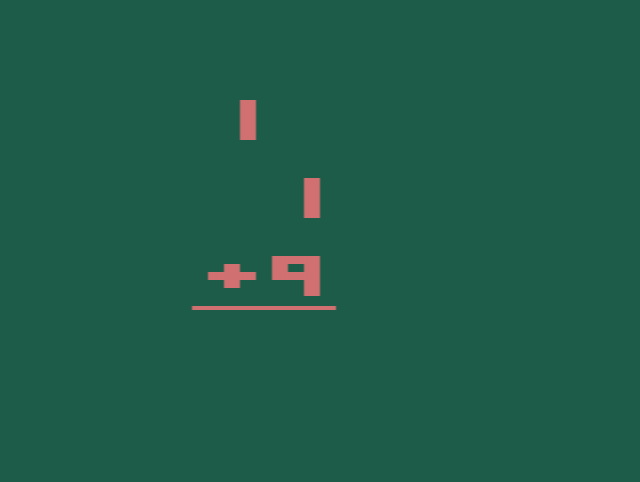
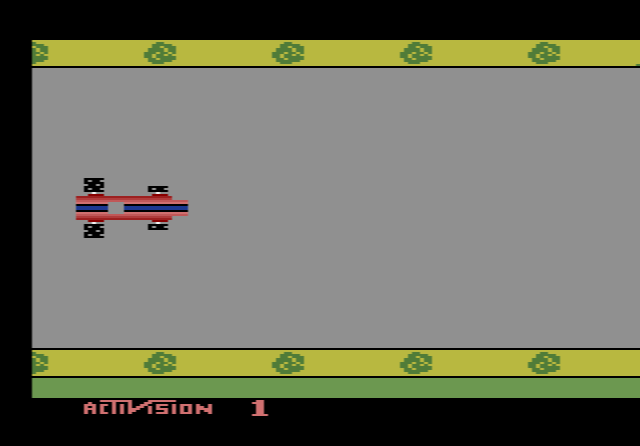
Two cars race to the finish line, and the first one across wins. Players take turns; in a one-player game your rival is the computer. On each turn you choose whether to try for two spaces or three. A two-space problem is a little easier. Answer correctly and your car moves forward; answer wrongly and the computer shows the correct answer while your car stays put. With the difficulty switch on A you get one minute for addition and subtraction and two minutes for multiplication and division.
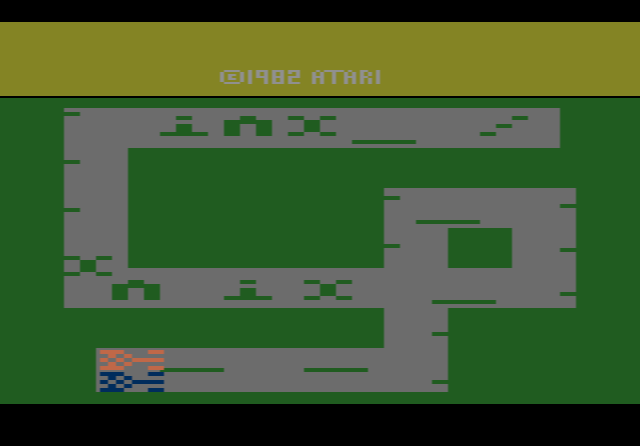
The track has special markers. The Spinner throws you one to four spaces ahead, the Skipper gives you an extra turn, and the Sinker protects you from being bumped. A bumped car breaks down at the roadside, and its driver then gets a two-space problem. The last marker, the Steps, allows only three-space problems until one of the cars finishes.
The nine games come in three groups of three, from easy to hard: games 1 to 3 are addition and subtraction, games 4 to 6 are multiplication and division, and games 7 to 9 mix all four operations.
Tips
- Take three spaces when you are sure. The harder problem is worth an extra space, and a wrong answer only costs you that one turn.
- Watch out in one-player games. The computer always lands on the track markers and always tries to bump you off the track.
- Answers of 10 or more: write the first digit, press right, then write the next one before you press the button.
History
Math Gran Prix came out in North America in July 1982 and in Europe in 1983. It followed Atari’s first maths cartridge, Basic Math from 1977, and TV Gamer magazine found it far more fun than its predecessor. Not every critic agreed: the French magazine Tilt marked its graphics down, and modern reviewers tend to see it as a curiosity rather than a game you come back to.