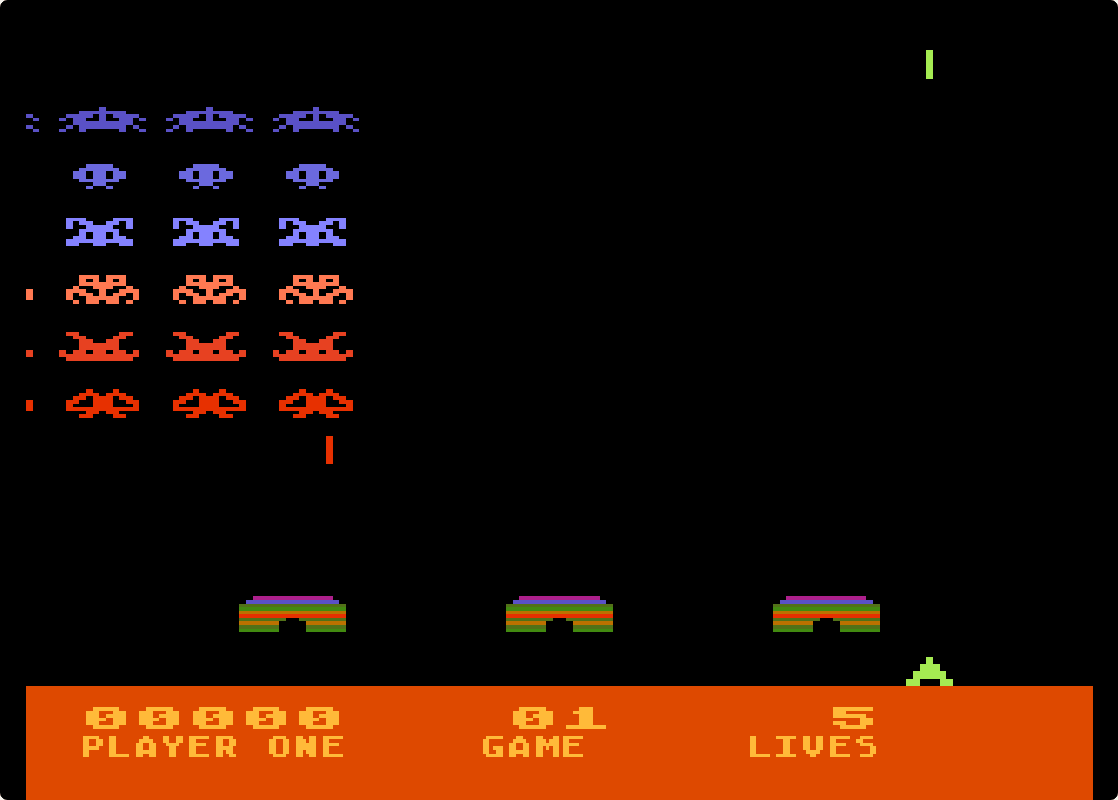
How to play Space Invaders online
- Move the laser cannon: left and right arrow keys
- Fire: Z (the lower buttons); hold it to keep firing
- Game Select (Games 1 to 12): – (the keypad * key)
- One or two players: = (the keypad # key)
- Start: Enter
- Pause and resume: P
- Player 2 (alternating turns): J and L to move, N or M to fire
- Full screen, save states: the emulator toolbar
The cartridge also supports Atari’s Trak-Ball; in the emulator you play with the joystick.
Gameplay
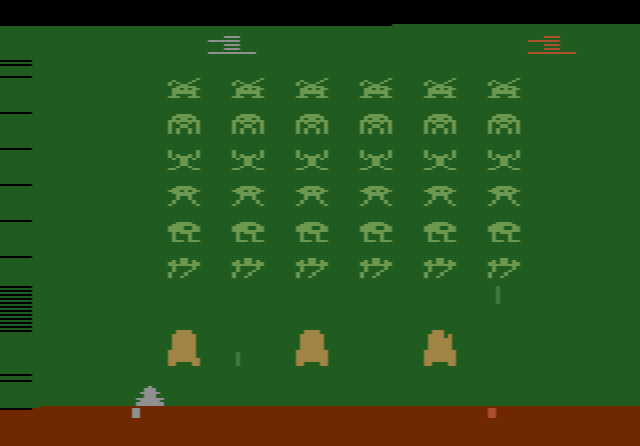
Forty-eight invaders march across the screen and down towards your planet, dropping bombs. Shoot them all before any land. Three shields protect you, but bombs and your own lasers wear them away, and they vanish as the invaders get close. Once 24 are down, the rest speed up and double in value.
The game runs in four waves of two screens each, and wave 4 repeats for as long as you last. Each wave starts the invaders lower and doubles their point values. In wave 4 the invaders mutate before your eyes, passing through a crystalline stage as they change shape; hit one while it is crystalline and you score nothing.
A Command Saucer crosses the top now and then, never when eight or fewer invaders remain. Its value depends on how many shots you have fired, up to 60 points for the fifteenth, when the count restarts. Every seven cleared screens the saucer swoops down, picks up your laser cannon and flies off with it, the “Close Encounter”, and the shields are reset.
Game variations
The * key steps through twelve games, which differ in bomb speed (slow, alternating or fast), whether the bombs home in on your cannon, and whether you get five lives or three. Game 1 is the beginner’s choice: slow bombs, five lives. Games 2 and 3 speed the bombs up, Games 4 to 6 repeat the three speeds with three lives, and from Game 7 the bombs steer towards you, with the three-life versions at Games 10 to 12. Two players take turns, and the first controller chooses the game.
Tips
- Shoot the edges of the rows. The formation only drops a step when it reaches the side of the screen, so trimming the outer columns slows its descent.
- Count to fifteen. The saucer is worth 60 points on your fifteenth shot. Shoot fourteen invaders, wait behind a shield for the saucer, and spend the fifteenth on it.
- Let the crystals finish. In wave 4, a mutating invader is worth nothing until it settles into its new shape.
The story behind Space Invaders
Tomohiro Nishikado designed Space Invaders for Taito in 1978. Atari’s 1980 cartridge for the Atari 2600 was the first official console version of an arcade game and sold more than four million copies by the end of 1981. The same year Rob Fulop wrote a very different version for the Atari 400 and 800 computers, with the invaders marching out of a rocket ship and no shields at all.
For the 5200, programmer Eric Manghise, with graphics by Marilyn Churchill, started from Fulop’s code rather than from scratch. The cartridge, model CX5204, was finished in April 1982 and sold from the console’s launch in October. According to AtariProtos he removed the rocket, added three shield bunkers, four sets of invader designs and Trak-Ball support, and traces of the rocket remain: the invaders never quite reach the left edge, and its descending sound still plays between rounds. AllGame later rated the 5200 version four out of five, calling its gameplay a welcome change from the arcade original.