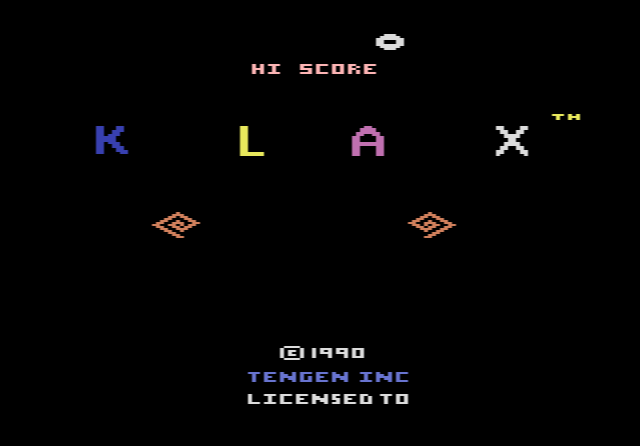
How to play Klax online
- Move the paddle: left and right arrow keys
- Drop the top tile into the bin below: Space bar
- Make the tiles tumble faster: down arrow
- Throw the top tile back up the ramp: up arrow
- Start and pick a wave: Space on the title screen, then left and right to choose
- Back to wave selection: F11 (the console’s Select switch)
- Pause: F2 (setting the TV type switch to black-and-white pauses the game)
Gameplay
Your paddle can hold up to five tiles. Three or more of one colour in a row, vertical, horizontal or diagonal, make a “Klax”, which vanishes and frees space in the bins. Flashing wild tiles count as any colour. Each tile you miss fills a space on the drop meter, and the game ends when the meter is full or when all 25 bin spaces fill up before you meet the wave’s goal.
Each of the 100 waves has its own objective: a number of Klaxes, only diagonal or horizontal ones, a points target, or surviving a set number of tiles. Later waves bring faster tiles and up to eight colours. Warp screens let you jump ahead for bonus points, and, unusually for the 2600, you can continue after failing a wave.
| Klax | 3 tiles | 4 tiles | 5 tiles |
|---|---|---|---|
| Vertical | 50 | 1,000 | 1,500 |
| Horizontal | 100 | 500 | 1,000 |
| Diagonal | 500 | 1,000 | 1,500 |
Tips
- Build diagonals early. A three-tile diagonal is worth ten times a three-tile vertical, and early waves are slow enough to plan them.
- Look for one tile that finishes two Klaxes. Multiple Klaxes earn an extra bonus.
- Don’t overuse the throw-back. Every tile you push up the ramp comes down again.
- Keep it simple on Tile Waves. Quick vertical Klaxes stop the bins from filling up.
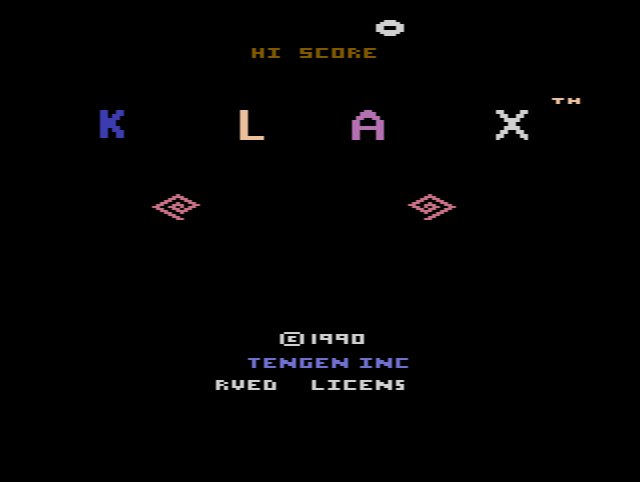
PAL and NTSC versions
By 1990 the 2600 was still on sale in Europe, but the American market had moved on, so Klax was released only as a PAL cartridge. Wikipedia dates the UK release to mid-1990 and calls it one of the final licensed games for the console; AtariProtos lists the final PAL build as dated 24 October 1991. An NTSC version was also finished, and Best Electronics later found prototypes of it, which shows an American release was planned but never happened. You can play that build here as Klax (NTSC). The arcade original was designed by Mark Stephen Pierce and programmed by Dave Akers.