How to play Super Breakout online
Super Breakout uses the Atari paddle controller. The emulator above switches to paddle mode automatically for this game.
- Move the paddle: left and right arrow keys
- Serve the ball: Space bar
- Start a new game: F12 (the console’s Reset switch)
- Choose a game variation (1–9): F11 (the console’s Select switch)
- Large or normal paddle: F4 toggles the Player 1 difficulty switch (F9 for Player 2)
- Switch between paddle and joystick mode: Alt + L
- Save and load your progress: Ctrl + 0–9 saves to a slot, Alt + 0–9 loads it
Gameplay
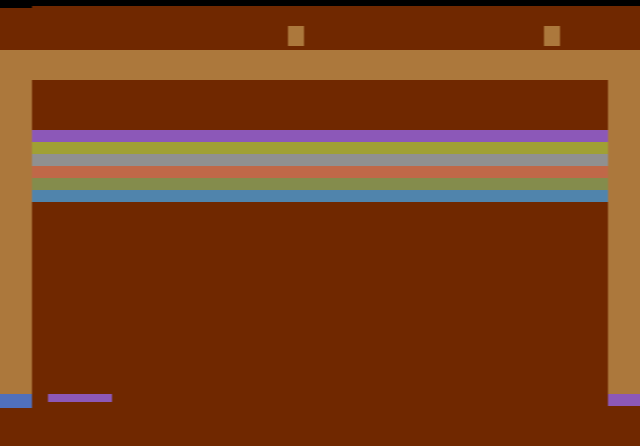
As in Breakout, you knock out bricks by bouncing a ball off your paddle, and you lose a turn each time the ball gets past you. Higher rows are worth more: the two bottom rows score 1 point per brick, then 3, 5 and 7 points for each pair of rows above. The ball speeds up after a set number of hits and when it reaches the top rows, and when it touches the top of the screen your paddle shrinks to half its size. Clear a wall and a new one appears, as many times as you can manage, so there is no upper limit to your score.
The game variations
The cartridge holds nine games. Breakout, Double, Cavity and the children’s version each come in a one-player and a two-player form, where players take turns; Progressive is for one player only.
- Breakout (games 1–2): the classic single-paddle, single-ball game.
- Double (games 3–4): you control two paddles, one above the other, with two balls in play at once.
- Cavity (games 5–6): also two paddles, but you start with one ball. Two more balls are trapped in pockets inside the wall, and break loose when you dig them out.
- Progressive (game 7): one player only. The wall starts as two blocks of four rows and keeps moving down the screen, with new bricks appearing at the top ever faster.
- Children’s versions (games 8–9): slower play. The ball does not speed up in the upper rows and the paddle never shrinks.
The difficulty switch sets the paddle size. In position B the paddle is twice as wide, which is good for beginners; position A gives the standard paddle.
Tips
- Brace for the top wall. The moment the ball touches the top, your paddle halves. Get back under the ball early, before the return comes.
- Count your hits. The ball gets faster after the 8th, 16th and 48th time it bounces off your paddle. Knowing when the jumps come makes them less of a shock.
- In Cavity, free the trapped balls early. With three balls bouncing around the wall at once, bricks fall much faster than they do from a single serve.
- In Progressive, clear the lowest rows first. They are the ones closing in on your paddle.
History
The arcade Super Breakout came out in September 1978. Like Breakout, it ran on a black-and-white monitor with coloured overlays, and it was among the top-earning arcade games of its time in both the USA and Japan. Home versions followed on several Atari systems. The Atari 8-bit computer version let up to eight players take turns, and the Atari 5200 version was packed in with the console in 1982, played with its analogue joystick instead of paddles. Every home version also includes a version of the original Breakout. Unlike the arcade machine, the 2600 cartridge draws its bricks in real colour, and it adds the two children’s games.