How to play Missile Command online
- Move the cursor: arrow keys, including diagonals
- Launch a missile: Z (the lower fire buttons)
- One or two players: the players key on the on-screen keypad (K)
- Skip waves: 0, up to nine times, to start at a later wave
- Practice against smart missiles only: 8
- Bonus cities on or off: = (the keypad’s # key)
- Start or restart: Enter
- Pause: P
The cartridge also works with Atari’s Trak-Ball; the emulator uses the joystick, so the cursor stops when you let go of the keys. Full screen, restart and save states are in the emulator’s toolbar; move the mouse over the screen to see it.
Gameplay
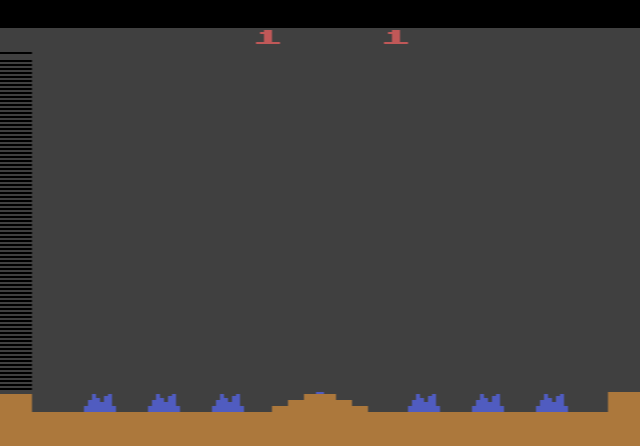
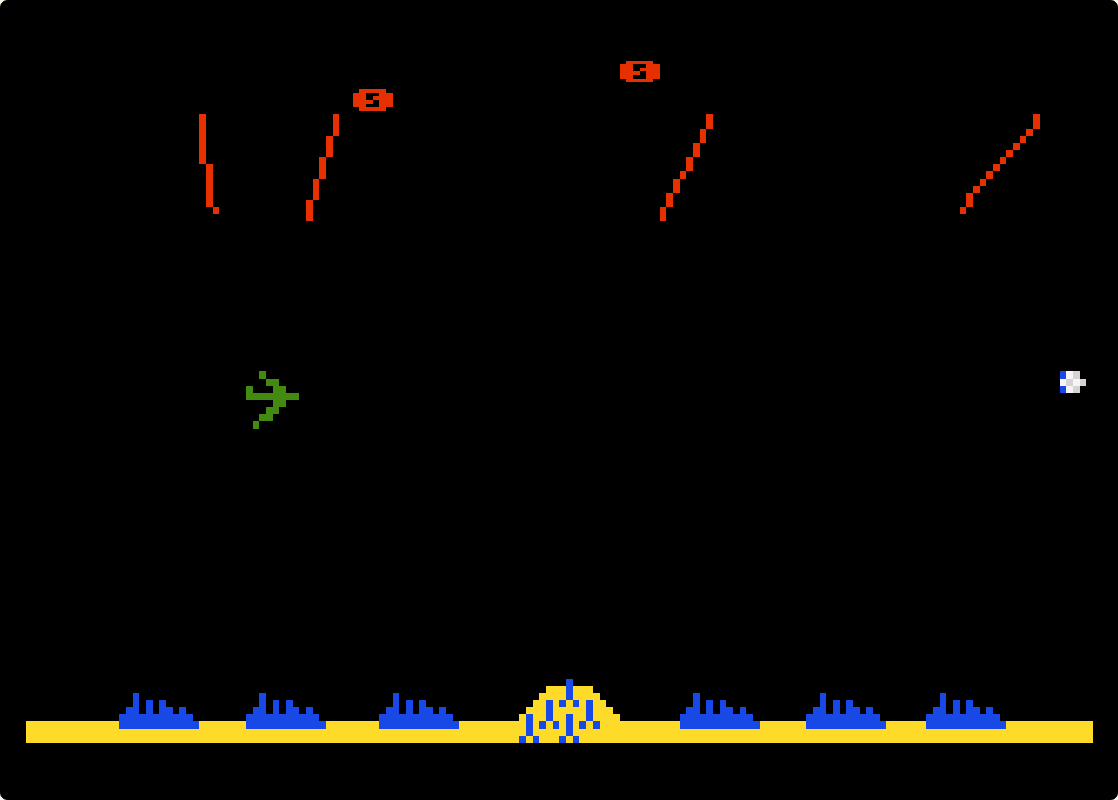
Six cities sit along the bottom of the screen, with your missile base in the middle. Enemy warheads fall from the top, and you stop them by moving the cursor into their path and firing: your missile flies up to the cursor and explodes, and anything that touches the blast is destroyed. You have 30 missiles per wave, and once they are gone you can only watch. Each wave ends when the sky is clear, and you get 5 points for every missile left and 100 for every surviving city.
Plain warheads are joined by MIRVs that split into several warheads, bombers and killer satellites that cross the screen releasing more, and from wave 6, smart missiles that swerve around your explosions. Base points are 25 for a warhead or MIRV, 100 for a bomber or satellite and 125 for a smart missile, multiplied by 2 in waves 3 and 4, by 3 in waves 5 and 6, and so on up to 6 from wave 11. The enemy can only wipe out three cities per wave, and you get a replacement city every 10,000 points, held in reserve until there is a gap for it. There is no winning: the game ends when all six cities are gone.
Tips
- Do not wait for the explosion. Fire the next missile while the last one is still flying; a chain of blasts under the incoming warheads works like an umbrella.
- Aim ahead. Put the cursor where the warhead will be, not where it is.
- Hit MIRVs high. Catch them before they split and you deal with one target instead of several.
- Shoot bombers and satellites early. The sooner they go, the sooner they stop seeding new warheads.
The story behind Missile Command on the 5200
Dave Theurer designed the arcade Missile Command for Atari in 1980, with a trackball to move the cursor and three missile bases. Atari first planned to put real Californian cities on the screen, then dropped all place names so that the game stayed a purely defensive one. Rob Fulop’s Atari 2600 version followed in 1981, as did one for the Atari 8-bit computers.
The 5200 cartridge (model CX5202), programmed by Rob Zdybel, was one of the first five games developed for the console and was in shops for its launch in October 1982. It is essentially the 8-bit computer game, which is why it has a single missile base rather than the arcade’s three. Atari’s Pro-Line Trak-Ball controller, released in the summer of 1983, was aimed squarely at this game and Centipede. Trak-Ball designer Dan Kramer later said he had built a special three-button Trak-Ball and a three-base version of the game to match it, but that version was never released. Missile Command sold well on the 5200 even though the console itself was discontinued in 1984.