How to play Stunt Cycle online
The game uses the paddle controller in place of the original console’s motorcycle handlebars.
- Control your speed: left and right arrow keys turn the paddle
- Start a new game: F12 (the console’s Reset switch)
- Choose a game variation: F11 (the console’s Select switch)
- Change the size of the landing zone: F4 (the difficulty switch)
- Switch between paddle and joystick mode: Alt + L
Gameplay
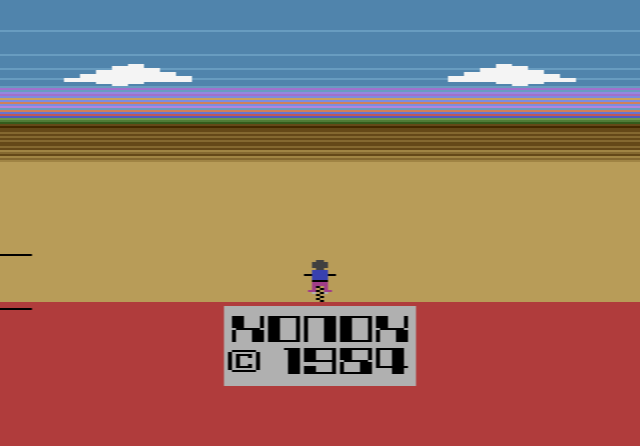
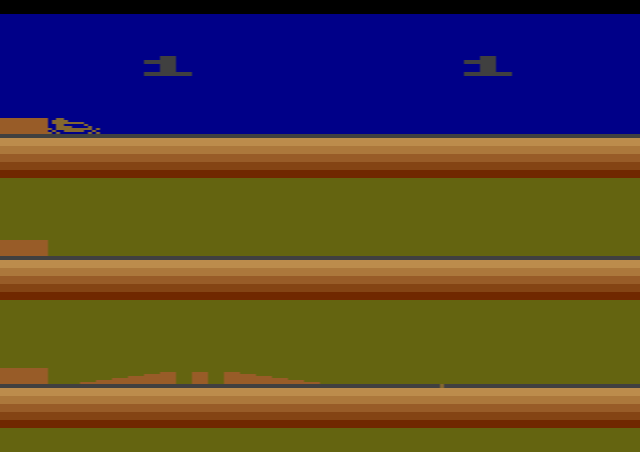
Your rider starts at the top of the screen and has two rows of track to pick up speed before reaching the ramp at the bottom. Hit the ramp too slowly and you fall short of the cars; too fast and you fly off the end of the screen. The difficulty switches set how big the landing area is.
The variations come in three groups. In the first, the easy mode, you cannot skid and you can still change speed in mid-air. In the second, the “pro” mode, you have to slow down for the turns at the edges of the screen or you skid out and crash, and your speed is fixed once you leave the ramp. The last group mixes the two: you can skid, but you can also adjust your speed in the air.
Tips
- Learn the jump in the easy mode. Being able to correct your speed in mid-air shows you how much speed a clean landing needs.
- Brake before the turns. In the pro variations, ease off at the screen edges, then speed up again on the straight.
Why Stunt Cycle was never released
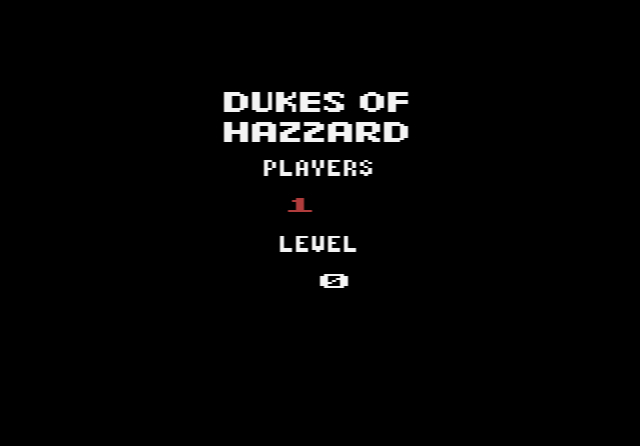
While Polaro was working on the conversion, Atari’s marketing department decided to turn it into a Dukes of Hazzard game. He swapped the motorcycle for the General Lee, replaced the cars with a lake, brightened the colours and added the show’s theme music. Playtesters then found they could go full speed at the ramp and brake in mid-air, which took the challenge out of the game. By late 1980 or early 1981 the game also looked dated, and Atari dropped it.
Mark Hahn of Atari’s New York office was then asked to write a completely new Dukes of Hazzard game, which was not released either. Stunt Cycle never appeared in an Atari catalogue and never received a product number. Prototype versions dated July 1980 have survived, together with the Dukes of Hazzard conversion.