How to play Defender online
- Fly: arrow keys. Up and down change height, left and right thrust in that direction and turn the ship around.
- Fire missiles: Z (the lower buttons)
- Smart bomb: X (the upper buttons). It destroys every alien on the screen.
- Hyperspace: any keypad digit (0 to 8 on your keyboard), or K for the on-screen keypad. You cannot choose where you reappear.
- Choose a game: on the menu, press the digit next to the option you want: one or two players, three difficulty levels and seven game variations, of which 7 is a demonstration.
- Start: Enter
- Pause: P
- Two players take turns and share the same keys.
- Restart, full screen and save states: the emulator toolbar (move the mouse over the screen)
Gameplay
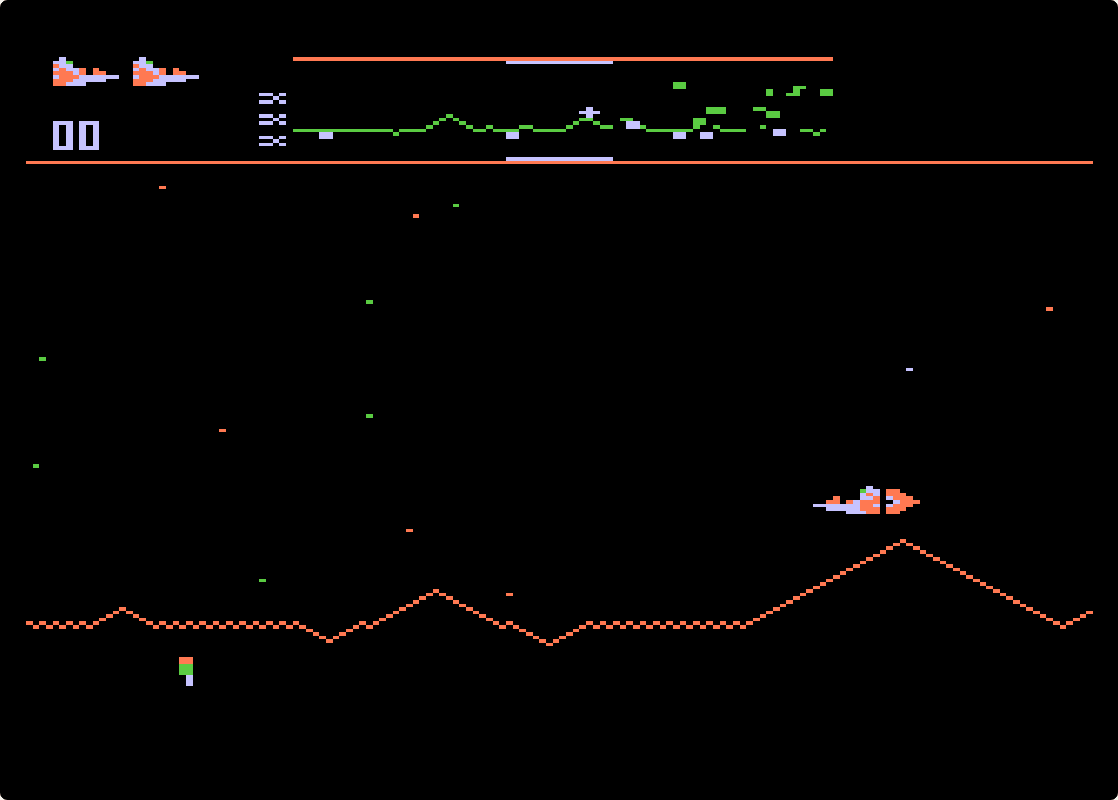
You patrol a planet that scrolls left and right, with its cities and humanoids along the bottom of the screen and a scanner at the top that shows the whole planet at once. Landers arrive first and try to pick up humanoids; if one reaches the top of the screen with its victim, the two become a mutant that hunts you. Shoot the lander while it is climbing and the humanoid falls. Catch him and carry him back down to a city for the biggest reward.
Other aliens are after you. Bombers leave mines that cannot be shot. Pods break into five to seven swarmers, which stick to you until you shoot them. Baiters show up late in a wave when you are taking too long; they are fast and shoot quickly. If every humanoid is lost, the cities explode and the planet fills with mutants; survive four more waves and both are restored.
You start with three ships and three smart bombs and get one more of each every 10,000 points. Each wave ends with 100 points for every surviving humanoid, multiplied by the wave number up to 500. The game ends when your last ship is destroyed; in a two-player game the higher score wins.
| Target | Points |
|---|---|
| Lander, mutant | 150 |
| Swarmer, baiter | 200 |
| Bomber | 250 |
| Pod | 1000 |
| Humanoid falls safely to the ground | 250 |
| Humanoid caught in mid-air | 500 |
| Humanoid caught and returned to a city | 1000 |
Tips
- Keep moving and keep firing. A stream of missiles in front of a moving ship clears most things before they reach you.
- Fly low. Staying near the cities lets you reach a lander before it gets away with a humanoid, but take care not to shoot the humanoids yourself.
- Watch the scanner. A humanoid being lifted on the far side of the planet shows up there first, and you hear a cry when one is taken.
- Keep one smart bomb back for a pod full of swarmers or a baiter, and treat hyperspace as the last resort it is.
The story behind Defender on the 5200
The arcade Defender was designed at Williams Electronics by Eugene Jarvis and Larry DeMar and reached North American arcades in March 1981. Its five buttons and joystick made it hard to learn, but it became Williams’ best-selling coin-op, with more than 55,000 machines sold.
Atari licensed it for its home systems. Bob Polaro’s Atari 2600 version came out in June 1982 and sold more than three million copies; with only one button, it fires, smart-bombs or hyperspaces depending on the ship’s height on the screen. The Atari 400/800 computer version was written by Steve Baker, and the 5200 cartridge, released at the end of 1982, is the same program with a different title screen: its options are numbered so they can be picked on the keypad instead of by pressing Select repeatedly. Two fire buttons and a keypad meant the 5200 could keep separate controls for missiles, smart bombs and hyperspace. David Ahl in Creative Computing’s video game magazine thought it offered a substantial challenge, and The Video Game Update called it a superior home rendition. Baker later programmed the sequel, Stargate, for the Atari computers; its 5200 version got no further than a prototype.