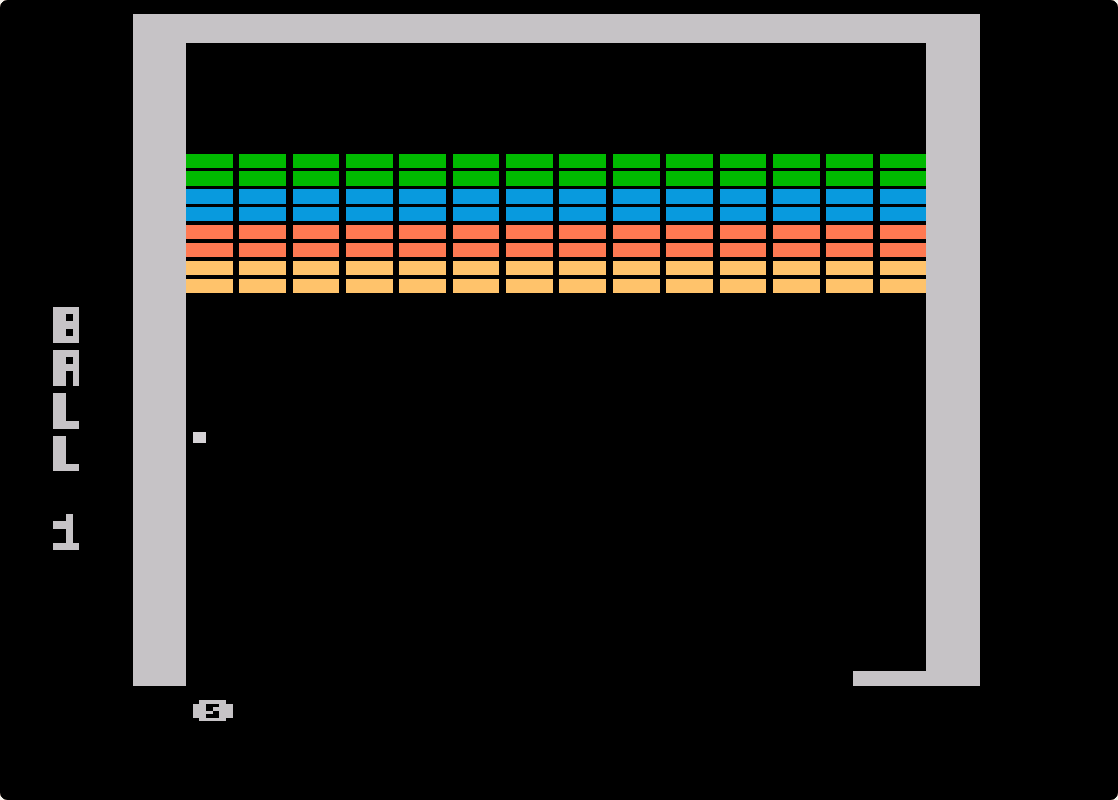
How to play Super Breakout online
- Move the paddle: left and right arrows
- Serve the ball: Z (the lower buttons)
- Number of players (1 to 4): the – key (the keypad’s * button) cycles through them
- Choose the game: the = key (the keypad’s # button) cycles through Breakout, Progressive, Double and Cavity
- Five extra serves: keyboard key 1, once per game, before the fifth ball is served
- Start: Enter
- Pause: P (only works while a ball is in play)
- Restart, full screen and save states: move the mouse over the screen to open the emulator’s toolbar
The cartridge also supported Atari’s Trak-Ball; here the arrow keys move the paddle like a joystick. Players take turns, so up to four people can share the keyboard.
Gameplay
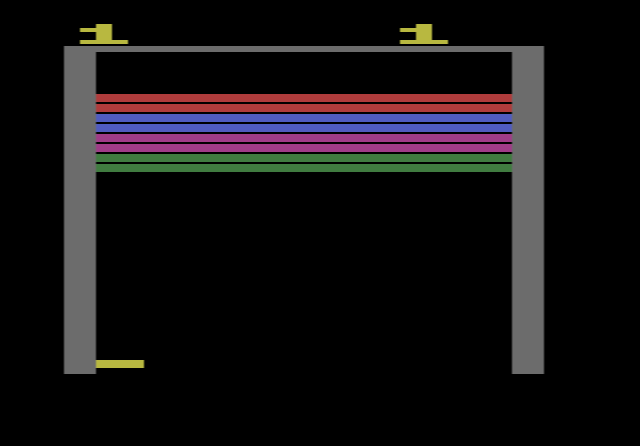
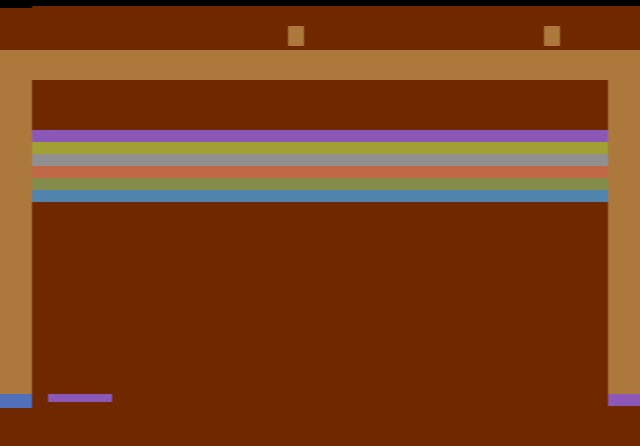
The manual’s story has you piloting a space shuttle through a force field around the planet Leris, but on screen it is Breakout: a paddle at the bottom, a ball, and rows of bricks to knock out one hit at a time. Gold bricks score 1 point, red 3, blue 5 and green 7. Every player gets five serves, and a serve ends when the ball (or, in the multi-ball games, the last ball) drops off the bottom.
The return angle depends on which of the paddle’s four sections the ball hits. The ball speeds up after the fifth and thirteenth hits and whenever it strikes a blue or green brick in the top four rows, and once it breaks through to the ceiling your paddle shrinks to half size until the next serve. Each game ends with a rating from OOPS to BEST; BEST needs 3,600 in Breakout, 4,400 in Progressive, 2,700 in Cavity and 2,600 in Double, whose maximum is 2,688.
The four games
- Breakout: the plain game, one wall and one ball.
- Progressive: the whole wall steps down towards you, and the longer the ball stays in play the faster it goes.
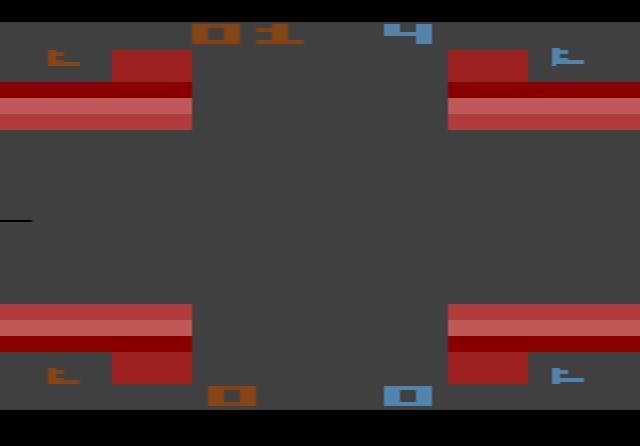
- Double: two paddles, one above the other, and two balls at once. While both are in play every brick is worth double.
- Cavity: two extra balls are trapped in pockets inside the wall. Free them and bricks are worth double with two balls out and triple with three. The wall resets twice, for a maximum of around 3,500 points.
Tips
- Dig a groove in a corner. The manual’s main advice: open a channel at the left or right edge so the ball gets behind the wall and does the work for you.
- Expect the fast return. The top four rows speed the ball up, so be ready before it comes back down.
- Move early. Watch the ball’s angle off the side walls and get to the spot before it arrives, especially once the paddle has shrunk.
The story behind Super Breakout on the 5200
Atari’s arcade Super Breakout, from 1978, was the sequel to Breakout. Ed Rotberg programmed it and Ed Logg helped with the design. Unlike Breakout it ran on a 6502 microprocessor rather than discrete logic, though the screen was still black and white with coloured overlays.
The 5200 version, model CX5203, was programmed by Alan Moss Sr. with graphics by Jerome Domurat, working from Larry Kaplan’s 1979 Atari 8-bit computer cartridge. They gave it a taller playfield, brighter bricks, new sounds and a “melting” animation when a brick is hit. According to AtariProtos it became the pack-in because Atari wanted a game that used all four controller ports and the planned Asteroids pack-in did not work well with the analog sticks. David H. Ahl wrote in 1983 that it was “a somewhat curious choice since it hardly uses the higher resolution of the 5200 to great advantage”.