How to play Stargunner online
- Fly your ship: arrow keys
- Fire: Space bar
- Choose one of the eight games: F11 (the console’s Select switch), or push the joystick up (up arrow) before a game
- Start a game: F12 (the console’s Reset switch) or Space
- Easier or harder ship control: F4 toggles the Player 1 difficulty switch
Gameplay
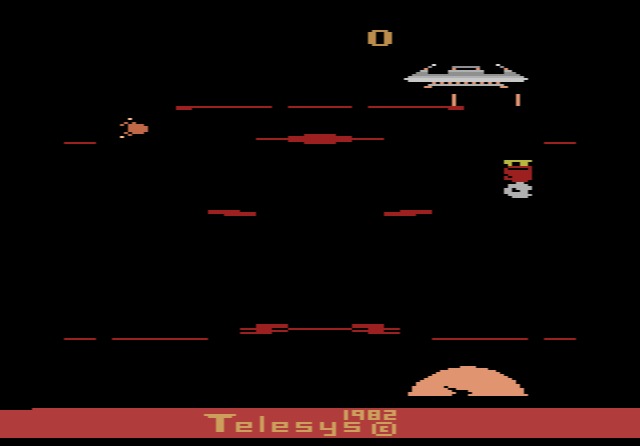
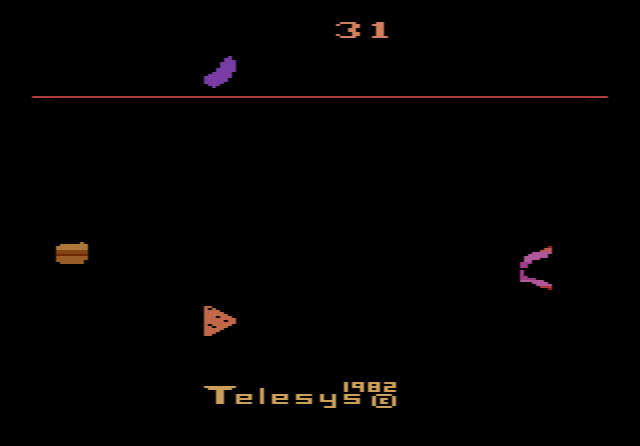
You pilot the last starfighter of the planet Yarthae, defending it against the Sphyzygies, a band of space outlaws. Their bio-droid, Bobo, hovers at the top of the screen and drops bombs from time to time. You can’t shoot Bobo or his bombs, so you have to dodge them. The enemies appear one at a time: four squares slide together at a random spot on the screen, and an alien materialises where they meet.
You lose a ship if a bomb hits you, if you fly into an alien, or if you are sitting on the spot where one appears. Each level has three waves. Every wave brings more aliens on screen at once, and when a new wave starts the count drops back to one, but the aliens move faster. To destroy an alien you need a direct hit; clipping its top does not count.
The difficulty switch changes your ship. In position B (easier) the ship can turn and shoot both left and right. In position A it can still fly both ways but only faces and shoots right.
Tips
- Watch the squares. When four squares start closing in, move away from the point where they will meet, then line up your shot for when the alien appears.
- Collisions are the real danger. Most ships are lost by flying into an alien rather than being hit. Your ship is fast, so keep some space around it instead of charging in.
- Try position A for a challenge. Once the game feels too easy, a ship that can only shoot to the right makes you plan every pass.
The story behind Stargunner
Alex Leavens had worked at Atari and Midway and had programmed the 2600 version of Gorf before going freelance. He developed Stargunner on his own and sold it to Telesys of Fremont, California, which released six 2600 games before the video game crash of 1983 put it out of business. Most sources list it as a 1982 release; Wikipedia dates it to January 1983. In an interview Leavens said he saw video games as an art form and wanted players to reach about 50,000 points before the game started to make them sweat.
Reviews were mixed: Video Games Player found it addictive but not new, Electronic Fun called it undistinguished, and The Logical Gamer found it easier to get into than Defender. AtariProtos calls the lack of challenge its fatal flaw, and notes that Leavens was asked to squeeze extra enemy graphics into an already full cartridge, hinting that the enemies’ behaviour paid the price. The cartridge is rare today, and AtariAge lists two different label designs.