In 1982 Atari launched the most ambitious promotion in the history of the 2600: four adventure cartridges, four comic books full of hidden words, and a series of contests with real gold and jewels as prizes. The series was called Swordquest. Two treasures were handed out, a third may or may not have been, and the grand prize, a jewelled sword, has never been seen since. Three of the four games were finished, and all three are on this site. Here is how the contest worked, how it fell apart, and what is known about the treasure.
From Adventure to Swordquest
Swordquest started life as a possible sequel to Adventure. AtariProtos lists the working title of the first game as “Adventure II”, and of the second as “Adventure III”. According to Atari historian Curt Vendel, the interest in Adventure’s hidden Easter egg gave Atari’s marketing department the idea of a series in which players had to find clues both in the game and in the printed material that came with it.
Atari was owned by Warner Communications at the time, and Warner had other companies it could bring in. DC Comics produced the comic books, written by Roy Thomas and Gerry Conway and drawn by George Pérez and Dick Giordano. The Franklin Mint made the prizes. Atari’s in-house artist Warren Chang painted the box covers.
Comics in the box were not new at Atari. Yars’ Revenge had come with a comic based on Howard Scott Warshaw’s story, and DC’s Atari Force comics were packed with the 2600 versions of Defender, Star Raiders and Phoenix. Swordquest went a step further: the comic was not just a bonus but half of the puzzle.
How the puzzle worked
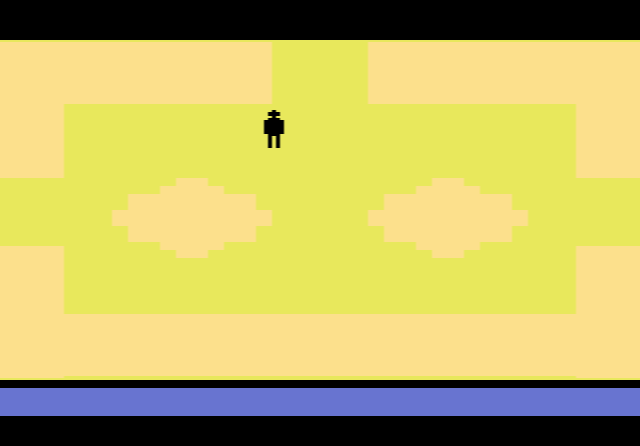
Each game was built around one of the classical elements and a system of symbols: Earthworld used the twelve signs of the zodiac, Fireworld the Kabbalah Tree of Life, Waterworld the chakras, and Airworld was to use the I Ching. In every game you walk through a set of rooms, pick up magical objects (you can carry six at a time), and drop them in other rooms. Some doors lead through short action tests first, such as jumping across rafts or dodging spears.
Leave the right objects in the right room and the game shows you a pair of numbers. The Earthworld manual gives the example “16 5”: look at page 16, panel 5 of the comic. Somewhere in that panel a word is hidden in the artwork. Collect the right words, put them in the right order, and send them to Atari on the entry form. There were traps, too. Earthworld’s manual says the game holds 11 clues, “some are valid to the puzzle, some are not”, and players had to spot a second hint in the manual to know which ones counted (for Earthworld, only clues pointing to prime-numbered pages).
The treasures
Atari advertised prizes worth $150,000 in total. The winner of each game’s contest would receive a Franklin Mint treasure valued at around $25,000, and the four winners would then play each other for the grand prize.
| Game | Prize | What it was |
|---|---|---|
| Earthworld | Talisman of Penultimate Truth | An 18-karat gold disc set with 12 diamonds, the birthstones of the zodiac signs and a small white gold sword |
| Fireworld | Chalice of Light | A platinum and gold goblet with diamonds, rubies, sapphires, pearls and green jade |
| Waterworld | Crown of Life | A gold crown with diamonds, rubies, sapphires and aquamarines |
| Airworld | Philosopher’s Stone | A piece of white jade in an 18-karat gold box set with emeralds, rubies and diamonds |
| Grand prize | Sword of Ultimate Sorcery | A silver blade with a jewelled gold handle, valued at $50,000 |
Earthworld: 5,000 entries, 8 correct
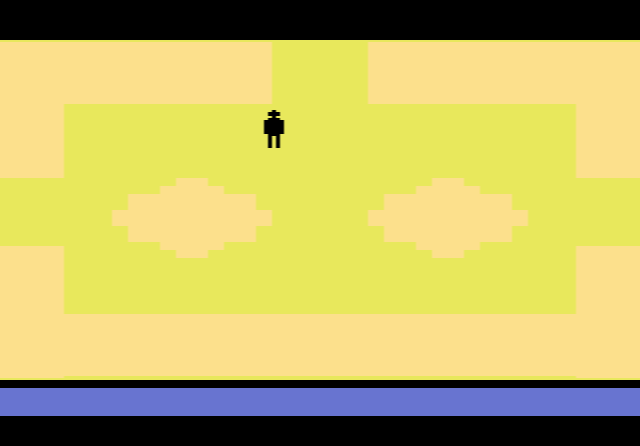
Swordquest: Earthworld reached shops in October 1982. AtariProtos credits the programming to Dan Hitchens, with graphics by Mimi Nyden, while other sources name Tod Frye as the programmer of the whole series, so the credits are not settled. The game has twelve zodiac rooms and action tests such as the Aquarius rapids, the Sagittarius spears, the Taurus horns and the Leo waterfall.
About 5,000 people sent in answers, and only eight were correct. According to AtariProtos, the finalists played a special tournament version that was much easier than the shop cartridge, needing only one or two items in each room, with a 90-minute time limit. The final was held in May 1983, and Stephen Bell won the Talisman.
Not everyone was impressed by the game itself. Reviewing Earthworld in The Space Gamer in March 1983, Richard A. Edwards wrote that “the only reason to purchase a copy of Swordquest: Earthworld is to try and solve the puzzle and win the prize.”
Fireworld: an essay, a hotel and a chalice
Swordquest: Fireworld, programmed by Tod Frye, followed in early 1983 (its manual carries a 1982 copyright). Its ten rooms are laid out like the Tree of Life, and its action tests include firebirds, fire goblins, falling knives and salamanders. The most important object is the chalice, which opens the secret room at the centre of the tree.
This time 73 entries were correct. To cut the field, Atari asked those players to write a short essay about what they liked in the game, and picked 50 of them for the final in January 1984. The winner was Michael Rideout. In an interview with Atari HQ he described the event: it took place at a Holiday Inn by Fisherman’s Wharf in San Francisco, the contest version was easier than the one sold in shops, and he finished in about 45 minutes, with one other player close behind. He had noticed that the room layout matched the Kabbalah Tree of Life, which he knew from studying Tarot. He won the Chalice of Light, which he said was valued at roughly $21,600 to $22,600 for tax purposes.
The crash ends the quest
By the time Rideout won, Atari was in deep trouble. The 1983 video game crash had turned its profits into huge losses, and the new chief executive, James J. Morgan, was cutting costs. Swordquest was cancelled, even though work on Airworld had begun. Atari’s lawyers, however, said the Waterworld contest had already been advertised and had to go ahead.
To keep the number of entries down, Swordquest: Waterworld was offered only to members of the Atari Club. Sources differ on when it came out: Atari Archive dates it to October 1983, based on Atari’s own club magazine, while Wikipedia gives February 1984. AtariProtos adds that it was later sold in shops, after the contest had been cancelled.

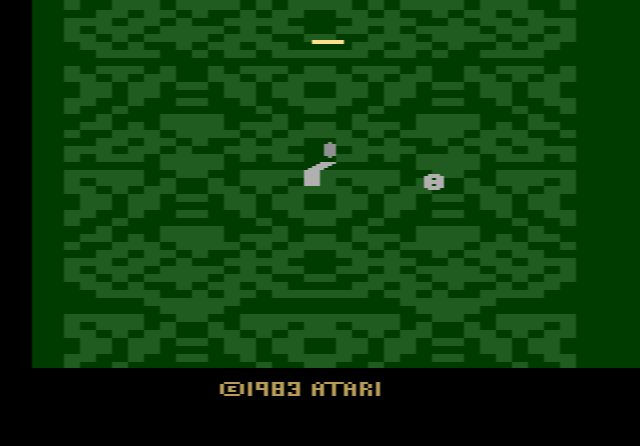
Waterworld is the smallest game of the three: seven rooms, 16 objects and three action tests (a sea of sharks, a school of octopi and slippery ice floes). Its manual says each room needs its own set of seven objects, and placing at least four of them is enough to reveal a clue. Of the seven number clues, three are decoys. The manual even suggests leaving the console switched on overnight to keep your progress, the way you might leave a chess game set up.
In July 1984 Warner sold Atari’s consumer business to Jack Tramiel. What happened to the Waterworld contest after that depends on the source. Curt Vendel said Atari quietly invited the players with correct entries to a final, and that the Crown was awarded to a winner whose name was kept private for legal reasons, possibly as a cash payment instead of the crown itself. AtariProtos says the national final was never held and the Crown was never awarded.
What is better documented is the settlement. Because the final round for the sword could not take place, Bell and Rideout each received an extra $15,000 and an Atari 7800, and the ten Waterworld finalists were given $2,000 each. Rideout confirmed the $15,000 and the 7800 in his interview.
Airworld: the game that never was
Tod Frye told AtariProtos that Airworld was based on the I Ching and would have had 64 hexagrams, each with its own small game: “As far as I got, it was never fully playable.” He was moved to Xevious, another 2600 game that was never released, and Airworld was left without a programmer. No code for it has been found. There is even a disagreement about the comic: Wikipedia says the Airworld comic was started, but George Pérez told AtariProtos that no Airworld story “was ever written or drawn”.
Frye stayed with the 2600 longer than most. He had written the 2600 version of Pac-Man, released in 1982, and at the end of the decade he programmed Save Mary! for Axlon. AtariProtos says he was working on Shooting Arcade at the same time. Neither game was released, and you can play both here.
Where is the treasure now?
- The Chalice: Rideout said in 2017 that he still had it, in a safe deposit box.
- The Talisman: Bell dropped out of contact after the contest. According to Vendel and Rideout, he appears to have had the gold disc melted down for its value (about $15,000 at the time) and kept the small sword and the stones. Where those are now is unknown.
- The Crown: unknown, and it may never have been handed out at all (see above).
- The Philosopher’s Stone and the Sword: never part of any contest that took place. A long-running rumour says the sword hung in Tramiel’s office or home; AtariProtos repeats it. Vendel thinks people mistook a Tramiel family heirloom for it. He points out that the prizes still belonged to Warner when Atari was sold, and thinks they most likely went back to the Franklin Mint and were melted down.
Swordquest after the contest
The story kept coming back. In 2017 Dynamite Entertainment published a new Swordquest comic series by Chad Bowers and Chris Sims, about a grown-up fan who still wants to finish the quest and goes after the real sword. In 2022, Digital Eclipse included a brand-new Airworld in the Atari 50 collection. Its developer, Dave Rees, consulted Tod Frye on what the game might have been like.
Other contests you can play here
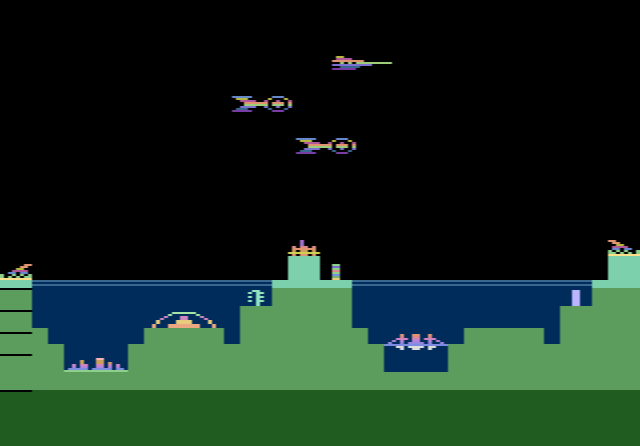
Swordquest was not the only 2600 game tied to a prize. Imagic ran a contest for Atlantis in 1982, and the four top scorers won a trip to Bermuda. Designer Dennis Koble later said good players could “pretty much play indefinitely”, so for the final he made a harder version, Atlantis II, with faster enemy ships worth fewer points. The contest winners were given it in a normal Atlantis box with a white “Atlantis II” sticker.
Playing Swordquest here
All three games use a single joystick: the arrow keys move you and Space is the button. Press Space to leave the title screen and again to enter a room. F12 (Reset) takes you back to the start. The difficulty and Select switches do nothing in any of the three games.
- Keep notes. Every manual says the same thing: write down every clue and which objects you left where. The games are puzzles first and action games second.
- Use save states. The original players had to leave the console switched on. You can press Ctrl+1 to save and Alt+1 to load, which is very useful before a hard action test.
- Stuck in a test? In Earthworld you can press the button to give up and move on. In Waterworld you are placed in the next room when time runs out, but not all of its objects will be visible, and touching one may make it disappear.
Without the comics you cannot finish the word puzzle, but you can still explore the rooms the contestants mapped by hand. If you want the adventure game that started it all, Adventure is one click away, and Raiders of the Lost Ark, another early mix of puzzles and action from 1982, makes a good companion.