How to play S.A.C. Alert online
The game was designed with Amiga’s Joyboard in mind, a board you stood on and leaned to steer. The Joyboard worked like a joystick, so the normal joystick keys work here.
- Fly the plane: arrow keys (up and down change your altitude)
- Fire: Space bar (your ammunition is unlimited)
- Choose a land or sea mission: F11 (the console’s Select switch)
- Start a new game: F12 (the console’s Reset switch)
Gameplay
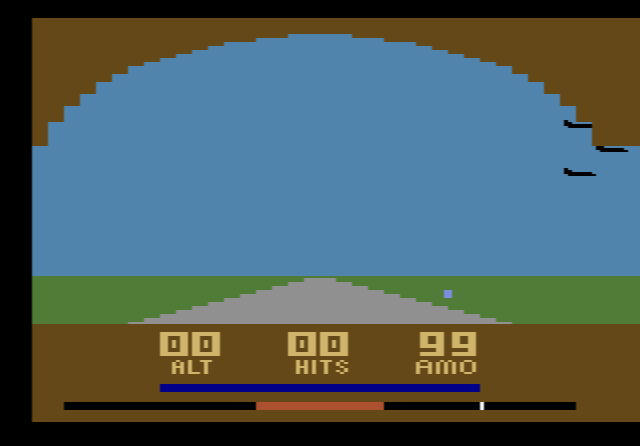
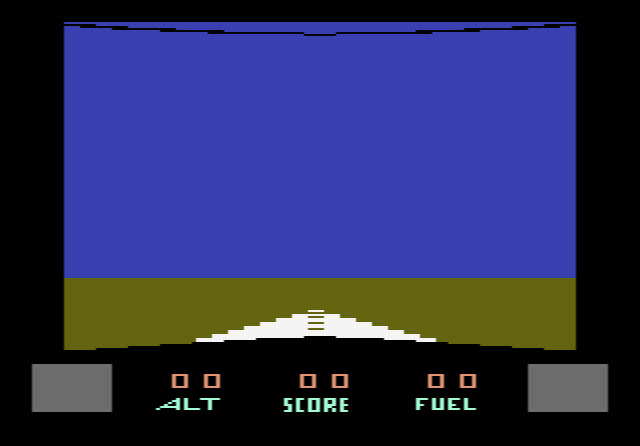
Each game starts with a very short take-off run. You have three planes and 99 units of fuel. The fuel works as a timer: when it runs out, you crash. An altimeter shows your height from 0 to 50, and it decides what you can hit. Fly high to shoot down enemy planes, or fly low to attack anti-aircraft guns on a land mission or destroyers on a sea mission. If your altitude drops to zero, the ground turns black and you crash a few seconds later.
Enemy planes swoop towards you, fire and pull away. The guns and destroyers are there from the start, but they only begin shooting back from the third mission. Warning lights on both sides of the status bar flash red when you are flying very low, yellow when fuel is getting short and orange when you have taken heavy damage. When you have lost all your planes, the game gives you a rank of crew, pilot or ace and a rating from 0 to 9.
Tips
- Shoot planes mid-swoop. They are the biggest target while they dive towards you.
- Land to repair. After heavy damage, fly low, line up with a runway or an aircraft carrier, and pull up once you are low enough to land.
History
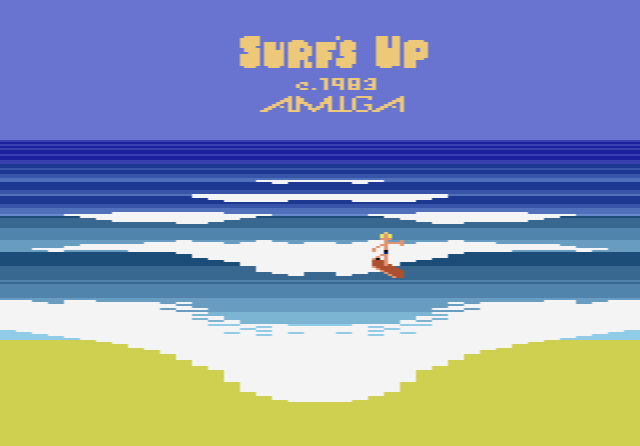
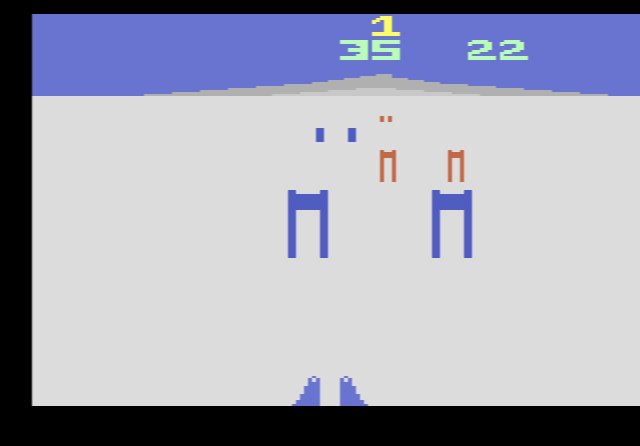
According to AtariProtos, S.A.C. Alert was programmed by Jerry Lawson’s company Videosoft. It was first planned as a cassette game for the Amiga Power Module, a tape add-on similar to the Starpath Supercharger. Later it was moved to Amiga’s Power Play Arcade multi-game cartridges, where it would have shared a cartridge with Mogul Maniac, Surf’s Up and Off Your Rocker. The project was cancelled when Amiga stopped making games to concentrate on its computer. NTSC and PAL prototypes both exist; this page runs the US (NTSC) version.