How to play Smurf online
- Walk left or right: left and right arrow keys
- Jump: up arrow. Jump while standing still to hop in place, or while walking to jump forward.
- Duck: down arrow
- Choose skill level and number of players: F11 (the console’s Select switch), shown on screen as a number and one or two Smurf heads
- Confirm your choice and start: Space bar
- Save and load your progress: Ctrl + 0–9 saves to a slot, Alt + 0–9 loads it
Gameplay
Your Smurf travels to the right, screen by screen. Fences, streams and rocks block the path and have to be jumped cleanly, and a mistimed jump costs you the Smurf. Gargamel also sends creatures after you: hawks, snakes, bats and a spider in the cavern. An energy meter on screen drops as your Smurf grows tired, but it fills up again every time you reach a new land.
The last screen is Gargamel’s laboratory. Here you hop across the furniture to reach Smurfette on a high shelf, sometimes with a bat guarding the room. When a Smurf is caught or worn out, another Smurf takes over the rescue. In a two-player game, the players take turns.
| Action | Points |
|---|---|
| Jumping an obstacle | 400 |
| Freeing Smurfette | 1,000 |
| Extra Smurf | at 10,000 points |
Skill levels
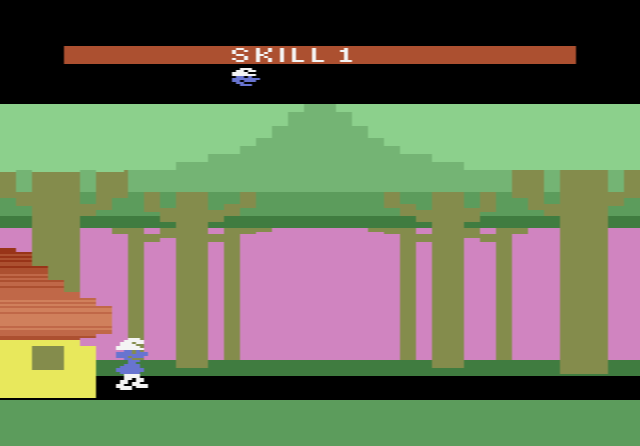
There are four skill levels, each for one or two players. Skill 1 has no creatures at all, so it is a good way to learn the jumps and see every screen. From skill 2 upwards, Gargamel’s creatures join in and the trip gets much harder.
Tips
- Keep holding up for a long jump. If you are still holding up when the Smurf lands, he goes straight into a bigger, faster jump forward. Chaining jumps like this covers ground quickly.
- Remember you can’t steer in the air. Once the Smurf leaves the ground, the jump is fixed. Line up your take-off point before you press up.
- Don’t walk into walls. Bumping into an obstacle in front of you is fatal, so jump early rather than late.
- Use the energy refill. Energy comes back at each new land, so push on to the next area rather than waiting around.
- Save before the laboratory. The furniture jumps on the final screen are the trickiest; a save state lets you practise them.
History
Coleco published the game, and the ColecoVision original came out in September 1982. The Atari 2600 version followed in April 1983. It was made for Coleco by James Wickstead Design Associates, a New Jersey design studio, with Henry Will IV leading the programming. In the UK it was sold on the CBS Electronics label.
Reviewers liked it. The newsletter Computer Entertainer found the 2600 version less polished than the ColecoVision game but still an excellent conversion, and praised the Smurf’s animation. The game also won an Arkie Award for its audiovisual effects. Computer and Video Games magazine called it very cute in 1984, but wondered how long it would hold the interest of experienced players.