How to play Surround online
In two-player games the left player uses the left joystick and the right player the right one. In one-player games against the computer, the manual tells you to use the right joystick, so you play with the Player 2 keys.
- Left player: arrow keys to steer, Space for Erase
- Right player (and one-player games): T/F/G/H (up/left/down/right) to steer, A for Erase
- Start or restart a game: F12 (Reset)
- Choose one of the 14 games: F11 (Select)
- Difficulty switches: F4 (left player) and F9 (right player)
Gameplay
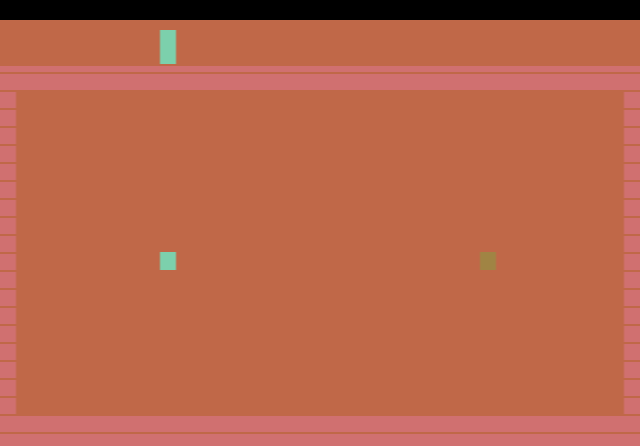
Your block never stops moving. You can only choose its direction, and every square it passes stays behind as part of your wall. You win a point when your opponent runs into any wall, whether it is their own trail, yours, or (in games without wraparound) the edge of the playfield. The first to reach 10 points wins. The best plan is to cut across your opponent’s path and slowly close off the space they have left.
Game variations and switches
Games 1 to 12 are Surround games that mix four optional features:
- Speed Up: the blocks get faster on their own during each round, through five speeds.
- Diagonal Movement: you can steer diagonally as well as straight.
- Erase: hold the fire button and your block moves without leaving a trail.
- Wraparound: leave one edge of the screen and you come back on the opposite side.
Games 13 and 14 are Video Graffiti, a drawing mode with no scoring where one or two players sketch on the screen, a bit like an Etch A Sketch. The difficulty switch in position B stops you from reversing straight back onto your own trail, which is kinder to beginners. In one-player games the left difficulty switch sets how well the computer plays: B for an amateur, A for a pro.
Tips
- Take the middle early. Walls built across the centre split the screen and leave your opponent the smaller half.
- Leave yourself an exit. Never follow a wall into a narrow pocket unless you can see the way out.
- Save Erase for emergencies. In games with Erase you can slip through a gap without sealing it behind you.
- Turn early in Speed Up games. At the top speeds you have very little time to react near a wall.
The story behind Surround
Like several of the console’s first games, Surround was based on an arcade hit. Gremlin Industries’ Blockade (1976) drew plenty of orders when it was shown to arcade operators, and a wave of copies followed, including Atari’s own arcade game Dominos. Surround came out in September 1977. At launch most games were only available by mail order at first, apart from Combat. Today it counts as an early home example of the snake genre.
Reviewers at the time praised it as complex and competitive. Miller himself later called its graphics very crude, and later reviews agreed about the looks and sound while still recommending it as a two-player game. Critics Bill Kunkel and Arnie Katz singled out Game 4 as the best solo option. The game has since appeared on collections such as Atari Anthology and Atari 50.