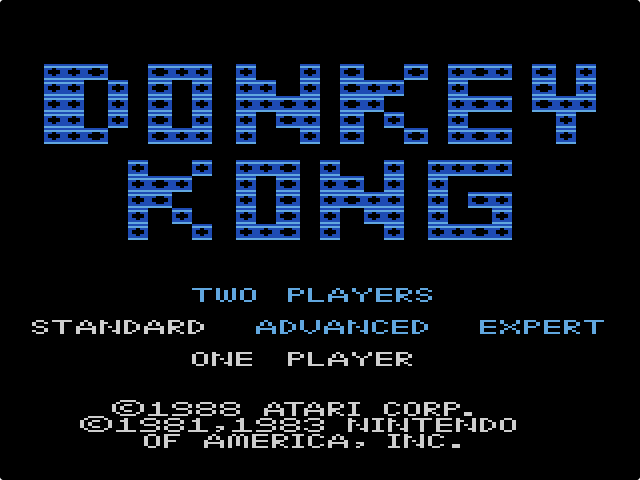
How to play Donkey Kong online
- Run and climb ladders: arrow keys
- Jump, or grab the hammer: Z (fire button)
- Choose 1 or 2 players: F2 (Select), or the up and down arrows on the title screen
- Choose the starting level: F2, or the left and right arrows on the title screen
- Start: Z
- Pause: F4
- Restart: F3 (Reset). F2 during a game returns to the title screen.
- Both the USA (NTSC) and Europe (PAL) cartridges are on this page; use the switch above the emulator.
Gameplay
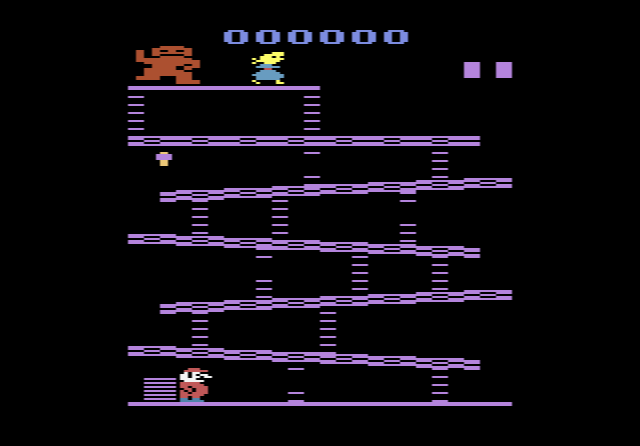
Donkey Kong has carried Mario’s girlfriend to the top of a steel fortress, and Mario has to get her back. The fortress has three screens. On the ramp screen, Mario climbs sloping girders while Donkey Kong rolls barrels down at him. On the elevator screen, he rides moving lifts from platform to platform while bouncing springs crash down from above. On the rivet screen, he removes every rivet by running or jumping over it, with fireballs chasing him. Clear the rivets and the game starts again from the ramps at a harder level, and it continues until you run out of lives.
Mario can climb down only ladders that are not broken. The hammer is his only weapon: jump up to grab it, and while he holds it he can smash barrels and fireballs, but he cannot climb, and the hammer soon disappears. Each screen also has a bonus counter that starts at 5,000 and counts down. If it reaches zero, you lose a life. You start with three Marios and earn an extra one at 20,000 points.
| Action | Points |
|---|---|
| Jumping a barrel | 100 |
| Removing a rivet | 100 |
| Smashing a barrel or fireball with the hammer | 500 |
| Picking up the purse or umbrella | 800 |
Tips
- Jump towards a barrel, not away from it. The manual notes that clearing a barrel or fireball is easier when Mario runs towards it.
- Check before you climb. Mario is helpless on a ladder, so wait until nothing is rolling or bouncing towards him.
- Treat the hammer as a short break. It does not last long, and you cannot climb while you hold it, so use it near the ladder you need next.
- Plan your route on the rivet screen. Take the rivets in an order that keeps the fireballs behind you instead of trapping you on a short girder.
- Don’t waste time. The bonus counter is both your score and your clock, and it travels with you from screen to screen.
The story behind Donkey Kong
Donkey Kong was Nintendo’s 1981 attempt to put unsold arcade cabinets to use after its earlier game Radar Scope had flopped. Nintendo president Hiroshi Yamauchi gave the job to Shigeru Miyamoto, then a first-time game designer. The game introduced Mario, who was sometimes called “Jumpman” back then. In 2017 The Strong National Museum of Play inducted it into its World Video Game Hall of Fame.
Coleco made early home versions for the ColecoVision, Atari 2600 and Intellivision; its 2600 cartridge came out in July 1982. Atari Corporation’s 7800 cartridge followed in November 1988, with the conversion credited in the manual to ITDC. Like most home versions of the time, it leaves out one of the arcade’s four stages, the conveyor-belt “pie factory”. In 1996 Next Generation magazine placed the arcade, Atari 7800 and Coleco Adam versions together at number 50 in its list of the top 100 games of all time.