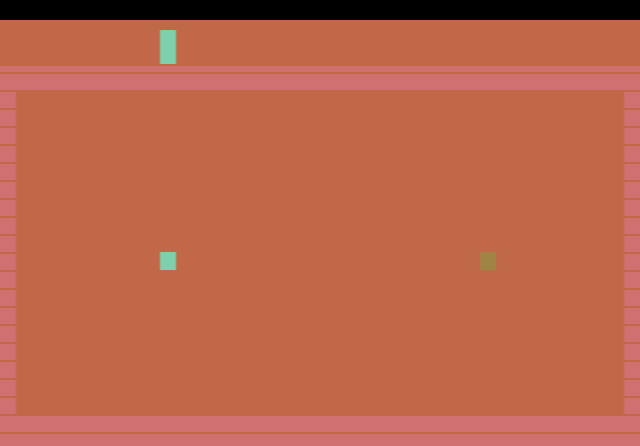
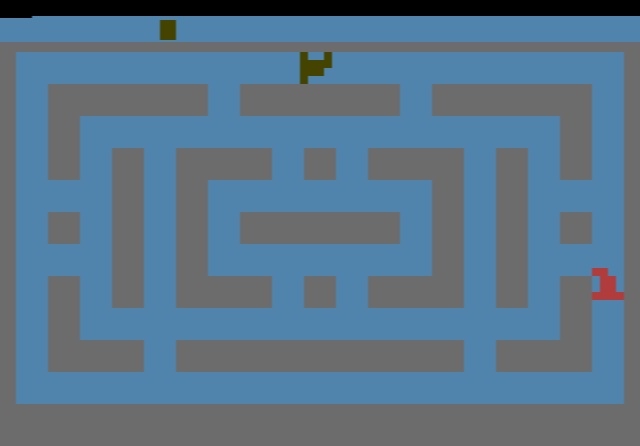
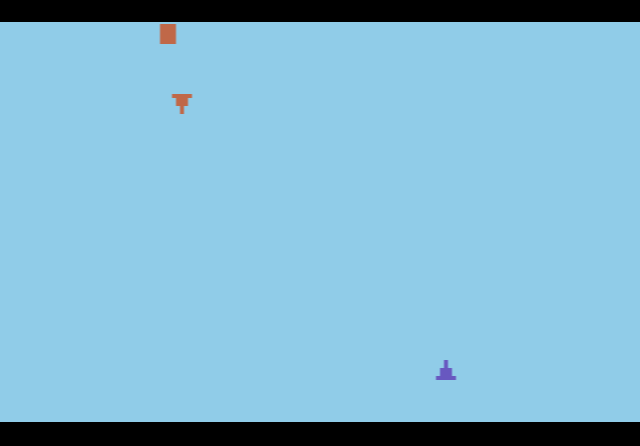
Combat was the game that came in the box with most Atari consoles from 1977 until 1982, so for millions of people it was the first thing they ever played on a 2600. It is a two-player duel with tanks, biplanes and jet fighters across 27 variations. This guide explains every variation, the controls for each vehicle and how to win, and it covers the unreleased sequel, Combat Two, as well.
One thing first: this site does not have Atari’s original Combat cartridge. It has the Sears Tele-Games release, Combat – Tank Plus, which Sears sold under its own name, and the prototype Combat Two. Tank Plus has the same 27 variations described in Atari’s Combat manual: we checked that its game numbers run from 1 to 27 and that the tank, biplane and jet games sit where the manual says. Everything below applies to it.
Two players on one keyboard
There is no computer opponent in Combat. Every game needs two people, one on each side of the keyboard.
- Left player (player 1): arrow keys to steer, Space to fire
- Right player (player 2): T/F/G/H for up, left, down and right, A to fire
- Choose a variation: F11 (Select). The game number shows at the top of the screen.
- Start: F12 (Reset)
- Handicaps: F4 and F9 are the players’ difficulty switches (see below)
Some keyboards cannot register many keys pressed at once. If a move or a shot is ignored while both of you are holding keys, try a different keyboard or connect gamepads, which the emulator supports.
The rules and the controls
Every game lasts 2 minutes 16 seconds, and each hit on your opponent scores one point. The vehicles steer differently:
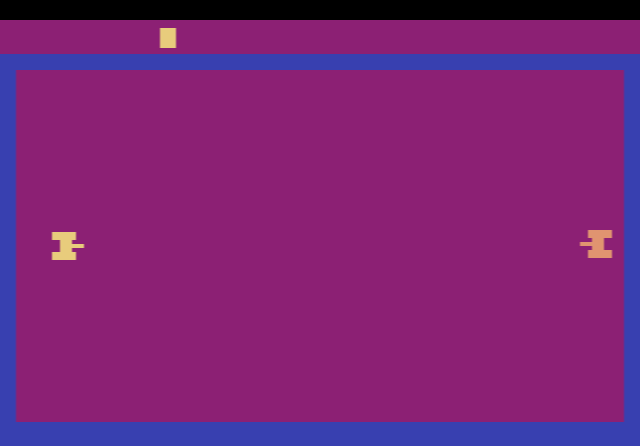
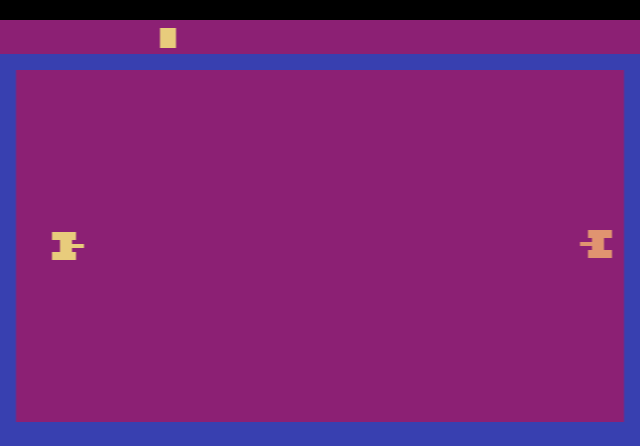
- Tanks (seen from above): up drives forward, left and right turn. Pulling back does nothing, so you cannot reverse.
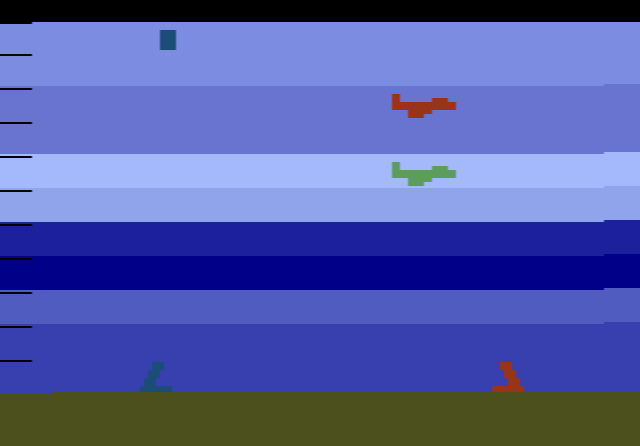
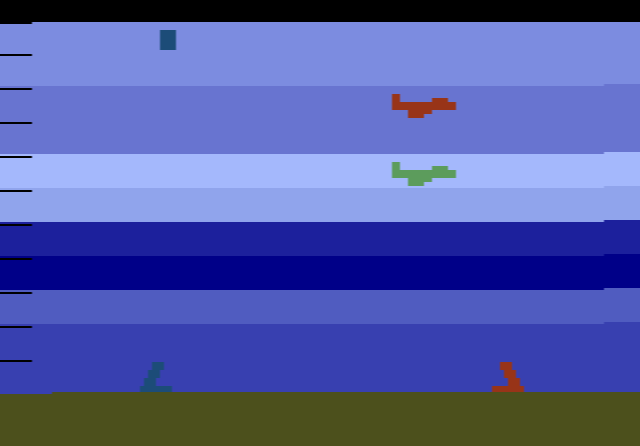
- Biplanes (seen from the side): left is slowest and right is fastest; up dives and down climbs.
- Jets (seen from above): up is fastest and down is slowest; left and right turn.
Shots come in three kinds. Straight missiles fly in a straight line. Guided missiles curve after you fire when you steer left or right. Machine guns are rapid-fire straight missiles.
The difficulty switches are a built-in handicap. A player on B plays normally. A player on A gets missiles with a shorter range, and in the plane games also flies slower. Put the stronger player on A and the games get much closer.
All 27 variations
| Game | Vehicle and mode | Playfield | Shots |
|---|---|---|---|
| 1 | Tank | Open field | Guided |
| 2 | Tank | Easy maze | Guided |
| 3 | Tank | Easy maze | Straight |
| 4 | Tank | Complex maze | Guided |
| 5 | Tank | Complex maze | Straight |
| 6 | Tank-Pong | Easy maze | Direct or bank shot |
| 7 | Tank-Pong | Complex maze | Direct or bank shot |
| 8 | Tank-Pong | Open field | Bank shot only |
| 9 | Tank-Pong | Easy maze | Bank shot only |
| 10 | Invisible Tank | Open field | Guided |
| 11 | Invisible Tank | Easy maze | Guided |
| 12 | Invisible Tank-Pong | Easy maze | Direct or bank shot |
| 13 | Invisible Tank-Pong | Open field | Bank shot only |
| 14 | Invisible Tank-Pong | Easy maze | Bank shot only |
| 15 | Biplane | Clouds | Guided |
| 16 | Biplane | Clouds | Straight |
| 17 | Biplane | Clouds | Machine guns |
| 18 | Biplane | Open sky | Machine guns |
| 19 | Biplane, 2 against 2 | Open sky | Guided |
| 20 | Biplane, bomber against 3 | Open sky | Straight |
| 21 | Jet | Clouds | Guided |
| 22 | Jet | Clouds | Straight |
| 23 | Jet | Open sky | Guided |
| 24 | Jet | Open sky | Straight |
| 25 | Jet, 2 against 2 | Clouds | Guided |
| 26 | Jet, 1 against 3 | Open sky | Guided |
| 27 | Jet, 2 against 2 | Open sky | Straight |
The modes explained, with tips
Tank (games 1–5)
The classic. The open field is pure aiming; the mazes add walls to hide behind. With guided missiles, fire slightly ahead of where your opponent is going and keep turning to bend the shot in. With straight missiles, turning is only for lining up, so line up first and fire second. Because tanks cannot reverse, the player who turns away first often gets hit in the back.
Tank-Pong (games 6–9)
Here the shots bounce off walls and barriers. In the “direct hit” games (6 and 7) a shot scores whether it hits straight on or after a bounce. In the “billiard hit” games (8 and 9) a shot must bounce at least once before it can score. If your own shot comes back and hits you, it does not count against you, so you can be bold. In the billiard games, aim at a wall, not at your opponent: a shot along a diagonal is the hardest to dodge.
Invisible Tank (games 10–14)
Both tanks are hidden. A tank shows up only when it fires, when it is hit, or when it bumps into a wall or barrier. That turns the game into cat and mouse. Every shot gives away your position, so fire only when you have a good idea where the other tank is, and then move straight away. Keep clear of walls: touching one reveals you just like firing does. Games 12 to 14 add Tank-Pong’s bouncing shots, which let you hit a tank you cannot see by ricocheting a shot through the area where it last showed up.
Biplane (games 15–20)
Seen from the side, with speed on left and right. Games 15 to 17 have two clouds you can fly into to hide, but the manual is clear that you can still be hit inside one. Machine guns (17 and 18) reward staying on your opponent’s tail. In game 19 each player flies two planes in formation, and in game 20 one player’s bomber takes on three biplanes. Planes in a formation all fire at once when you press the button, so the formation’s spread is your weapon: fly across the bomber’s path rather than straight at it.
Jet (games 21–27)
Jets are seen from above: left and right turn, up and down set the speed. Speed is your defence: pull back to slow down and let a straight missile fly past in front of you, then turn in behind your opponent. The formation games (25 to 27) follow the same idea as the biplanes, with two against two or one against three.
Quirks players have found
The Combat code is famously small, and it has a few odd behaviours. The tips page on AtariAge lists some that players have reported: two tanks pressed turret-to-hull can start spinning in circles, and in game 9, turning a tank around at the start and firing can send both tanks flying across the screen or make them swap places. We have not tested them on Tank Plus, but they are harmless fun to try once you have played the real games.
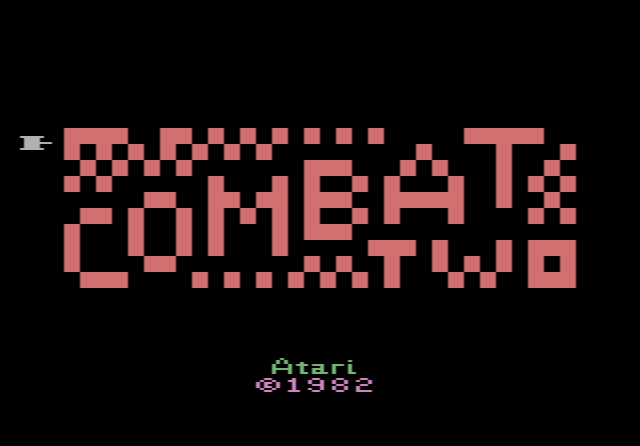
Combat Two: the sequel that never shipped
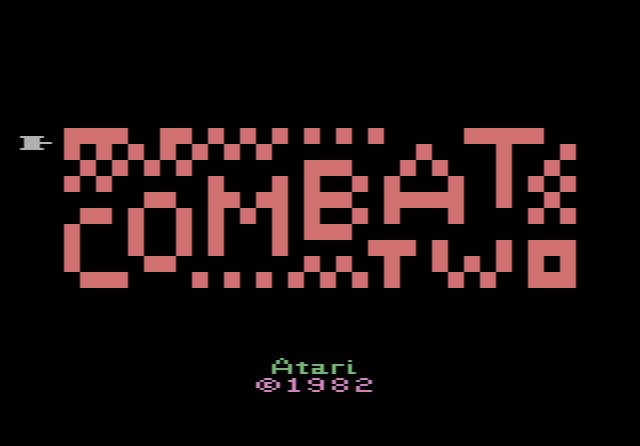
According to AtariProtos, Combat Two was programmed in 1982 by Alan Hodgkinson and Tom Calderwood at GCC for Atari, under model number CX-2663, a number Atari later gave to Road Runner. It was never released. The site describes a very different game from the original: a large landscape with forests, rivers and bridges; forests you can drive through but must shoot away to hit anyone hiding in them; brick walls that stop you; and water that slows you down unless you use a bridge. Each player has a base in a corner that shields them from a few hits and can launch a cruise missile that homes in on the enemy, which then needs time to recharge. Tanks have three levels of armour that recover over time, each player has three lives, and the last tank standing wins. There is also a simple editor for placing walls or forests on your side. Like Combat, it is for two players only.
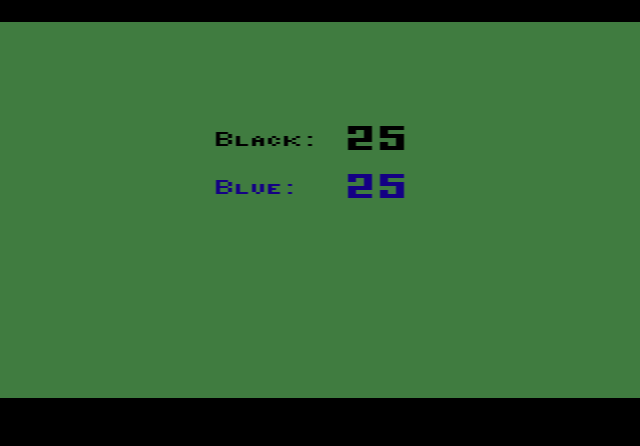
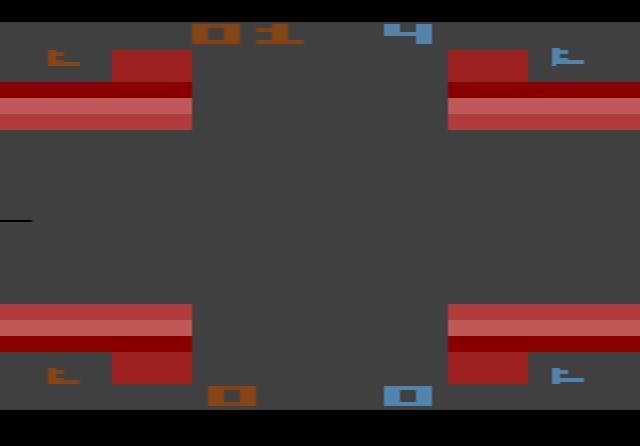
Not every version seems to match that description. Keita Iida’s review for Atari Gaming Headquarters found only three screens to choose from and a river that did not slow the tanks. After its title screen, the version on this site shows a green field split by a winding river with two bridges, a base in the top-left and bottom-right corners, and three tank symbols for each player at the bottom of the screen. In 2001 Retrodesign produced a boxed release with a manual for Classic Gaming Expo, where 200 copies were sold for $30, with 50 more for collectors outside the United States.
Expect a slower, more tactical game than Combat. Use the bridges, stay near your base while your armour recovers, and save the cruise missile for when your opponent is out in the open.
Where Combat came from
Combat is based on Atari’s 1974 arcade game Tank. Steve Mayer and Ron Milner of Cyan Engineering had started on a home version by late 1975, while the console itself was still being designed. Joe Decuir then wrote it for the final hardware in a 2 KB cartridge, and Larry Wagner refined the tank games and added the biplanes and jets. It was one of the nine launch cartridges of 1977, alongside Decuir’s own Video Olympics, Air-Sea Battle and Surround.
More head-to-head games
- Air-Sea Battle – another launch title: shoot down planes and ships, alone or against a friend.
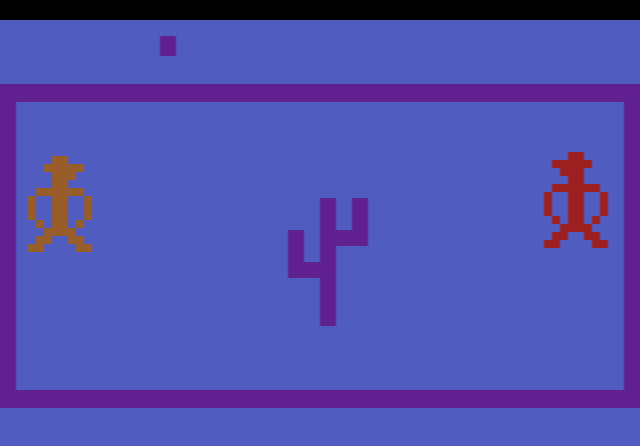
- Outlaw – two cowboys, one cactus, and bouncing bullets in some variations.
- Slot Racers – Warren Robinett’s cars chase each other through a maze firing missiles.
- Space War – Atari’s version of the 1962 computer classic Spacewar!
- Armor Ambush – M Network’s two-player tank battle over varied terrain.
- Warlords – up to four players defending their castles.
- Robot Tank and Battlezone – first-person tank games for one player, when your friend has gone home.