Carol Shaw’s River Raid looks simple: fly up a river, shoot things, don’t crash. What keeps players coming back is the fuel gauge, which forces a decision every few seconds. This guide explains how the river is built, how fuel really works, what each enemy does and how to push your score past the milestones Activision set in 1982.
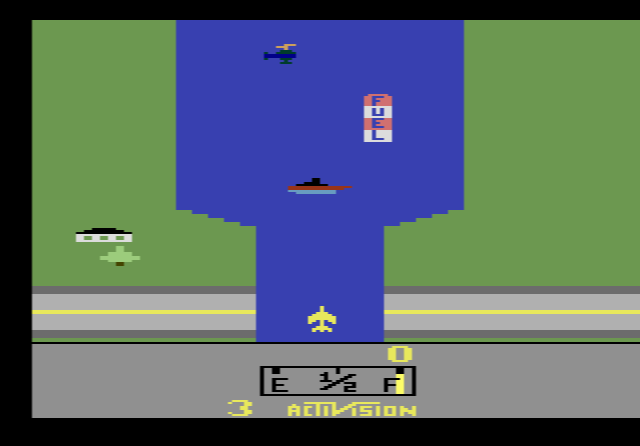
Controls in the browser
- Bank left and right: left and right arrow keys
- Speed up / slow down: up and down arrow keys
- Fire: Space. Hold it down for continuous fire.
- Start: F12 (Reset) brings your jet to the start line; press fire or move to take off.
- One or two players: F11 (Select). Game 1 is one player, game 2 is two players taking turns. Player 2 flies with T/F/G/H and fires with A.
- Missile type: F4 for player 1, F9 for player 2 (the difficulty switches). In position A missiles fly straight ahead. In position B you can steer them after firing by banking your jet, which makes aiming much easier.
- Save and load: Ctrl + 0–9 saves, Alt + 0–9 loads.
Points and lives
| Target | Points |
|---|---|
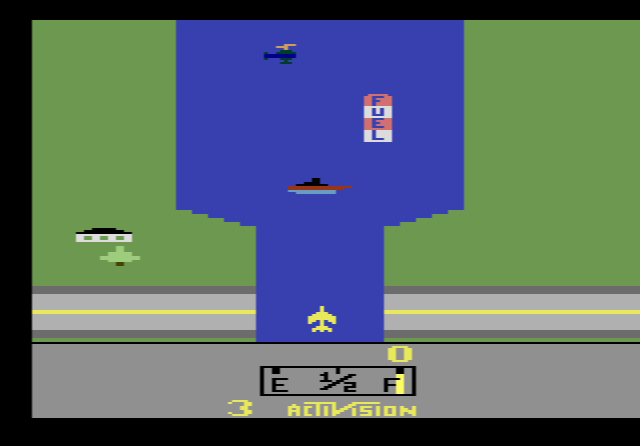
| Tanker (ship) | 30 |
| Helicopter | 60 |
| Fuel depot | 80 |
| Jet | 100 |
| Bridge | 500 |
You start with three jets in reserve and earn another every 10,000 points, up to nine in reserve. You lose a jet if you hit the riverbank, an enemy or a bridge you have not destroyed, or if you run out of fuel. Fuel depots are the one thing you can fly into safely. In 1982 Activision sent a River Raider patch to anyone who photographed a score of 15,000. The score tops out at one million, when the digits turn into exclamation marks.
How the river is built
The river never ends, but it is not random in the way it looks. Shaw generated it with a formula that always starts from the same value, so the river is the same every time you play. That is why her tips in the manual suggest taking notes on each section. Thomas Jentzsch’s commented disassembly of the game shows how it is put together:
- Sections and blocks. The river is divided into sections. Each one is 16 blocks long, and the last block is always a road with a bridge.
- One object per block. Each block holds a single object: an enemy (ship, helicopter or jet), a fuel depot, or a house on the bank. Houses are scenery.
- A quiet start. In the first section nothing moves, and its banks are straight. Enemy jets only appear from the third section on, and the narrowest channels are held back until after the fourth.
- A short breather. The first stretch after a bridge never contains an enemy or a depot, only a house.
- Harder, then steady. Every section raises a difficulty counter. The higher it is, the more blocks hold enemies and the fewer hold fuel. The code’s own comments put fuel at around a quarter of blocks at the start, falling to about one block in sixteen. The counter stops rising at 48, so the river does not get any worse after that.
Fuel: the rules that matter
The manual explains three facts, and together they decide how you should fly.
- Fuel burns at the same rate whatever your speed. So flying faster gets you further on one tank. On an open, easy stretch, push up and cover ground.
- The slower you pass over a depot, the more fuel you get. The gauge fills a little on every frame you touch the depot. Pull back as you cross one, and drift over it for as long as you can. A higher-pitched tone means the tank is full.
- A siren warns you at a quarter tank. Treat it as the last warning, not the first. Further up the river the next depot may be a long way off.
Shaw’s own advanced tip: once you are skilled, you can shoot a depot while you are refuelling from it and get the fuel and the 80 points. For everyone else, the rule is simple. When the gauge is below half, every depot is fuel, not points.
Know your enemies
- Tankers and helicopters may sit still or move sideways, at half the speed of the enemy jets. Some patrol back and forth, turning around when they reach the bank. A helicopter in a narrow channel is the most common way to die: shoot it early rather than trying to slip past.
- Jets fly straight across the screen at full speed and do not turn back. They are worth the most of any enemy, but you do not have to shoot them; often it is safer to let one pass.
- Bridges are worth 500 points and they block the whole river, so you must destroy them. They are also your checkpoint: if you crash later, your next jet starts at the beginning of the section after the last bridge you destroyed. Crash before the bridge and you replay the section.
Strategy for bigger scores
- Play with guided missiles first. Position B lets you curve shots into helicopters as they move. Switch to A once you want the full challenge.
- Keep your thumb on fire. Holding the button fires continuously, and a missile already on its way often clears a target before you have even noticed it.
- Fly in the middle of the channel. Ships and helicopters can pull out in front of you, and a jet in the middle has room to go either way.
- Speed up in straight sections, slow down in winding ones. Straight banks give you time to react; islands and narrow channels do not. Since fuel burn does not depend on speed, the time you save on straights costs nothing.
- Use the gap after each bridge. The first stretch of a new section never holds an enemy, so that is the moment to check your fuel and settle your speed.
- Don’t chase jets near the banks. 100 points is not worth a jet, especially below 10,000 where you are still earning spares.
- Learn the river. Since it never changes, practise the early sections with save states and write down which ones are tight on fuel. After a while the first ten bridges become routine, and that is where a high score really starts.
Two players, one keyboard
In game 2 the players take turns, each with their own score, jets and place on the river. Each player also has their own missile setting: player 1 uses the left difficulty switch (F4) and player 2 the right one (F9). That makes a fair handicap: give the stronger player straight missiles and the newer player guided ones.
The story behind the river
Shaw had made 3-D Tic-Tac-Toe and Video Checkers at Atari before she joined Activision. Inspired by the arcade game Scramble, she first pitched a space game; Alan Miller told her there were too many of those. Horizontal scrolling looked jerky on the 2600, so she scrolled vertically, and a mirrored playfield turned into a river with islands. Her first design used a boat until Pitfall! creator David Crane suggested a jet. The fuel depots came from colleagues too, from Crane or Steve Cartwright.
Released in December 1982, River Raid was the second best-selling 2600 game of 1983, behind Ms. Pac-Man, and won Arkie awards. In West Germany it was banned for its military theme. The 1988 sequel, River Raid II, designed by Dan Kitchen and programmed by David Lubar, used the same formula as Shaw’s original to generate its river.
More games to fly next
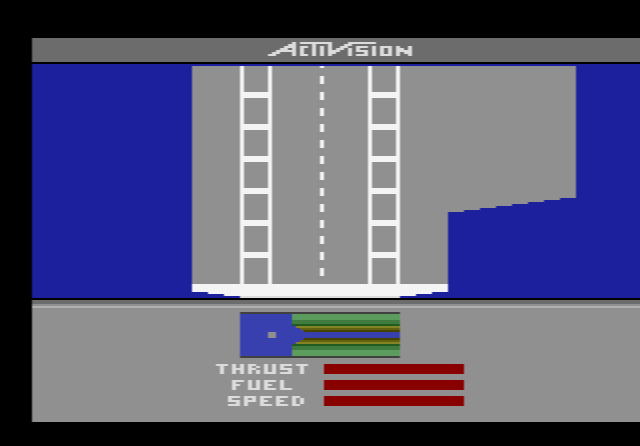
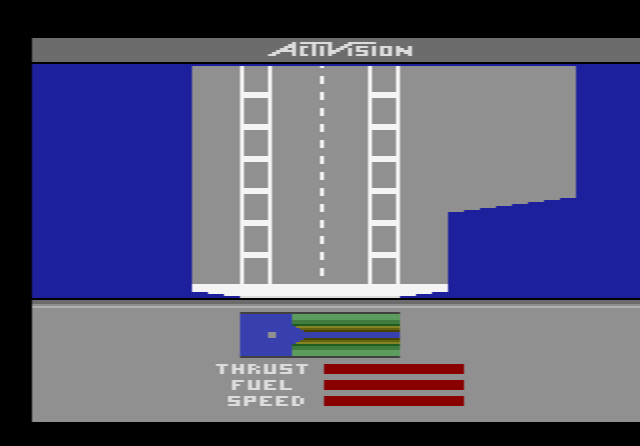
- River Raid II – the sequel, with carrier take-offs and landings and altitude control.
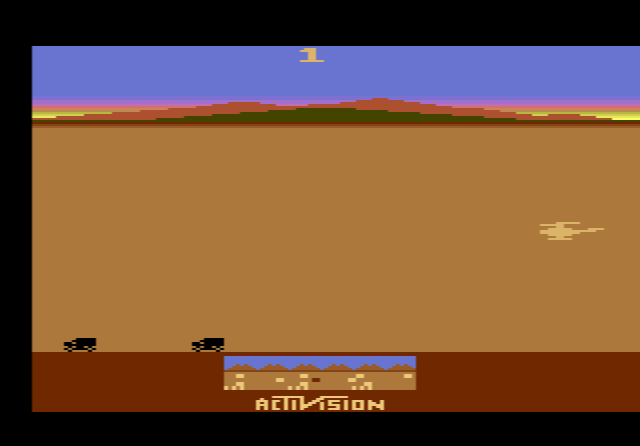
- Chopper Command – Activision’s helicopter shooter, protecting a convoy of trucks.
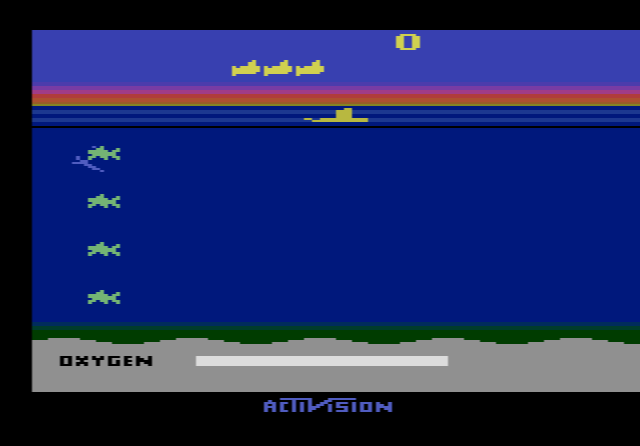
- Seaquest – the same kind of pressure, with oxygen instead of fuel.
- Super Cobra – Konami’s follow-up to Scramble, the arcade game that inspired River Raid.
- Vanguard – a scrolling arcade shooter in the Scramble mould.
- Beamrider and Megamania – two more Activision shooters from the same era.