Most visitors to AtariOnline.org head for the same few cartridges. Adventure alone has 234 player ratings, and Pitfall!, Pac-Man and River Raid are not far behind. Meanwhile some of the best-made games on the console sit a few clicks away with fewer than fifteen votes. This list is about those games: titles that our players rate highly when they do find them, and that reviewers, then and now, have praised. Every one of them runs in your browser, so you can read a paragraph and start playing straight away.
How we picked them
We started from the site’s own rating data, read from every game page on 30 September 2026. We looked for games with fewer than 15 votes and an average of 4.5 stars or more, well above the site average of about 3.5. That gave us a long list, and a handful of five-star votes proves little on its own. So we kept only games that also have a good record with critics: period magazines, modern retro reviewers or awards. Games that already appear in our earlier Top 10 lists or in the player ranking’s top 20 were left out.
“Underrated” here means underplayed on this site. A few of these games sold well in the 1980s; they have simply been overlooked since. The vote counts below are from the same 30 September snapshot and will change as more of you rate them.
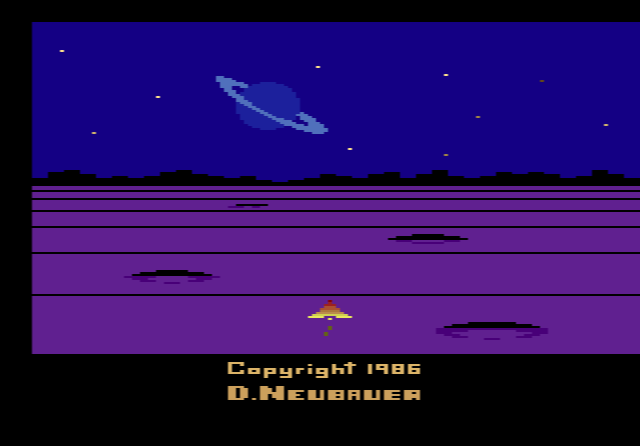
1. Solaris (Atari, 1986)
Our players: 4.6 stars from 14 votes.
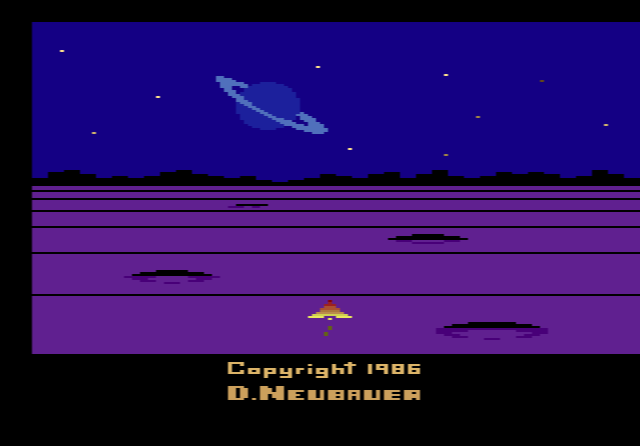
Solaris is Doug Neubauer’s space epic, and Neubauer is the man who wrote Star Raiders for the Atari 8-bit computers in 1980. You fly a star cruiser across a galaxy map of 16 quadrants, warp from sector to sector, fight Zylon fleets, refuel at Federation planets and land on enemy worlds to rescue stranded cadets, all while searching for the legendary planet Solaris. It came out very late, in November 1986, on a 16K bank-switched cartridge, and it looks and plays like nothing from the console’s early years. The Video Game Update called it the best space game ever done for the system.
Try this: the manual’s own advice is to keep your ship “in focus” during hyperwarp, which wastes less fuel, and to map your progress on paper. Running out of fuel costs a life, so plan your jumps via friendly planets.
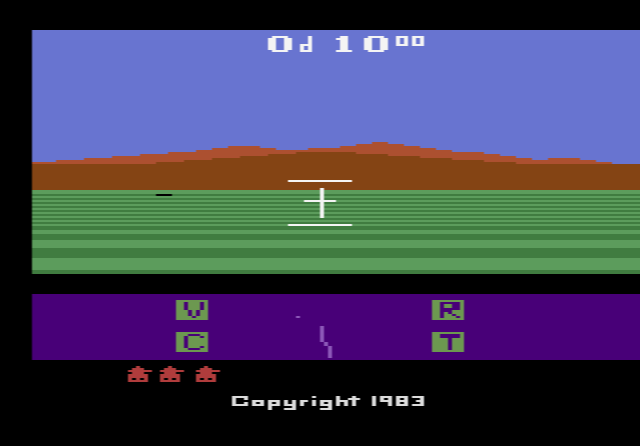
2. Robot Tank (Activision, 1983)
Our players: 4.8 stars from 12 votes.
Alan Miller’s Robot Tank is a first-person tank battle, a bit like Battlezone but with ideas of its own. Enemy tanks arrive in squadrons of 12, and the battlefield changes with a running clock: day turns to night, and rain, snow and fog come and go. Hits do not simply destroy you. They knock out one system at a time, shown as letters on the dashboard: V for video, C for cannon, R for radar and T for treads. A tank with broken radar or a flickering screen can still fight, but the damage is permanent. Computer Entertainer called it the best combat game yet for the 2600.
Try this: practise aiming with the radar alone. At night and in fog you will barely see the enemy, and the radar is what wins those fights. Push the arrow keys to drive and aim; Space fires.
3. Pressure Cooker (Activision, 1983)
Our players: 4.8 stars from 9 votes.
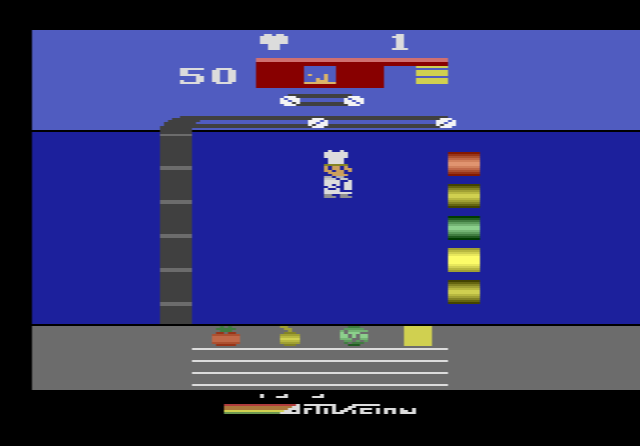
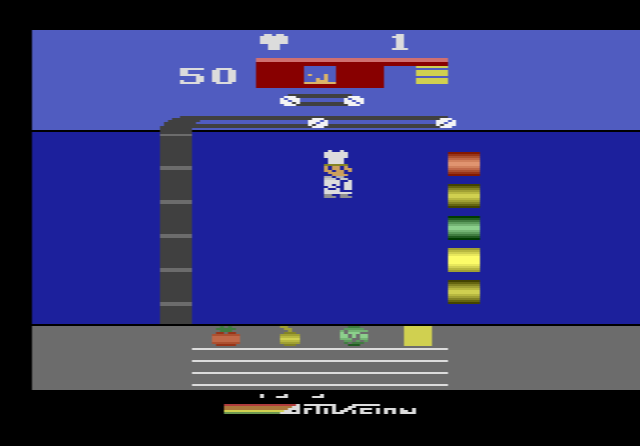
Garry Kitchen, the designer of Keystone Kapers, got the idea for Pressure Cooker from the conveyor belts in a Burger King kitchen. You are Short-Order Sam. Burgers roll out of the oven, tomatoes, onions, lettuce and cheese fly at you from the sides, and an order board shows what the red, green and blue customers want. Catch the right toppings with your belly, put them on the right burger, add the bun and drop it down the matching chute. It is part action game, part memory test, and it gets frantic quickly.
Try this: hold Space to reject toppings you do not need. Knocking the wrong ones away early makes the right ones come round sooner. You start with 50 performance points and lose them for wasted or doubled toppings, so tidy work matters more than speed. Odd-numbered games are for one player, even-numbered ones for two taking turns.
4. Gravitar (Atari, 1983)
Our players: 4.7 stars from 10 votes.
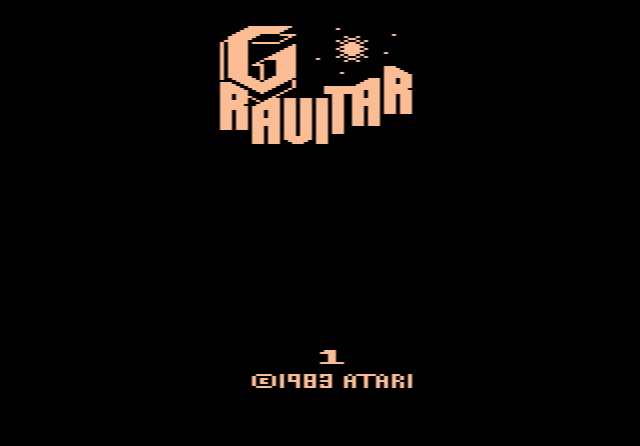
The arcade Gravitar was known for being brutally hard. Dan Hitchens’s home version of Gravitar keeps its best idea, a small ship fighting gravity as much as the enemy, and adds easier game levels, including one with 100 ships and one with no gravity at all. You rotate, thrust, shoot bunkers on each planet and pull in fuel with a tractor beam. The cartridge was first sold only through the Atari Club, with a silver label that collectors now hunt for, which is one reason so few people played it at the time. Critics are divided on it; the Video Game Critic scored it 92%.
Try this: press F11 until you reach level 5 (no gravity, 25 ships) for your first game. Tap the up arrow for thrust instead of holding it; the ship drifts after you let go.
5. Tron: Deadly Discs (M Network)
Our players: 4.6 stars from 12 votes.
Film tie-ins have a poor name on the 2600, which may be why Tron: Deadly Discs gets passed over. Mattel’s M Network version of its Intellivision game is a tight arena fight. Warriors walk in through three doors and throw discs at you; you throw yours back in any of eight directions and press the button again to call it home. Each new wave brings warriors in a new colour, worth more points, from light green (10) up to gold (800). You survive five hits, and clearing a wave quickly heals one.
Try this: hit the doors with your disc to lock them open. With two opposite doors locked you can teleport between them, and the enemy cannot shoot for about two seconds after you arrive. The manual’s short advice: keep Tron on the run.
6. Radar Lock (Atari, 1989)
Our players: 4.5 stars from 8 votes.
Doug Neubauer again. For Radar Lock he reused the Solaris engine to make a fast jet-fighter game, released when most people had long stopped buying 2600 cartridges. You fly five missions against drones, interceptors, bombers, stealth fighters and super bombers, and refuel in mid-air by lining up behind a tanker. Kieren Hawken’s A–Z of Atari 2600 Games gave it 9 out of 10.
How it plays here: the game uses both joysticks even with one player. The arrow keys fly the jet and Space fires. The second joystick picks the weapon, so press F for guided missiles or H for proximity missiles, and hold A to speed up. With a friend, one person flies and the other handles the weapons. You only carry five guided missiles, so save them for the big targets. F2 pauses the game.

7. Secret Quest (Atari, 1989)
Our players: 4.5 stars from 4 votes.
Secret Quest is a top-down action adventure from the console’s final years. Nolan Bushnell’s name is on the box, but the programming was done by Steve DeFrisco. You explore eight alien space stations, fight what lives in them with a sword, a sonic blaster or a particle beam, collect the self-destruct code and get out before the station blows. Oxygen runs down all the time and every weapon costs energy, so exploring is a constant trade-off. The game gives you a passcode to continue later, rare on the 2600.
How it plays here: the status screen is on the console’s TV Type switch, which is F2 in the emulator. Draw a map as you go, as the manual suggests, and write down each station’s code. The emulator’s save states (Ctrl+0–9) are a handy extra safety net.
8. Oink! (Activision, 1983)
Our players: 4.5 stars from 8 votes.
Mike Lorenzen’s Oink! turns the Three Little Pigs into a sort of reverse Breakout. The wolf, Bigelow B. Wolf, blows holes in the bottom of your house wall, and your pig grabs patches from the top of the screen and drops them into the gaps before the wall gives way. Each pig has its house from the fairy tale: straw, sticks, then bricks. It won the award for most humorous game at the 1984 Arkie Awards, and in one variation two players take turns as the pigs and the wolf.
Try this: hold Space to grab a patch and let go to drop it. Fix small holes at once; the wolf’s breath widens them, and a big hole can knock your pig out of the house.
9. Atlantis (Imagic, 1982)
Our players: 4.6 stars from 9 votes.
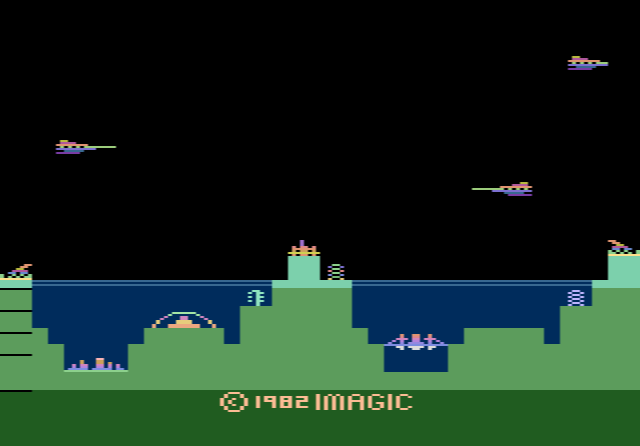
In Dennis Koble’s Atlantis you cannot move at all. You defend an underwater city with three fixed guns: the centre one fires straight up, the two at the ends fire diagonally. Gorgon ships sweep across the sky, dropping lower until they can fire on the city, and every wave is faster than the last. It was Imagic’s second-best seller after Demon Attack, yet on this site it has a quarter of Demon Attack’s votes.
Try this: Space alone fires the centre gun; hold the left or right arrow while pressing Space for the side guns. Their shots score double, so use them whenever the angle allows. Game 3 is for two players, one on each side gun.
10. Vanguard (Atari, 1982)
Our players: 4.6 stars from 14 votes.
The arcade Vanguard had four fire buttons, one for each direction, and it scrolled up, sideways and diagonally through tunnels. The 2600 version keeps all of that. You fly through zones with names like Mountain, Rainbow, Stick and Bleak towards the City of Mystery, your fuel refills as you shoot enemies, and energy pods make you invincible for ten seconds. Video magazine called it a marvellous home-arcade translation and noted that it was the first cartridge with a continue option.
How it plays here: the difficulty switches choose how you aim. Both start on B in the emulator: you pick a direction with the arrow keys first and then press Space. Press F4 to put the left switch on A, and you hold Space and push an arrow key to fire that way instead. The right switch (F9) decides whether the forward laser fires automatically when you press the button. Your ship moves twice as fast when it is not firing, which is worth remembering in the narrow tunnels. After your last life in the first tunnel, press Space within ten seconds to continue.
A few more worth a look
These did not quite make the ten, because reviews of them are more mixed, but our players like them:
- Mountain King (CBS Electronics, 1983): a platform game in a dark mountain, where a flashlight reveals hidden treasure chests and Grieg’s “In the Hall of the Mountain King” plays as you climb. The cartridge carries extra memory, which CBS sold as “RAM Plus”. Five of our players rated it, all with five stars.
- Crazy Climber (Atari): another Atari Club exclusive and a rare cartridge. You push up to raise the climber’s arms and pull back to haul him up, scaling four buildings to reach a helicopter at the top.
- Dark Chambers (Atari, 1988): a Gauntlet-style dungeon crawl based on John Palevich’s computer game Dandy, and one of the few 2600 games two people can play together at the same time.
Rate them when you play
Each game page has a star rating box under the emulator. A game with nine votes can move a long way with a few more, and the ratings are how other visitors find the good games among the site’s hundreds of cartridges. If one of these surprises you, give it a rating and a favourite so the next player finds it too.