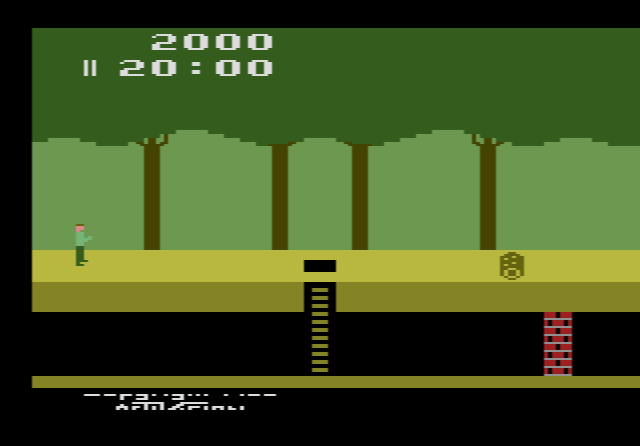
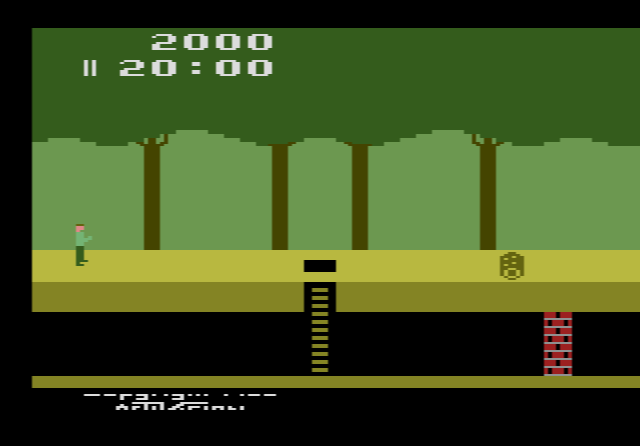
David Crane’s Pitfall! gives you 20 minutes, three lives and a jungle of 255 screens to find 32 treasures. Most players run right, fall into the first swamp and never see a gold bar. This guide explains how the jungle is built, where the treasures are, how to beat each hazard, and how to chase a better score in the emulator on this site.
Controls in the browser
- Run: left and right arrow keys
- Jump: Space. Hold left or right while you press it to jump forward. Jumping while running is also how you grab a vine.
- Let go of a vine: down arrow, at the end of the swing
- Climb a ladder: up and down arrows
- Start a game: F12 (Reset). The clock starts as soon as you move. Select and the difficulty switches do nothing in this game.
- Save and load: Ctrl + 0–9 saves, Alt + 0–9 loads. Handy for practising one crocodile pond again and again.
Scoring and the rules
You start with 2,000 points. There are eight treasures of each type, 32 in all:
| Treasure | Points |
|---|---|
| Money bag | 2,000 |
| Silver bar | 3,000 |
| Gold bar | 4,000 |
| Diamond ring | 5,000 |
Together they add 112,000 points, so the perfect score is 114,000. You lose 100 points for falling down a hole, and rolling logs drain points for as long as they touch you. Scorpions, fire, cobras, crocodiles, swamps, quicksand and tar pits cost a life instead. The game ends when the clock runs out, when you lose your third life, or when you collect the last treasure. Activision’s manual offered an Explorers’ Club patch for 20,000 points, which is a good first goal.
How the jungle is built
Crane did not store a map. Each screen is calculated from a single number that the game steps forward when you go right and backward when you go left. Thomas Jentzsch’s commented disassembly of the game shows the details, and they explain almost everything you see:
- The jungle is a loop. After 255 screens in one direction you are back at the start. The layout is the same in every game.
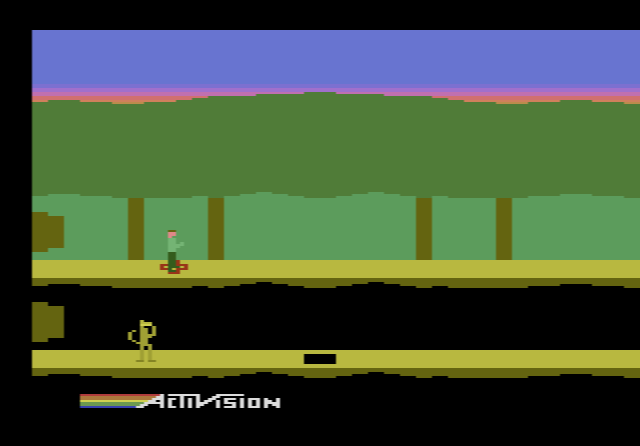
- There are eight kinds of screen: one hole with a ladder, three holes with a ladder, a tar pit, a swamp, a crocodile swamp, a treasure screen with a shifting pit, and two more kinds of shifting pit (one black, one blue). Tar pits, swamps, crocodile swamps and the black shifting pit have a vine; treasure screens and blue shifting pits do not.
- Only hole screens have ladders, and every ladder screen has a brick wall in the tunnel, either left or right of the ladder. Screens without a ladder have a scorpion in the tunnel instead.
- The tunnel is a shortcut. Each screen you walk underground moves you three screens along the surface.
- Treasures sit near the right edge of their screen, to the right of the pit.
That last point matters. If you travel left, you enter each screen from the right, so you touch the treasure almost as soon as you arrive, before you reach the pit.
Why you should run left
Crane’s own tip in the manual is simple: run left. Logs always roll from right to left, so going left means they roll the same way you do, and you jump far fewer of them. When you lose a life, the new Harry drops in on the left side of the screen, so going left also means you do not have to cross the hazard that killed you again.
The start screen helps you on your way. Its ladder leads to a tunnel whose wall is on the right, so the way left is open. Climb down, walk two screens left under the jungle and climb the ladder you find there. You come up six screens from the start, having skipped a crocodile swamp, two shifting pits, a swamp and a three-hole screen. There is nothing to collect on the screens you skipped.
Where the treasures are
Because the jungle never changes, the treasures are always in the same places. The table counts surface screens to the left of the start screen; one underground screen counts as three. We worked this out from the game’s code and checked the first screens in the emulator, so treat the exact numbers as a planning aid and count carefully as you play.
| Screens left of start | Treasures |
|---|---|
| 17, 27 | money bag, diamond ring |
| 49 | money bag |
| 58, 60, 62, 64 | diamond ring, diamond ring, gold bar, gold bar |
| 79, 81, 91, 98 | money bag, gold bar, silver bar, diamond ring |
| 107, 111, 118, 120, 125 | money bag, gold bar, silver bar, gold bar, silver bar |
| 134, 137 | silver bar, silver bar |
| 160 | money bag |
| 172, 176, 178, 183, 186 | money bag, gold bar, diamond ring, diamond ring, silver bar |
| 198, 204, 206, 209, 212, 214 | money bag, money bag, diamond ring, silver bar, silver bar, diamond ring |
| 227 | gold bar |
| 249 | gold bar (this is six screens to the right of the start) |
A few things stand out. The nearest treasure of all is the gold bar six screens to the right, but the route there crosses three-hole screens, a tar pit and a crocodile swamp. The screens from 58 to 64 hold four treasures worth 18,000 points, the richest stretch in the game. And a full lap to the left ends with that same gold bar, so you never need to turn around.
Underground shortcuts are a trade. They save time, but you skip every treasure on the surface above you. Going left, the tunnels from the code that skip no treasure at all start at the start screen, at screen 31 (it brings you up at 46), at screen 70 (up at 76) and at screen 236 (up at 242). A tunnel only works if its first ladder has the wall on the right and the ladder where you want to come up has the wall on the left. A wall between you and the next ladder means a dead end, and you have to walk back.
Every hazard, and how to beat it
- Holes: jump them, or fall in on purpose if you want the tunnel. An accidental fall costs 100 points, and there is a ladder back up on the same screen.
- Rolling logs: they only take points, never lives. When you run left they come from behind you and roll the same way, so you can often simply outrun them. Stationary logs just need a jump.
- Fire and cobras: they do not move. Jump them with a running jump from close range.
- Vines: run toward the pit and press Space as the vine swings toward you. Press down only when the swing has carried you over solid ground.
- Crocodiles: you can stand on their heads only while their mouths are shut. Crane’s tip: jump onto the first head when the jaws close, wait for them to open and close again, then jump to the next. The pond usually has a vine too, which is safer until you are confident.
- Shifting pits (quicksand): they open and close. Wait at the edge and run across while they are shut, or use the vine if there is one.
- Tar pits and swamps: they never close. You need the vine.
- Scorpions: they only live in the tunnels. The manual warns that the margin for jumping them is smaller than for anything else, so jump late and from very close.
- Brick walls: they block the tunnel completely. Check which side of the ladder the wall is on before you commit.
Score-chasing tips
- Draw a map. Crane recommends it in the manual, and it still works. Note each screen type as you go, and mark where the walls are.
- Take the start tunnel every time. It is free time, and it gets you past the crocodiles on screen 1.
- Protect the 18,000-point cluster. Screens 58 to 64 are the best return for your time; slow down and play them safely.
- Do not trade lives for logs. A log costs a few points; a panicked jump into a pit costs a life.
- Practise with save states, then play clean. Save before a hard screen, try it until it feels easy, then play a full run without loading.
- Watch the clock. 20 minutes sounds generous, but going around all 255 screens with every hazard in the way is tight. Tunnels that skip nothing are where you win time back.
A bit of background
Crane had worked at Atari on games like Outlaw, Canyon Bomber and Slot Machine before he co-founded Activision, where he made Dragster, Fishing Derby, Laser Blast, Freeway and Grand Prix. Pitfall! started as a running-man animation he had carried around for years. He later said the design took about ten minutes and the programming about 1,000 hours, much of it spent squeezing the game into 4 KB. The whole jungle fits in fewer than 50 bytes of that. His team talked him into giving Harry three lives instead of one in the last week of development.
Released in September 1982, it topped the Billboard video game chart for 64 weeks and sold more than four million copies on the 2600. Like Adventure and Superman, it shows one screen at a time, and Racing the Beam authors Nick Montfort and Ian Bogost describe it as building on Adventure’s kind of exploration. Unlike Pitfall!, Haunted House and Raiders of the Lost Ark store their worlds in the cartridge instead of generating them.
Where to go after the jungle
- Pitfall II: Lost Caverns – Crane’s 1984 sequel, with no time limit and checkpoints instead of lives.
- H.E.R.O. – Activision’s underground rescue game, screen by screen through mine shafts.
- Jungle Hunt – more vine swinging and crocodiles, this time from a Taito arcade game.
- Montezuma’s Revenge – a treasure hunt through a temple of rooms, ladders and ropes.
- Keystone Kapers – another Activision race against the clock, chasing a robber through a store.