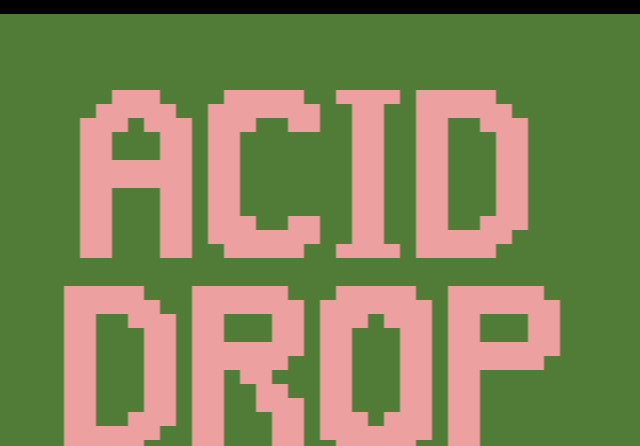
How to play Acid Drop online
- Get to the game: press Space on the title screen, again on the credits screen, then pick a level with the up and down arrow keys and press Space to start
- Move the falling block: left and right arrow keys
- Cycle the three colours: Space bar
- Turn the block between upright and lying flat: up arrow
- Drop the block faster: down arrow
- Pause: F11 (the console’s Select switch)
- Restart: F12 (the console’s Reset switch)
Gameplay
Blocks made of three coloured squares fall from the top of the screen. While a block is falling you can slide it, rotate its colours and turn it on its side, and the aim is to land it so that three or more squares of one colour line up in a row or a column. A finished line disappears and scores 100 points for every square in it. Unlike Columns, diagonal lines do not count.
After every 50 blocks, a special block of three white squares lying flat comes down. This is the “Acid Drop”, and it eats away at whatever it lands on, so it is your chance to break up a crowded part of the pile. Each Acid Drop also takes you up one level, and the game gets a little faster. There are 30 levels, and you can start on any of them. The top of the screen shows your score, your level and the time left on the current screen.
Tips
- Save the Acid Drop for your worst spot. It only arrives once every 50 blocks, so steer it onto the tallest or most jumbled column rather than letting it land anywhere.
- Don’t count on chain reactions. A new line of three that forms when blocks collapse does not clear by itself. You have to land another block of that colour on it.
- Use the flat position. Turning a block on its side lets one block complete a row and a column at once.
The story behind Acid Drop
Acid Drop came out in 1992, long after most companies had stopped making 2600 games. It was made for the European PAL market by Salu Ltd. The title screen credits D. M. Kiss as programmer and Salu as producer, and the instruction leaflet is printed in both English and German. It was never sold in North America. The PAL cartridge image makes the picture roll in a browser emulator, so this page runs an NTSC conversion by Thomas Jentzsch; the game itself is unchanged. Collectors and databases often call it the last official commercial game for the 2600, although “official” is a loose term here, since Atari itself did not publish it.
Reviews have been mixed. Players enjoy the Columns-style puzzle, but the graphics are very plain and the music is often singled out as the weakest part.