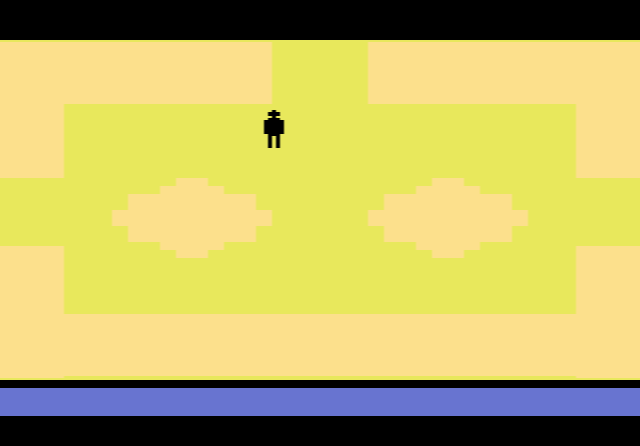
In 1982 there was no bigger game than Pac-Man, and Atari had the home rights. The Atari 2600 cartridge became the best-selling game the console ever had, and also one of the most criticised. Both are true, and the reasons are technical, commercial and a little political. Here is what went into Atari 2600 Pac-Man, why it looks the way it does, and how it compares with the Ms. Pac-Man cartridge that followed. Both are playable on this site, so you can judge for yourself.
A high-profile job for a new programmer
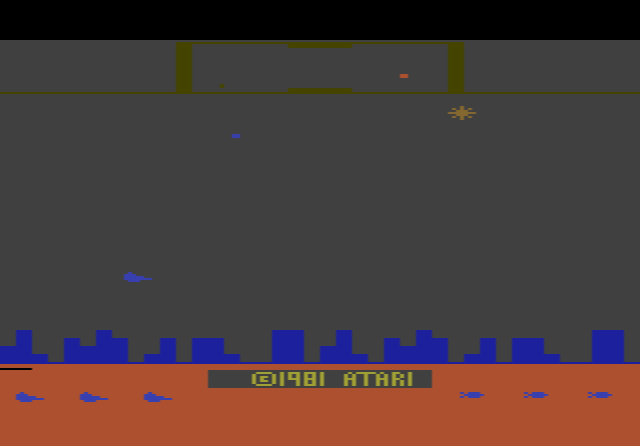
Atari had licensed both Defender and Pac-Man for the 2600. Tod Frye, a fairly new programmer at the company, would have preferred Defender, but that job went to Bob Polaro, whose version you can also play here. Frye got Pac-Man by default. Not everyone at Atari was pleased. Someone wrote “Why Frye?” on the Pac-Man arcade machine in the office, and Frye answered by drawing a line over “Why”, which in logic notation means “not”.
According to Frye’s Wikipedia biography, he started in May 1981. Cartridge chips took months to manufacture, so the code had to be finished around September for the game to reach shops in early 1982. He had no design documents from the arcade side and worked out how the game behaved by playing it. He reportedly worked 80-hour weeks, and most accounts give the development time as about six months.
An arcade board versus a 4 KB cartridge
| Pac-Man arcade board | Atari 2600 Pac-Man | |
|---|---|---|
| Program ROM | 16 KB | 4 KB |
| Working RAM | 2 KB | 128 bytes (the console’s entire RAM) |
| Video RAM | 2 KB | none |
| Processor | Zilog Z80 | MOS 6507, clocked about a third as fast |
Management insisted on a standard 4 KB cartridge. The sources give slightly different reasons: Frye’s biography says 8 KB cartridges were not quite ready yet, while the Wikipedia article on the game says 4 KB was chosen because it was cheaper to make than the new 8 KB bank-switched carts. Joe Decuir, one of the console’s hardware designers, later said that nobody who built the 2600 expected a game that “pushed too hard”, like Pac-Man, to be converted to it.
Why it looks the way it does
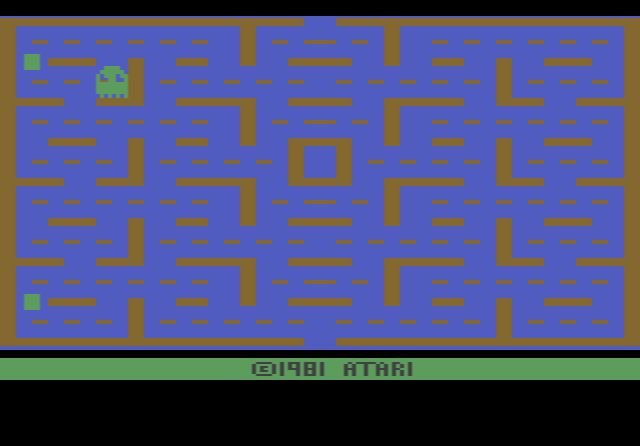
The 2600 has no screen memory. It draws each picture line by line, using a background, a blocky “playfield” for walls, two 8-pixel sprites, two thin missiles and a ball. (Our article on racing the beam explains how that works.) Almost every famous difference in Pac-Man comes from fitting the game into those parts:
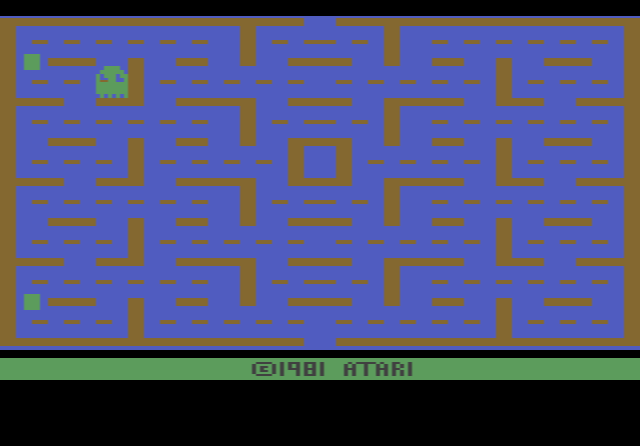
- Wafers instead of dots. The dots are drawn with the same playfield graphics as the walls, so they are wall-coloured rectangles. When you eat one, the game leaves it out as it sends the maze to the screen.
- A simpler, sideways maze. The corridors follow a more regular pattern, and the escape tunnels run off the top and bottom of the screen instead of the sides.
- Power pills and the vitamin. The one-pixel-wide missiles draw the flashing power pills and the centre of the vitamin, an orange square that replaces the arcade’s fruit.
- Flickering ghosts. One sprite is Pac-Man. The other has to serve all four ghosts, so each ghost is drawn only one frame in four. The ghosts also share one colour and do not look in the direction they move.
- A blue background. According to Frye, Atari’s home products policy allowed black backgrounds only for space games.
Two of Frye’s own decisions made things worse. He had planned a flicker-management system but dropped it under time pressure. He also decided that a two-player mode was important, so the score, lives and maze state had to be stored twice in RAM. The sources disagree on the cost: Frye’s biography says 25–30 bytes, while the article on the game says 46 of the 128 bytes. Either way, that memory could not be used for other features.
The biggest launch Atari had ever had
Expectations were huge. In 1981 Atari said it had preorders for “three or four million” copies, and a Goldman Sachs analyst predicted 9 million sales in 1982. Atari planned a “National Pac-Man Day” for April 3, 1982, but some shops were already selling the cartridge from mid-March. Helped by a $1.5 million publicity campaign, it sold more than a million copies in less than a month.
By the end of 1982 it had sold about 7.2 million cartridges and replaced Space Invaders as the best-selling 2600 game. Wikipedia’s figures reach about 7.96 million by the end of 1983 and just over 8 million by 1990. Frye was reportedly paid 10 cents in royalties per cartridge. Yet by mid-1982 demand was already fading, and shops were left with large stocks of unsold cartridges.
What the critics said
Reviewers compared it with the arcade machine and did not like what they saw. Electronic Games gave it 4 out of 10, its first negative review of an Atari game, and asked how a game with so much time and anticipation behind it could lose so much of the original’s charm. Phil Wiswell of Video Games magazine called it “Flickerman”. Softline asked why Atari was suing Pac-Man clones when its own version resembled the arcade game less than many of them did.
That point about clones was real. Atari won an injunction against Philips’s K.C. Munchkin for the Odyssey², but it could not stop others, including On-Line Systems’ Jawbreaker, which you can play here. A few writers defended the game. In 1983 Danny Goodman of Creative Computing Video & Arcade Games argued that it was unfair to expect the 2600 to copy the arcade hardware and that it was a decent maze game on its own terms. Wired’s Chris Kohler later called it an impressive technical achievement for the console.
Later opinion has mostly been harsher. In 1998 Next Generation called it the “worst coin-op conversion of all time”. Nick Montfort and Ian Bogost, in their book Racing the Beam, point out that the flicker tired players’ eyes and took away the ghosts’ separate personalities.
Did Pac-Man cause the crash?
It is often named as one cause of the 1983 video game crash, but it was not the only one. On December 7, 1982, Warner Communications, Atari’s owner, cut its growth forecast for 1982, and its share price fell by around 35% right after the announcement. Warner later admitted that Pac-Man’s strong sales, despite its quality, had made Atari overconfident about its next big licences, E.T. the Extra-Terrestrial and Raiders of the Lost Ark, which then sold poorly. Historians such as Montfort and Bogost argue that the disappointment made retailers wary, and that later problems added to it. The fairest summary is that Pac-Man damaged trust in Atari at the worst possible time.
Ms. Pac-Man: the port people had wanted
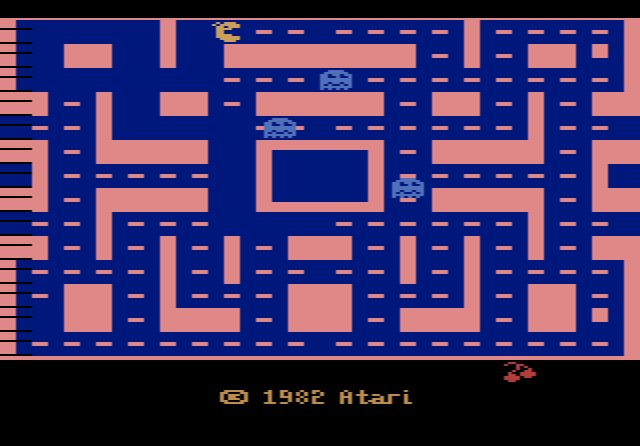
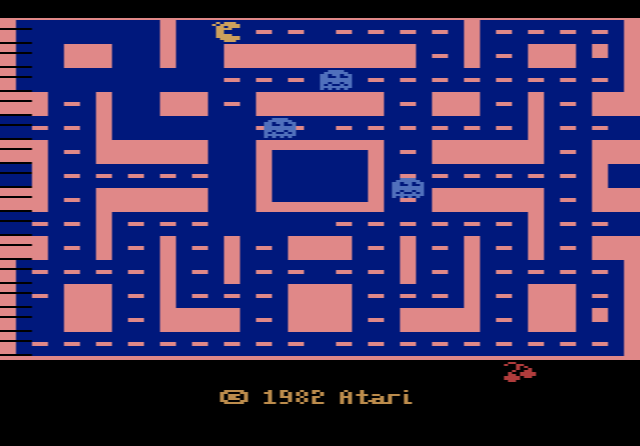
Atari’s 2600 version of Ms. Pac-Man came out in 1983. It was developed by General Computer Corporation (GCC), the company that had made the arcade sequel. With twice the cartridge space and no two-player mode to pay for, it fixed most of the complaints. In January 1984 it shared the Videogame of the Year award at the Arcade Awards.
| Pac-Man (1982) | Ms. Pac-Man (1983) | |
|---|---|---|
| Cartridge size | 4 KB | 8 KB |
| Players | 1 or 2, taking turns | 1 |
| Ghosts | Heavy flicker, one shared colour | Much less flicker |
| Tunnels | Top and bottom | Left and right, as in the arcade |
| Mazes | One | Several, changing as you progress |
| Bonus items | Vitamin | Fruit and pretzels |
| Variations | 8 (Pac-Man and ghost speeds) | 4 (one, two, three or four ghosts) |
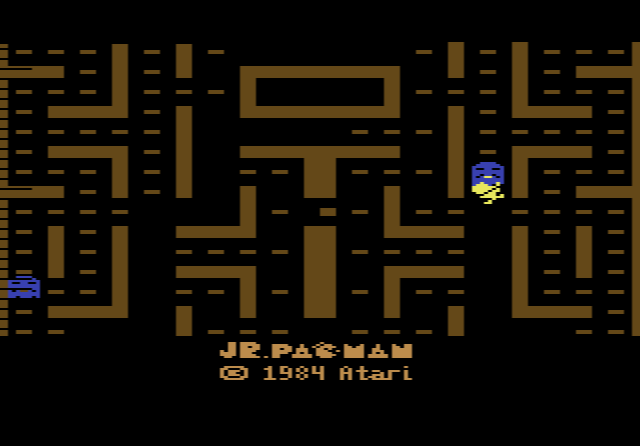
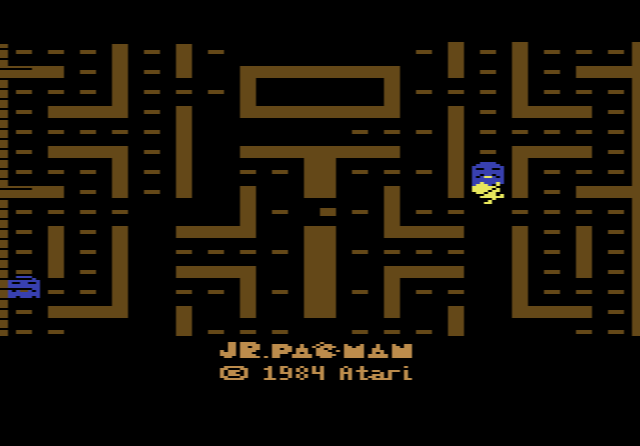
GCC also converted Jr. Pac-Man, with its wide scrolling mazes. It was finished in 1984, after the market had collapsed, and Atari Corporation only released it in 1986.
Playing Pac-Man here today
- Move: arrow keys
- Start: F12 (Reset)
- Choose one of the 8 variations: F11 (Select). They combine a slow or fast Pac-Man with crawling, walking, jogging or running ghosts. The manual suggests games 3 and 7 for young children and calls game 6 the hardest.
- Power pill length: F4. In position B, power pills and vitamins last longer.
- Save and load: Ctrl + 0–9 saves, Alt + 0–9 loads
Treat it as its own maze game, not a copy of the arcade, and it plays better than its reputation. Leave the power pills until the ghosts are close, because four ghosts on one pill are worth 20, 40, 80 and 160 points, far more than the 1-point wafers. Use the top and bottom tunnels to escape when you are chased from both sides. Then load Ms. Pac-Man straight afterwards and compare the ghosts: you can see what the extra 4 KB bought.
What Tod Frye did next
Frye has not apologised for the port. He has said his choices were sound given what he had, while admitting that more ROM would have changed them. He stayed at Atari and worked on the Swordquest series, including Fireworld and Waterworld. He also developed the “Red-Blue” kernel, a way of reusing sprites further down the screen, which was used in RealSports Football and other games. Two of his unreleased 2600 games, Save Mary and Xevious, survive as prototypes and can be played here too.