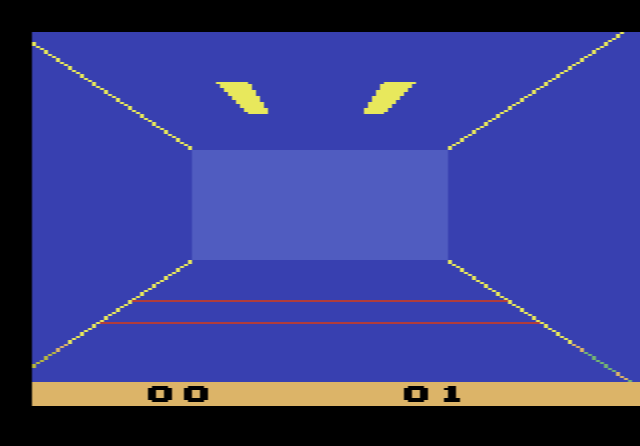
How to play Racquetball online
- Move your player: arrow keys, in any of eight directions
- Serve: Space bar
- Player 2: T/F/G/H to move, A to serve
- Start a new game: F12 (the console’s Reset switch)
- Difficulty: F4 (Player 1) and F9 (Player 2)
You never press a button to swing. Once your player is in the right place, the racquet swings by itself and hits the ball. In a one-player game the computer controls the right-hand player.
Gameplay
Each match opens with a short animation of the two players walking onto the court and shaking hands. Then the rally starts. A serve has to reach the front wall before it touches the floor. Your opponent may hit the ball on the fly or after one bounce, but a second bounce ends the rally.
The game follows the real sport’s scoring. Only the serving player can win a point: if you serve and your opponent misses, you score. If you miss while serving, the serve passes to the other side and nobody scores. The first player to reach 21 points wins.
The difficulty switches change how easy it is to aim. In position B your shots are easier to control; in position A they are less accurate. In a two-player game you can give a newer player B and an experienced player A as a handicap.
Tips
- Follow the shadow, not the ball. You are in range to hit the ball when its shadow on the floor is level with your player’s feet.
- Position early. The swing is automatic, so the whole game is about getting to the ball in time.
- Serve well. Points only come while you are serving, so a rally lost on your own serve costs you a chance to score.
- Try two players. The computer likes to put the ball in the hardest corners to reach.
The story behind Racquetball
Games by Apollo, founded in 1981, was one of the earliest third-party 2600 publishers after Activision. Its lead developer Ed Salvo had already written Skeet Shoot and Spacechase. In an interview he said Racquetball took him about four weeks and that the idea probably came from company owner Pat Roper. Byron Parks, a sound engineer at Apollo, wrote the music.
Reviewers in 1982 liked the ambition but struggled with the perspective. Several magazines found it hard to tell where the ball really was among all the shadows on the walls, floor and ceiling. Salvo later agreed, saying that if he could redo the game he would use fewer shadows. Apollo filed for bankruptcy in November 1982, only months after the game came out. In Germany the game was also sold by the mail-order company Quelle under the name Hili Ball.