Shooting games were what the Atari 2600 did best. The console had two player sprites, two missiles and a ball to work with, and a ship firing at a row of enemies fits those parts almost perfectly. That is why so many publishers made them, and why the genre ranges from careful arcade conversions to odd experiments that only existed on this machine. Our Top 10 action games list already covers Space Invaders, Megamania, Demon Attack, Defender and Yars’ Revenge, so this list skips them. Here are the shoot’em ups to try next, grouped by the way they play, and every one of them runs in your browser on this site.
The keys are the same for all of them: arrow keys to move, Space to fire, F12 to start (the console’s Reset switch) and F11 to choose a game number where there is one. Ctrl + 0–9 saves your game to a slot and Alt + 0–9 loads it back, which is handy before a boss or a new wave.
Fixed shooters: the enemy comes to you
In a fixed shooter your cannon sits at the bottom of the screen and slides left and right. The screen never scrolls; the challenge is in how the enemies move.
Phoenix (Atari, 1983)
Phoenix is the fixed shooter with the most variety. General Computer Corporation’s conversion of the arcade game gives you two waves of small, weaving birds, then two waves of big birds whose wings grow back if you only clip them, and finally an alien mothership. To reach its pilot you have to chip a hole through the hull layers, and one of those layers slides along, so the last shot is a matter of timing. Pull back on the joystick (the down arrow) and a force field appears for about a second and a half. You cannot move while it is up, but any bird that touches it is destroyed. The programmers had to cut more than a third of their code to fit the game into 8 KB, but the mothership survived, and the cartridge won an Arkie Award in 1984.
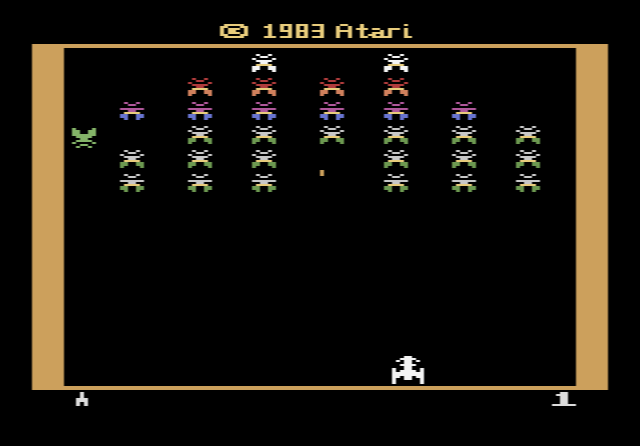
Galaxian (Atari, 1983)
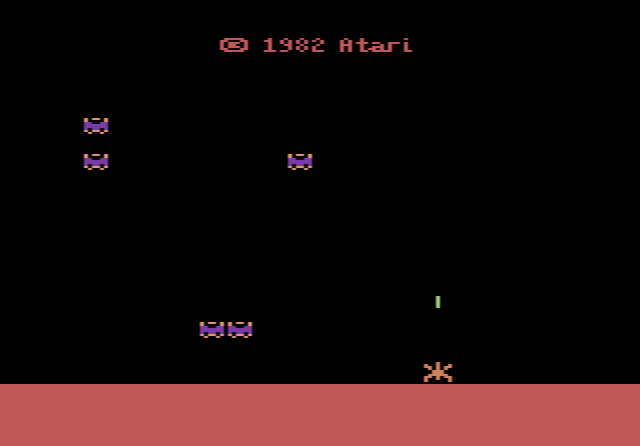
Namco’s 1979 arcade game reached the 2600 in 1983, more than three years after it first appeared in arcades and after its own sequel, Galaga. Galaxian is the step between Space Invaders and Phoenix: the aliens still start in a formation at the top, but they break away and dive at your cannon instead of marching down in rows. It is plainer than Phoenix, with no bosses or shields, and that makes it a good one to learn on. Our players rate it 4.7 stars from 23 votes, one of the best scores for any shooter on the site.
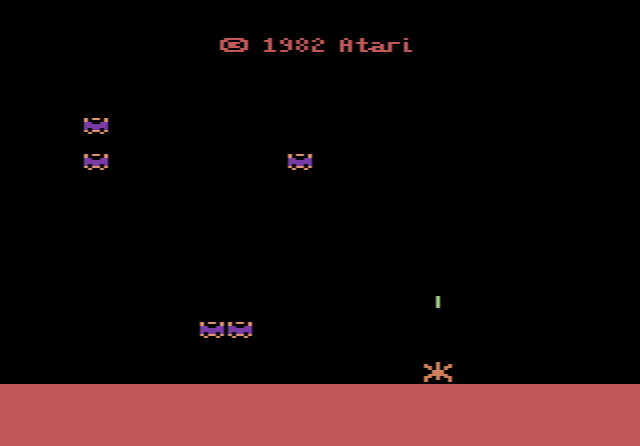
Spider Fighter (Activision, 1982–83)
Larry Miller’s Spider Fighter asks you to protect three pieces of fruit, not just your own blaster. Master Nests try to carry the fruit off the left edge of the screen, Spy Pods call in reinforcements, Green Widows give covering fire and Stingers home in on you. The designer’s advice was to shoot the Spy Pod first and leave the nest for last. The right difficulty switch (F9) is worth knowing about: in position B your shots are guided and follow the blaster sideways after you fire, which makes the fast Stingers much easier to hit.
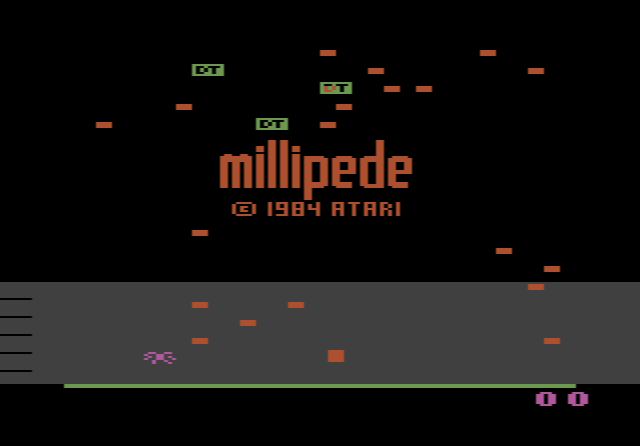
Millipede (Atari, 1984)
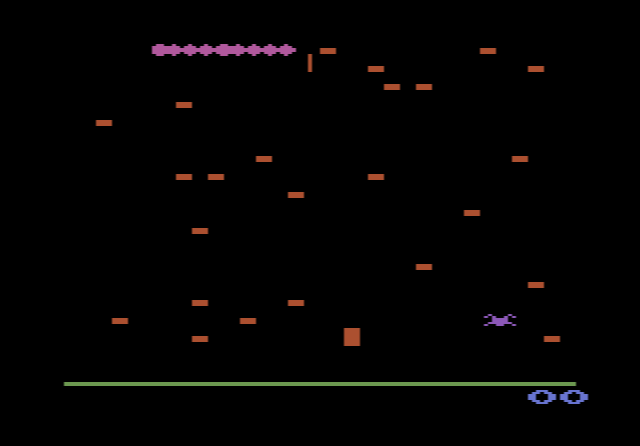
Millipede is the sequel to Centipede and one of Atari’s later 2600 releases, on a 16K cartridge that was large for the console. The segmented bug still winds down through a mushroom field, but now it has company: spiders, earwigs that poison mushrooms, inchworms that slow everything down when you hit them, swarms of bees and dragonflies, and DDT bombs that destroy every bug in the cloud for triple points. Instead of game numbers you choose a starting score with F11 and the up and down arrows, up to 15,000 points below your previous best. If you prefer the original, Centipede is on the site too.
Scrolling shooters: flying through the level
Chopper Command (Activision, 1982)
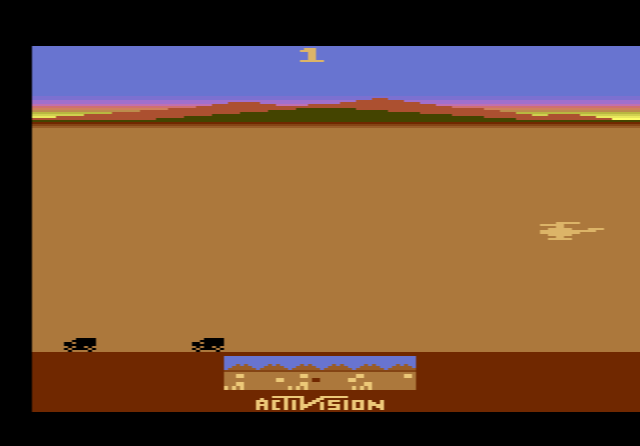
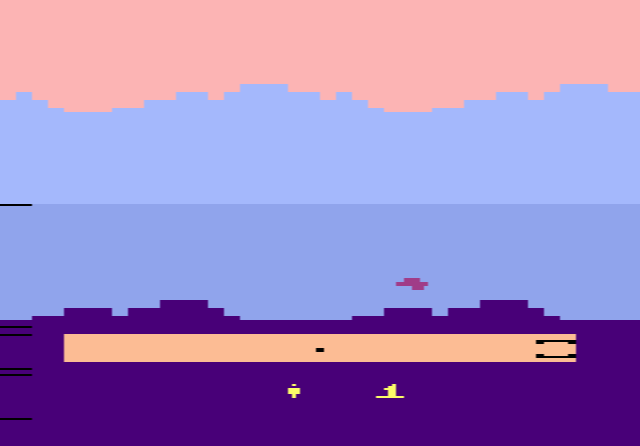
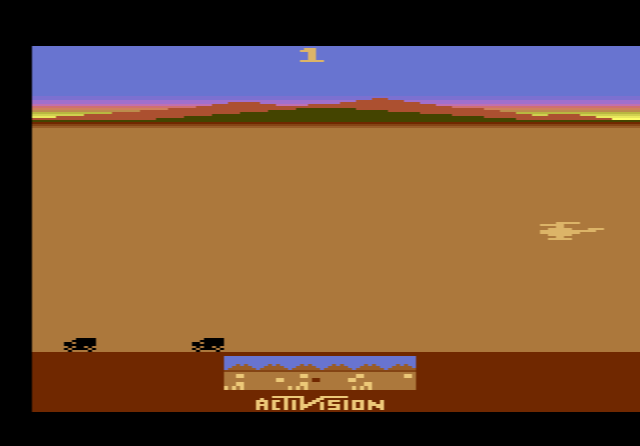
Bob Whitehead’s Chopper Command puts you in a helicopter over the desert, defending a convoy of trucks from jets and helicopters. The battlefield wraps around, and a long-range scanner at the bottom shows every enemy, including the ones off screen. Reviewers compared it with Defender, and the author Brett Weiss summed it up as “Defender in the desert”. The enemy missiles split in two and cannot be shot down, so you spend as much time dodging as firing. It won Best Action Video Game at the 4th Arkie Awards. Tip: wait on the left side facing right, because both the trucks and the enemies travel from right to left.
Seaquest (Activision, 1983)
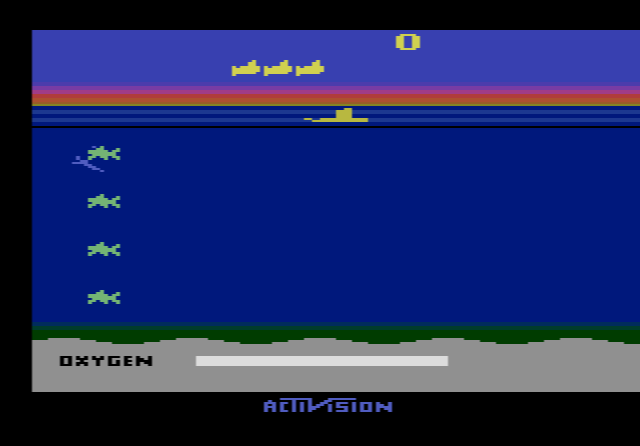
Steve Cartwright later described Seaquest as essentially a reskin of Defender, but under water it becomes its own game. You shoot sharks and enemy subs in fixed lanes while collecting divers, and your oxygen runs down the whole time. The rules for surfacing are what make it: come up with six divers and you score them all, come up with fewer and you lose one, come up empty and you lose a sub. It is a shooter where the real decision is when to stop shooting.
Laser Gates (Imagic, 1983)
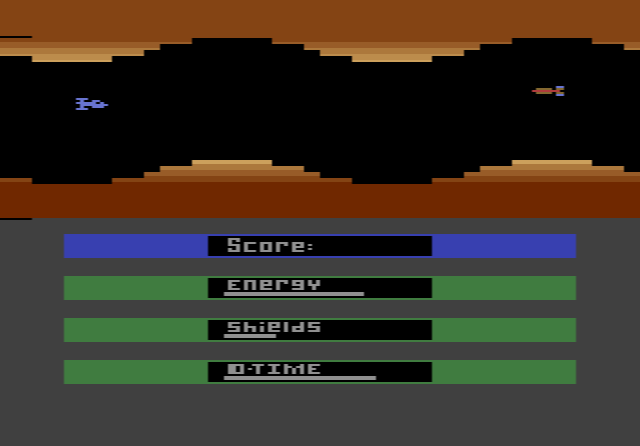
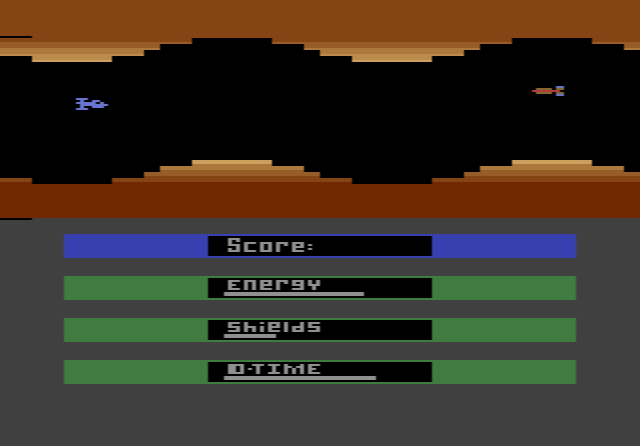
Laser Gates is the least known game on this list and one of the most interesting. Dan Oliver’s side-scroller sends a small ship called the Dante Dart through the passages of a giant computer to destroy four Failsafe Detonators, each marked 6507, the name of the 2600’s own processor. You juggle three meters at once: energy that drains as you fly, shields that drop with every scrape and crash, and a countdown to the next detonator. Brushing a wall costs one shield unit, but hitting a forcefield costs six, so a graze is always the cheaper mistake. It came out in October 1983, just as the market was collapsing, and soon ended up in bargain bins. Only three players have rated it here so far, all with five stars.
Star Wars: The Empire Strikes Back (Parker Brothers, 1982)
The first licensed Star Wars video game is a side-scrolling shooter set during the battle of Hoth. In The Empire Strikes Back you fly a snowspeeder against a column of Imperial Walkers marching on the Rebel power generator. Each Walker takes 48 hits, and changes colour every eight hits as it slows down, unless you find the flashing bomb hatch that destroys it at once. You can never win; you can only hold the Walkers back longer. A useful trick is to damage the lead Walker without killing it, because a weakened leader slows down the whole column. There are 32 game numbers, and the later ones add homing smart bombs and solid Walkers that destroy your speeder if you fly into them.
Into the screen: faking 3D
The 2600 had no hardware for 3D, so shooters that look into the distance are small technical tricks. Three of them are worth playing.
Beamrider (Activision, 1984)
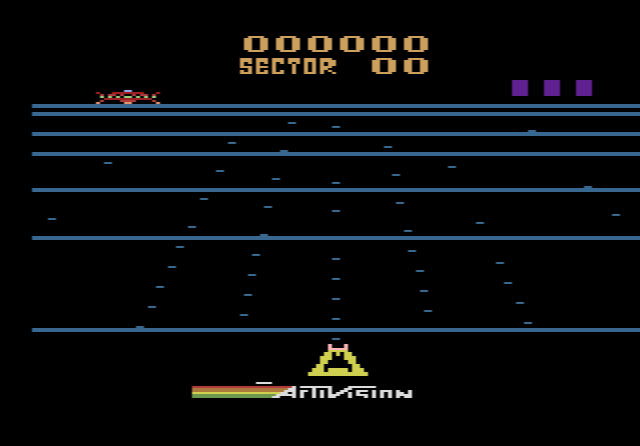
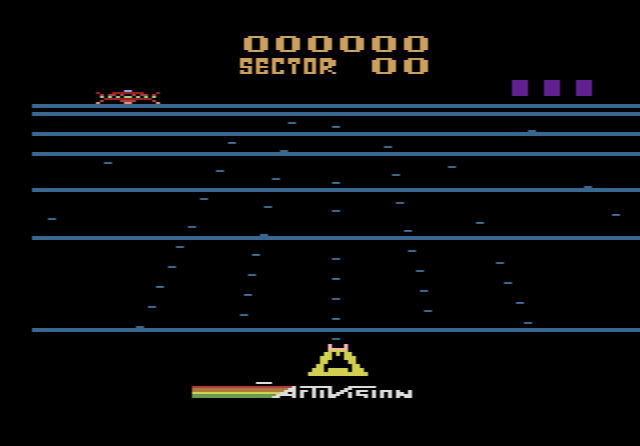
Beamrider began on the Intellivision, designed by Dave Rolfe, and the 2600 conversion was handled by Cheshire Engineering. Your ship jumps between beams of light that stretch towards the horizon, and enemies race down them at you. In each of the 99 sectors you must destroy 15 white saucers with your short laser, and then a Sentinel ship crosses the top of the screen that only a torpedo can hit. You get three torpedoes per sector, so every one you spend on a Blocker or a Tracker is one fewer for the Sentinel. It is the highest-rated shooter on the site right now, with 4.8 stars from 15 votes. Tap the arrow keys rather than holding them: one tap moves you exactly one beam.
Zaxxon (Coleco, 1983)
Sega’s arcade Zaxxon was known for its angled isometric view, which the 2600 could not draw. Coleco’s cartridge moves the camera directly behind your fighter instead. You fly over the wall of an asteroid fortress, shoot fuel tanks and gun turrets, fight enemy planes in open space and then face the robot Zaxxon, whose only weak point is the missile under its arm. Judging height from behind the ship is hard, so watch the altitude bar on the left. Remember that the controls are like a flight stick: the down arrow climbs and the up arrow dives.
Star Wars: The Arcade Game (Parker Brothers, 1984)
Atari’s 1983 Star Wars arcade machine used colour vector graphics and a flight yoke. Parker Brothers’ 2600 version cannot copy the vectors, but it keeps all three stages of the attack: the dogfight with TIE fighters, the run over the Death Star’s surface towers, and the trench, where you dodge catwalks and fire a torpedo into the reactor port. Shoot the fireballs as well as the fighters; each one is only worth 3 points, but every fireball you destroy is a shield you keep. Setting F4 to A starts you on wave 3, where the Death Star bonus jumps from 1,000 to 6,500 points.
Two curiosities
Tempest is an unfinished prototype of Atari’s vector arcade game, dated January 1984 and roughly half done. The 2600 could not draw the arcade’s tubes, so enemies climb lanes on a flat shape. It is rough, but it is a rare look at a conversion that never shipped.
Gamma-Attack is the opposite case: a finished game that almost nobody bought. Gammation, a small Ohio company, released it in 1983. You fly a saucer over a planet and fire diagonally down at tanks, much like Activision’s Laser Blast. Only one original cartridge is known to exist, and Guinness World Records later listed it as the rarest video game. Its code has been preserved, so you can play it here for free.
Where to start
| If you want… | Play |
|---|---|
| A classic arcade feel | Phoenix or Galaxian |
| Something to think about while you shoot | Spider Fighter or Seaquest |
| A busy screen and big scores | Millipede |
| A real sense of speed | Beamrider |
| A hard, tense game few people know | Laser Gates |
| A game you can never win | The Empire Strikes Back |
If you still want more, try the other Defender-style games on the site, Stargate (Atari’s 1984 version of the Defender sequel, later reissued as Defender II) and Super Cobra, a Konami arcade conversion where you fly and shoot through a narrow scrolling cave. When you find a favourite, give it a rating on its page. Several games on this list have only a handful of votes, and yours will help other players find them.