Atari 2600 games are a good first step into video games for young children. The rules fit on one screen, a round lasts a few minutes, and many cartridges from the early 1980s were made with families in mind. Atari even ran a line of children’s games with the makers of Sesame Street. This guide is for parents and grandparents who want to share these games with a child. It picks learning games and gentle character games that actually work in the browser on this site, explains the settings that make them easier, and is honest about the few well-known children’s titles that do not work here.
Before you start: four settings that help
- Keys: the child moves with the arrow keys and presses Space for the button. A second player uses T/F/G/H to move and A for the button, so two people can share one keyboard.
- Starting a game: F12 is the console’s Reset switch and starts the game. F11 is Select, which changes the game number, and in several games below the lowest or highest number is the easy one.
- Difficulty switches: F4 and F9. In many games position B is the easier setting.
- Save states: Ctrl + 0–9 saves the game and Alt + 0–9 loads it. If a child keeps losing at the same spot, save just before it.
Learning games
Basic Math (Atari, 1977)
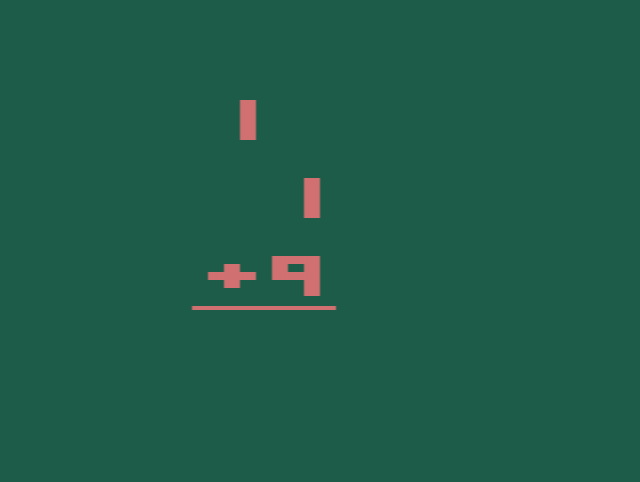
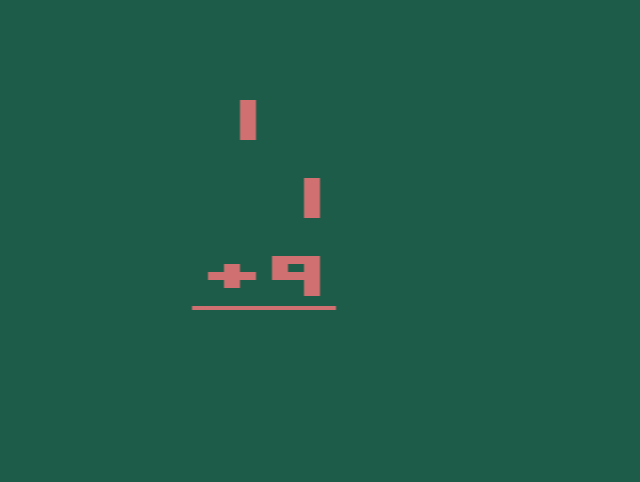
Basic Math was one of the games on sale when the console launched in September 1977, programmed by Gary Palmer. It shows a sum, and the child moves the joystick to scroll through the digits 0 to 9 and fill in the answer. There are eight modes covering addition, subtraction, multiplication and division; in four of them the child picks the top number. The right difficulty switch turns a timer on or off, so a young player can take as long as they need. It is very plain, and reviewers found the controls fiddly, so sit with a child for the first few sums. It was later reissued as Fun With Numbers.
Hangman (Atari, 1978)
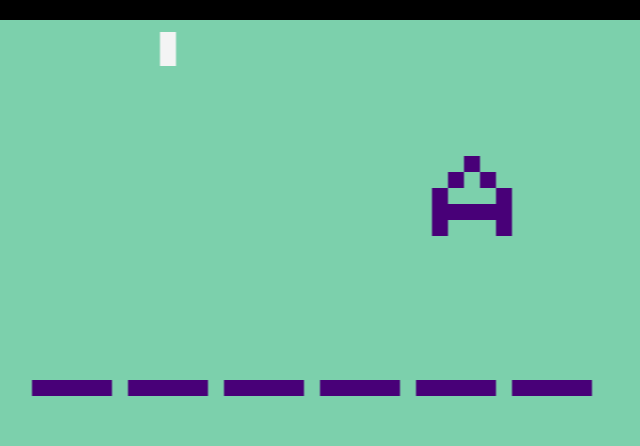
Alan Miller, who later co-founded Activision, wrote Hangman. It knows 510 words of up to six letters, split into four levels that run from first grade to high school. A wrong guess adds a piece to the gallows, and the figure hanging from it is a monkey rather than a person, which makes it a little less grim for children. You get 11 wrong guesses, and there is a two-player mode, so a parent and child can play together.
Peek-A-Boo (Atari prototype, 1984)
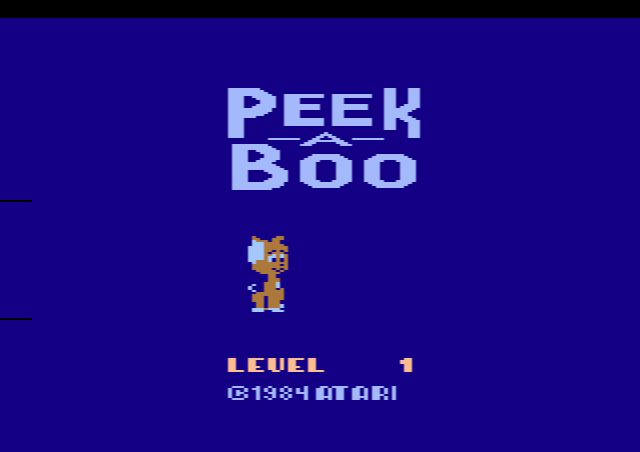
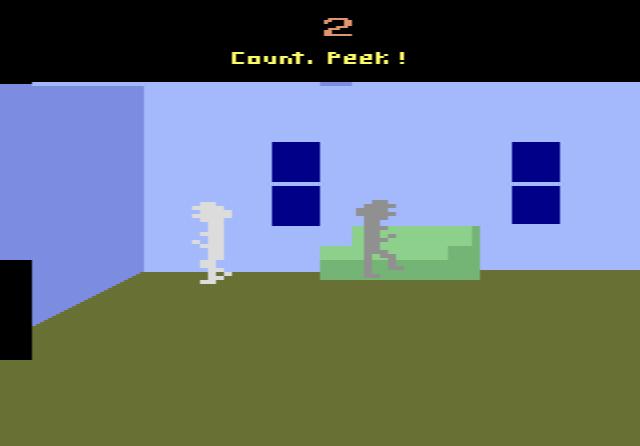
Peek-A-Boo was designed with the child psychologist Dr. Lee Salk for the youngest players, around the ideas of peek-a-boo and hide-and-seek. It was never sold: by 1984 the collapsing market had no room for a game aimed at such a small audience. The prototype survives, and in our test the little character moved around with the arrow keys as expected. It is a curiosity more than a finished game, but it shows how far down in age Atari was trying to reach.
Friendly character games
Snoopy and the Red Baron (Atari, 1983)
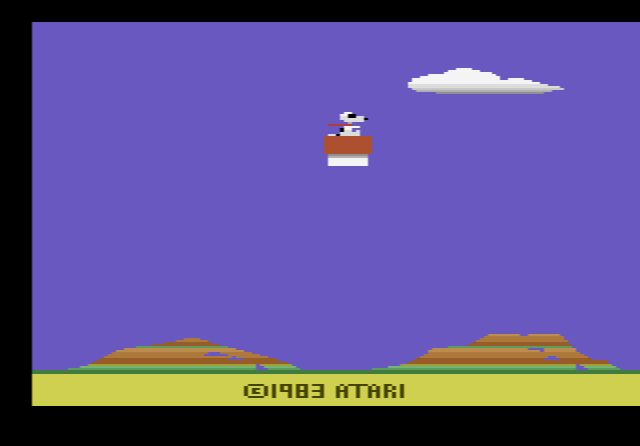
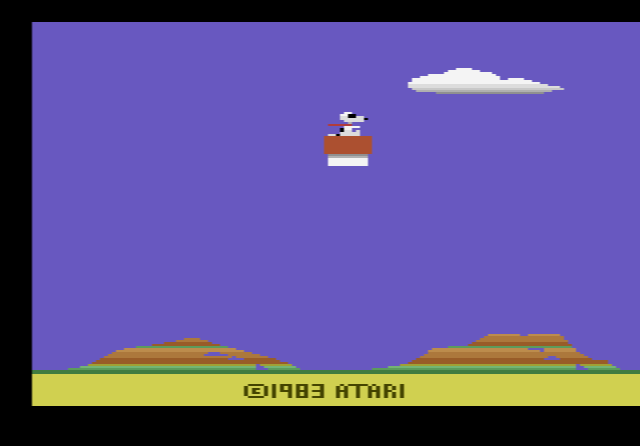
The first Peanuts video game puts Snoopy in his flying doghouse against the Red Baron, who has stolen the food supplies. Snoopy and the Red Baron is a dogfight, but a mild one: the Baron drops hamburgers, ice cream and popcorn for Snoopy to catch, and the danger is the skull and crossbones he drops too. For children, choose game 4 with F11. It is an easy version meant for young children and beginners, while games 1 to 3 are medium, advanced and expert.
Smurf: Rescue in Gargamel’s Castle (Coleco, 1983)
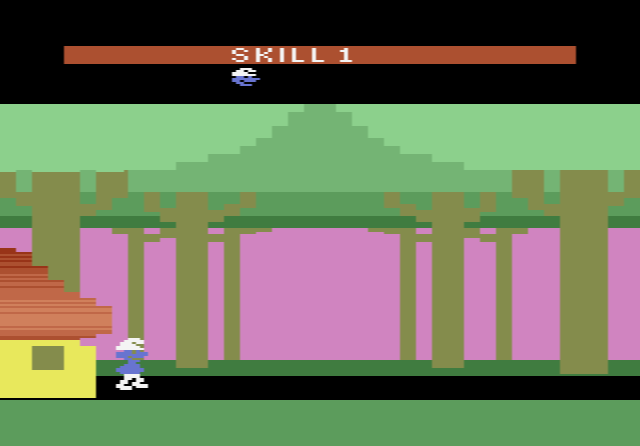
A Smurf walks from the village to Gargamel’s castle to rescue Smurfette, jumping fences, streams and rocks on the way. Smurf is colourful and the controls are simple: left and right to walk, up to jump. Skill 1 has no creatures at all, so a child can learn the jumps and see every screen without hawks, snakes or bats getting in the way. Choose the skill with F11 and confirm with Space. The jumps on the last screen are the trickiest, so it is a good place for a save state.
Sorcerer’s Apprentice (Atari, 1983)
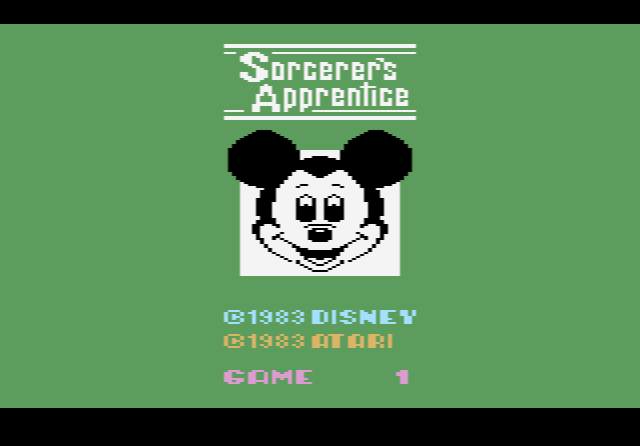
Based on the Mickey Mouse segment of Disney’s Fantasia, Sorcerer’s Apprentice has two screens. On the first, Mickey shoots at or catches objects falling from the sky; on the second, he runs up and down stairs to stop an army of marching brooms before they flood the room. Peter Niday designed and programmed it. Reviews were mixed: TV Gamer recommended it to young players and Disney fans, while Video Games magazine found it weaker than Atari’s other children’s games.
Pigs in Space (Atari, 1983)
This Muppets cartridge, designed by Michael Sierchio in collaboration with Jim Henson, is really three small games. In Pigs in Space, Chickenvaders is a Space Invaders-style shooter with sausages and egg-dropping chickens, Pastaroids has Miss Piggy dodging flying pasta in the style of Frogger, and the third game sends the Swinetrek through tunnels. Short, silly games like these suit children who get bored quickly.
Donald Duck’s Speedboat (Atari prototype, 1983)
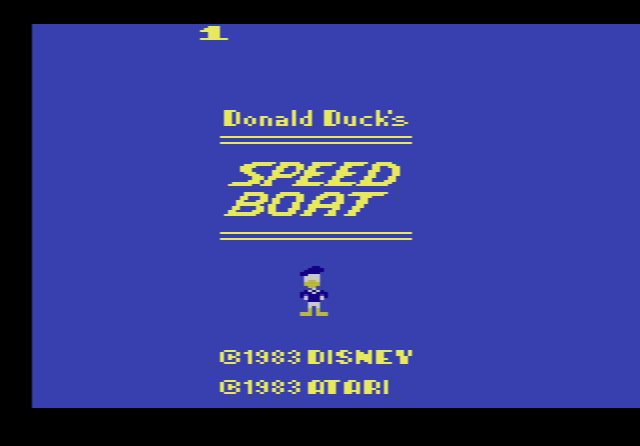
Donald steers a speedboat through obstacle courses on the water and wins a bronze, silver or gold cup depending on his time. According to AtariProtos, Donald Duck’s Speedboat was designed so that children could go slowly and carefully while older players hold the throttle down for a high score. Suki Lee programmed it, and it was cancelled so late that promotional material had already gone out. A cartridge once thought to be a Brazilian release turned out to be a modern forgery, so the game was never officially sold anywhere.
Games to play together
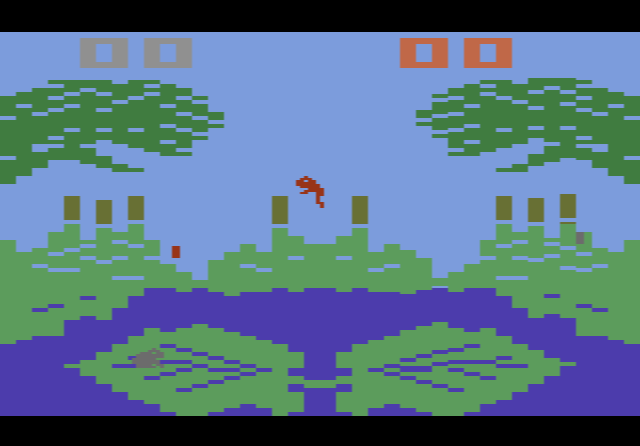
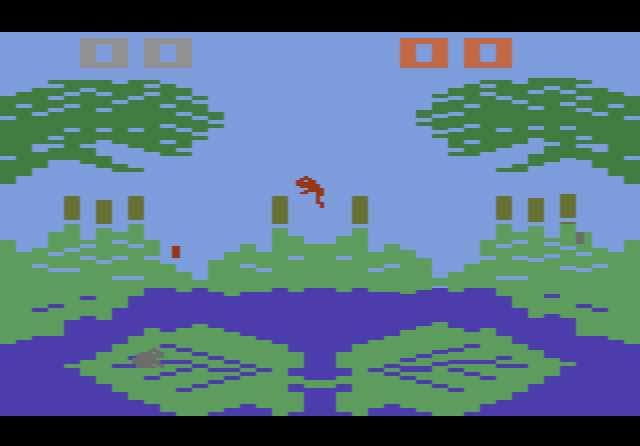
- Frogs and Flies (M Network, 1982): two frogs on lily pads catch flies for about three minutes while the sky turns from day to night. With the difficulty switch on B the frog jumps in a fixed arc, never falls in the water and sticks out its tongue by itself, so a small child only has to press a direction. If one player stops, the computer takes over their frog after 15 seconds.
- Sneak ‘n Peek (U.S. Games, 1982): hide-and-seek in a spooky old house with twenty hiding places. One player hides while the other looks away, just like the real game. Novice mode (switch on B) makes the hiding places bigger and easier to enter.
- Fast Food (Telesys, 1982): a giant mouth gobbles flying burgers and fries and must avoid the purple pickles. It won a Certificate of Merit as the most humorous home arcade game at the Arkie Awards, and missing food costs nothing, so there is little to be frustrated about.
The Sesame Street games: made for a controller we cannot emulate
In 1983 and 1984 Atari and the Children’s Computer Workshop, part of the team behind Sesame Street, released a series of learning games for young children. Alpha Beam with Ernie teaches letter matching, Cookie Monster Munch and Big Bird’s Egg Catch practise counting and collecting, and Oscar’s Trash Race works on numbers and directions. They were built for the Kid’s Controller, a 12-key pad with big soft buttons and picture overlays.
We have to be honest here: the emulator on this site has no keypad emulation. When we tried these four games, and the unreleased Grover’s Music Maker, with the arrow keys and Space, none of them got past the title screen. They are on the site for preservation and curiosity, but if you want a game a small child can actually play, choose one from the lists above.
A few things parents should know
- Not everything in the library is for children. The 2600 era also produced horror film tie-ins, such as The Texas Chainsaw Massacre, and a handful of adult cartridges. Check a game’s page before you hand over the keyboard.
- Some licensed children’s games are hard. The unreleased Cabbage Patch Kids game was adapted from an action game and is surprisingly tough, and Atari’s Dumbo’s Flying Circus prototype is known for being difficult. Start with the easy settings described above.
- Short sessions work best. Most games here last a few minutes a round. That makes it easy to stop after one more go.
Two more friendly prototypes are worth a look once a child has the hang of the keys: Bugs Bunny, in which Bugs steals carrots from Elmer Fudd and dives for cover, and Garfield, an unfinished platform game in which the lazy cat hops across fences and rooftops on his way to Nermal.