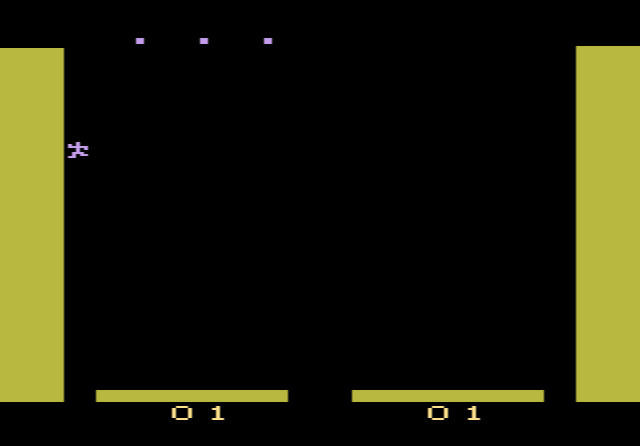
Mazes suited the Atari 2600. The console drew its playfield as a pattern of blocks, perfect for corridors and walls, and a maze gives a simple game a lot of room: routes to learn, corners to hide behind, enemies to lure away. Puzzle games were rarer, because a machine with 128 bytes of memory struggles to think, but a few clever ones exist. This list covers the best of both, from chase games to a Rubik’s Cube you solve with a joystick. All of them are joystick games unless we say otherwise, and all of them run here in your browser.
Maze chase games
Pac-Man set the pattern: clear a maze while enemies hunt you. The best 2600 games of this kind each add one idea of their own.
Ms. Pac-Man (Atari)
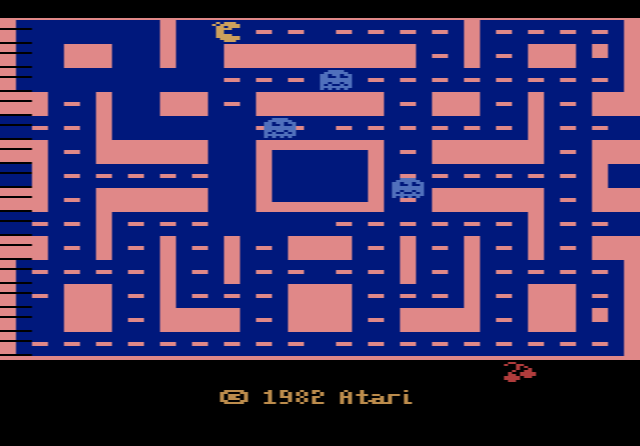
If you want the classic maze game on the 2600, play Ms. Pac-Man. General Computer Corporation’s version has far less flicker than the 1982 Pac-Man cartridge, and it tied for Videogame of the Year at the 1983 Arcade Awards. The game variations let you choose how many ghosts chase you: the “Cherries” games use all four, the “Bears” games one to three, which makes it a good game for younger players too. Wait next to an energy pill until the ghosts come close, then eat it.
Lock ‘n’ Chase (M Network, 1982)
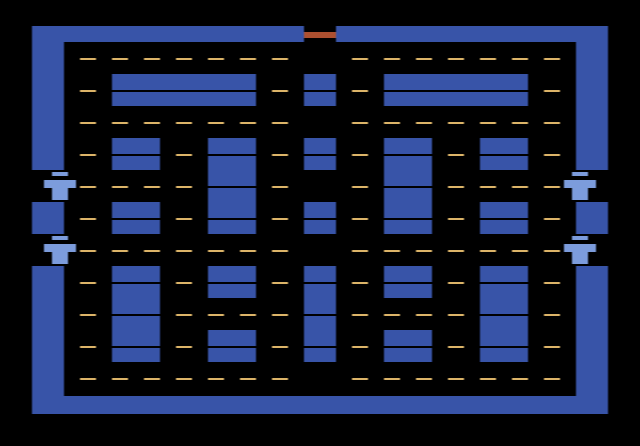
Lock ‘n’ Chase, based on Data East’s arcade game, makes you the thief. You collect gold bars in a bank vault while four police officers chase you, and the button slams a door behind you. Only two doors can be shut at once and they reopen after a few seconds, so each one has to count. Trap an officer between two doors and you earn 2,000 points. Just check that you have not locked yourself in.
Mouse Trap (Coleco, 1982)
In Mouse Trap you are a mouse eating cheese while cats prowl the maze. Holding the button opens and closes the maze’s doors, which changes the paths for everyone, and a tap turns you into a dog for a moment if you have eaten a bone, so you can chase the cats instead. The home version has three cats instead of the arcade’s six. One unusual detail: the console’s colour/black-and-white switch makes the maze invisible. Press F2 in the emulator if you want to play from memory.
Jawbreaker (Tigervision, 1982)
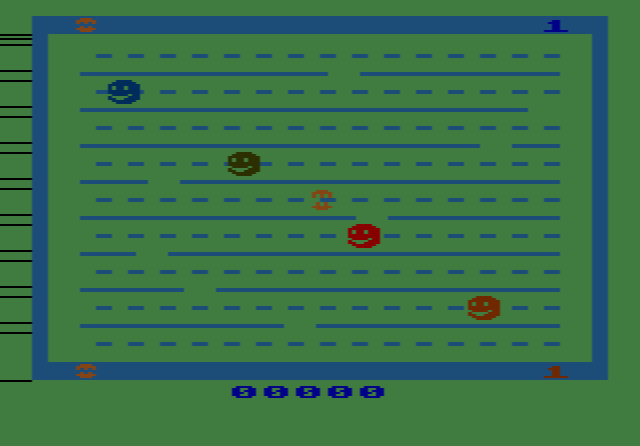
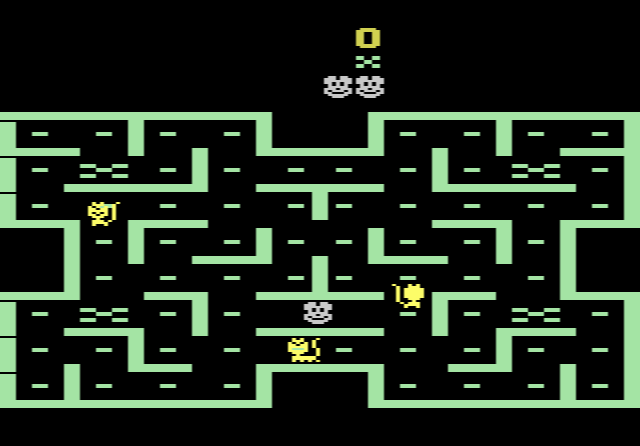
John Harris’s Jawbreaker is not a copy of his computer game of the same name. The 2600 could not draw that maze, so he built a new one: horizontal rows of candy separated by walls with sliding gaps. You steer a set of chomping teeth, time the gaps to change rows and avoid the smiling faces, and a vitamin pill appears three times per screen so you can eat them. The graphics are smooth and flicker-free, rare for a 1982 maze game. Hold Space to stop and wait beside a gap instead of running past it.
Lady Bug (homebrew, 2006)
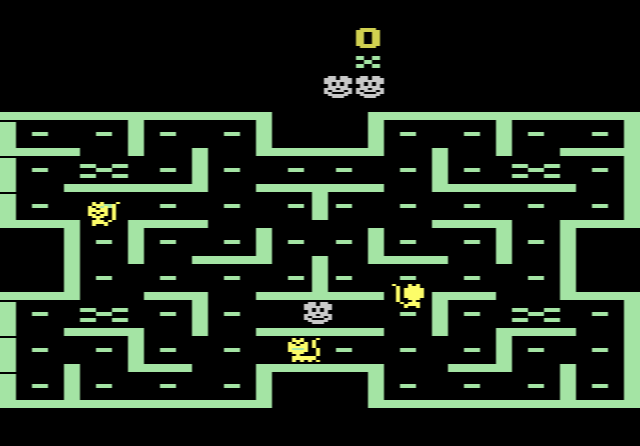
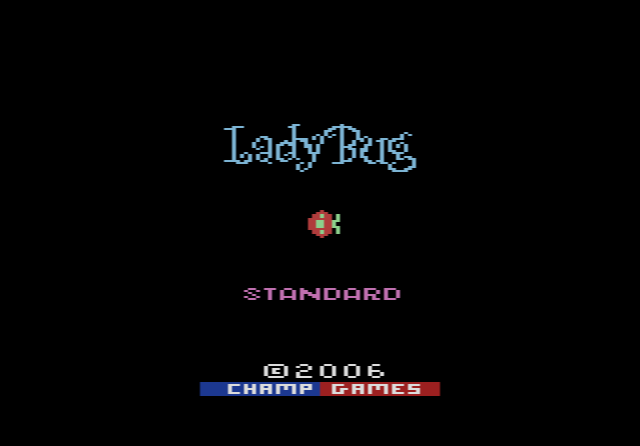
Coleco announced a 2600 version of the arcade Lady Bug in 1982 and never released it. John W. Champeau wrote one from scratch more than twenty years later. The idea that sets it apart is the green gates: they turn when you push through them, so you reshape the maze as you run, shutting a path behind you to block the insect on your tail. Collect the right letters to spell EXTRA and SPECIAL for bonuses. AtariAge reviewers praised how close it comes to the arcade game.
Mazes to explore and escape
Maze Craze (Atari, 1980)
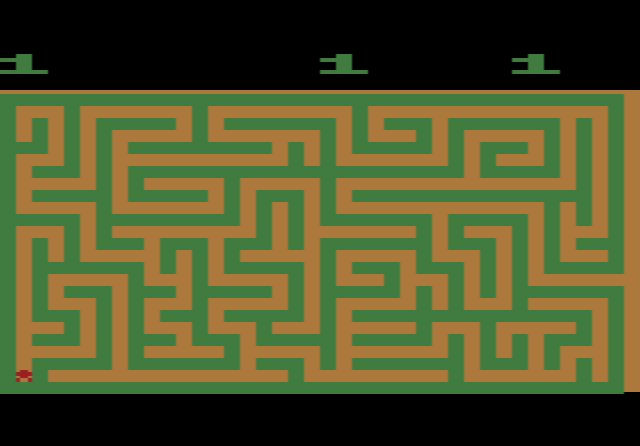
Rick Maurer, who also made the 2600 Space Invaders, built Maze Craze around a simple race: two police cars start on one side of a maze and the first to reach the exit wins. The maze is generated at random for every game, so you can never learn it. The variations add robbers that wander the corridors, invisible mazes where you can only “peek” now and then, and blockades that drop a fake dead end in your opponent’s way. It is a two-player game at heart; the second player uses T/F/G/H in the emulator. Set a difficulty switch to A to slow one car down as a handicap.
Entombed (US Games, 1983)
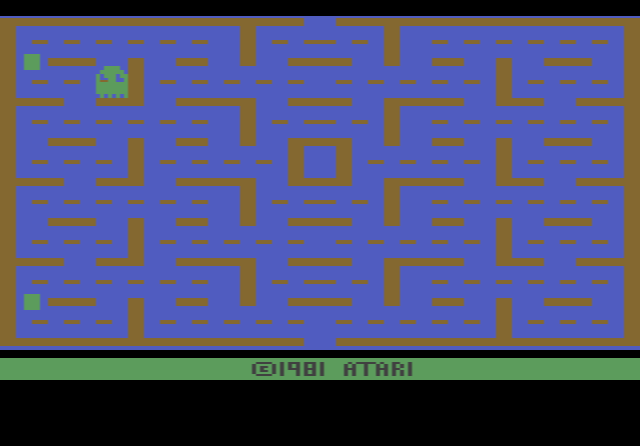
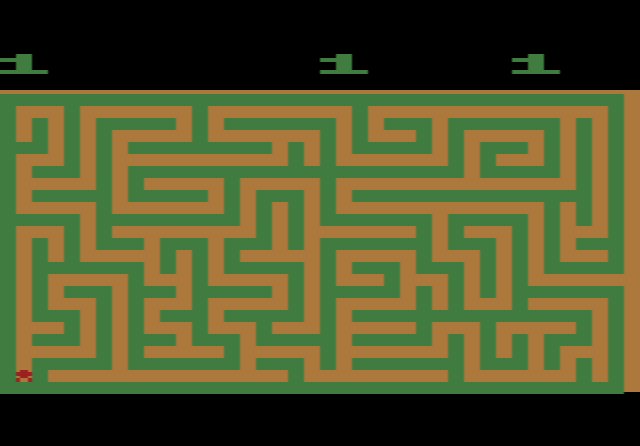
Entombed is a maze that never ends. You are an archaeologist in a tomb whose maze keeps scrolling upward, and you have to keep finding a path through it while zombies wander the corridors. If you are stuck, press Space with a direction to use a “make-break”, which breaks a wall or builds one; you get three on difficulty B and two on A. The manual’s advice: the early mazes scroll slowly, so there is no need to rush.
The game became famous decades later. In 2019 John Aycock and Tara Copplestone published a study of how Entombed builds its maze. Each new square depends on five neighbouring squares, which are looked up in a small table of 32 values that seem to have been chosen by hand, and the researchers could not explain how anyone arrived at them. The paper credits the maze routine to Paul Allen Newell and Duncan Muirhead, and the game’s code to Steve Sidley. Sidley recalled that the routine came from someone who was “drunk and whacked out of his brain”; Newell remembered it as a problem he and Muirhead worked out after going out for a beer.
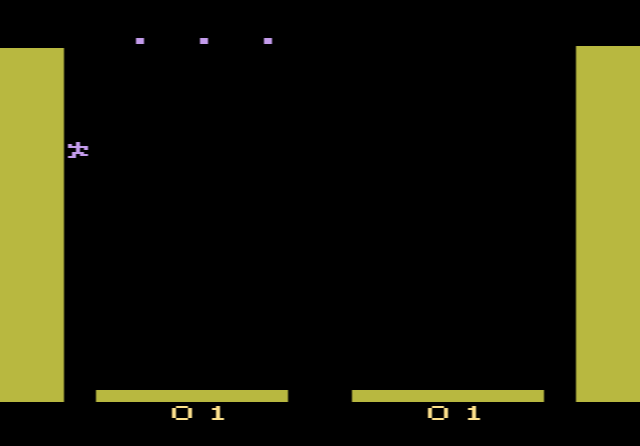
Tunnel Runner (CBS Electronics, 1983)
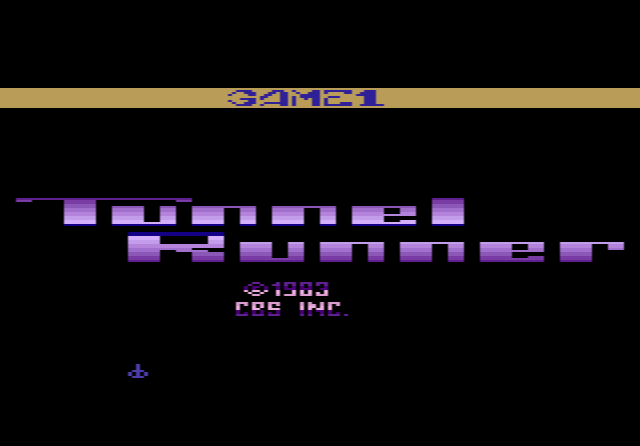
Tunnel Runner puts you inside the maze. You run through first-person 3D corridors, find a key, and reach an exit before the timer runs out, while creatures called Zots hunt you. You have no weapon, and in later mazes the walls turn black and only the floor is visible. The cartridge carried extra memory, sold by CBS as “RAM Plus”. Game 1 uses the same mazes every time, so you can learn them; Game 2 makes new ones at random. Hold Space to see the map, and listen: you hear a Zot before you see it.
Haunted House (Atari, 1982)
In Haunted House the maze is a dark mansion. You are a pair of eyes, you light matches to see the rooms around you, and you search four floors for the three pieces of an urn while a bat, tarantulas and a ghost hunt you. Electronic Games found it much more atmospheric than Adventure, and it is often mentioned as an early survival horror game. Find the sceptre first: while you carry it, the creatures cannot hurt you (except the ghost in game 8).
Puzzle games
Boulder Dash (homebrew, 2011)
This Boulder Dash is a modern homebrew by Andrew Davie and Thomas Jentzsch, released in a run of 250 cartridges, and it is one of the most technically ambitious things ever written for the console. You dig through caves collecting diamonds, and every tunnel you dig can bring a boulder down on your head. The creatures are puzzles too: drop a boulder on a butterfly and it turns into diamonds. According to its makers it includes all 16 caves and 4 intermissions of the 1984 original.
Pengo (Atari, 1984)
Pengo is a maze game where you build the maze yourself. You are a penguin on a field of ice blocks; kick a block and it slides until it hits something, crushing any Sno-Bee in the way. Line up two or three Sno-Bees and one block gets them all, for up to 3,200 points. Push the three jewel blocks into a row for a bonus of 5,000, or 10,000 if the row is away from the walls. It came out in 1984, in the middle of the video game crash, so the cartridge is fairly rare today.
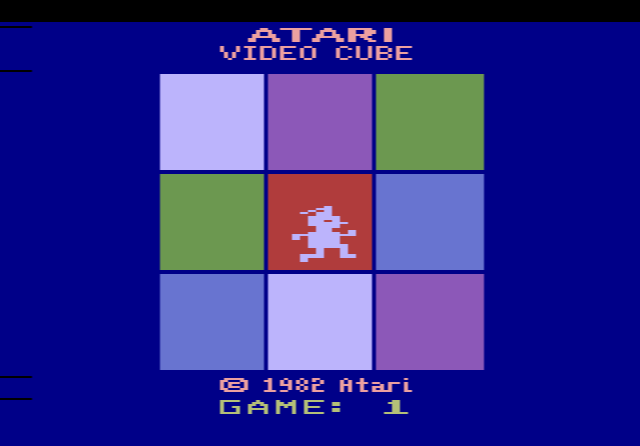
Atari Video Cube (Atari)
Atari Video Cube is the Rubik’s Cube on a TV screen. Instead of twisting layers, a little character called Hubie the Cube Master picks up coloured squares and swaps them around until each face of the cube is one colour. He cannot step onto a square of the colour he is carrying, which is where the thinking comes in. There are 18 game variations, including smaller and easier cubes, a hidden-cube mode and demonstrations where the computer solves it. The move counter at the bottom tells you how efficient you were.
Klax (Atari, 1990)
Klax was one of the very last 2600 games. Coloured tiles tumble down a conveyor belt, you catch them on a paddle, and you drop them into a bin to make rows of three of the same colour. It has 100 waves and a continue option. It was only released in PAL form, in the UK; the NTSC version on this page comes from surviving prototypes. The manual’s tip is to go for complicated Klaxes early.
Board games: Othello and 3-D Tic-Tac-Toe
Atari’s board game cartridges are slow by modern standards, but two of them are still good company. Othello has three computer levels (games 1 to 3) and a two-player game 4. The old advice from the manual still holds: a piece on a corner square can never be flipped, so fight for the corners. 3-D Tic-Tac-Toe, by Carol Shaw, plays noughts and crosses on a 4×4×4 cube with 76 ways to win. Games 1 to 8 are against the computer, which can think for many minutes at its hardest level, and game 9 is for two players. The way to win is to make two threats at once.
One that does not work here
Hunt & Score is a memory game in the style of Concentration: turn over squares and find matching pairs. It is a proper puzzle game, but it needs Atari’s keypad controllers, and the emulator does not emulate keypads, so you cannot play it properly in the browser. We mention it so you do not go looking for it and wonder why the keys do nothing.
Where to start
If you want a maze game you can pick up in seconds, start with Ms. Pac-Man or Lady Bug. For something tense and strange, try Tunnel Runner with the sound on. For a real puzzle, Boulder Dash will keep you busy for weeks. And for two people, Maze Craze’s random mazes make every race different. The emulator’s save states (Ctrl+0–9 to save, Alt+0–9 to load) are handy in the longer puzzles: save before a risky move in Boulder Dash and you can try it again without starting the cave over.