The Atari 2600 was built for two. It had two joystick ports from day one, and several of its 1977 launch cartridges, Combat among them, had no computer opponent at all. Many of the console’s best evenings were spent side by side on a sofa, and that still works today: on AtariOnline.org two people can play on one keyboard, in the same browser window. This list covers the games that are most fun with a second player, grouped by the kind of fun they offer, and every one of them was checked against its original manual.
How two people share one keyboard
The emulator gives each player their own side of the keyboard:
- Player 1: arrow keys to move, Space to fire.
- Player 2: T (up), F (left), G (down), H (right), and A to fire.
- Shared console switches: F12 is Reset (start the game), F11 is Select (choose the game number), F4 and F9 are the Player 1 and Player 2 difficulty switches.
Paddle games work too. The emulator switches to paddle mode by itself and handles two paddles: Player 1 turns the dial with the left and right arrows and presses Space, Player 2 uses F and H with A as the button. If a game picks the wrong controller, Alt+L switches between paddles and joysticks.
Two practical points. Player 1 sits on the right of the keyboard and Player 2 on the left, which feels backwards when the game puts Player 1 on the left of the screen; just swap seats. And many keyboards drop key presses when several keys are held at once. If one player’s moves start to vanish in a hectic game, plug in a gamepad for one of you: the emulator makes the first pad Player 1 and a second pad Player 2.
One more thing to know before you start: “two players” meant two different things on the 2600. In simultaneous games both players are on screen at once. In alternating games you take turns, like passing a pinball machine back and forth. Most of the games below are simultaneous; the turn-taking ones are grouped at the end.
Head-to-head duels
Combat (Atari, 1977)
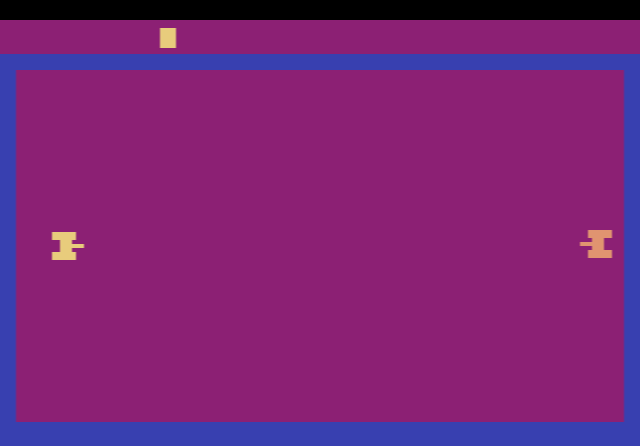
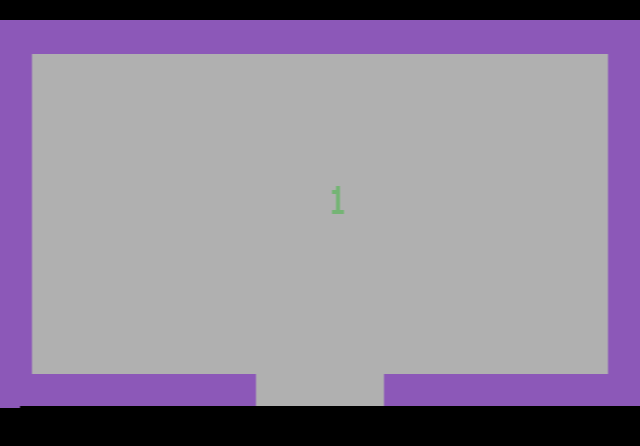
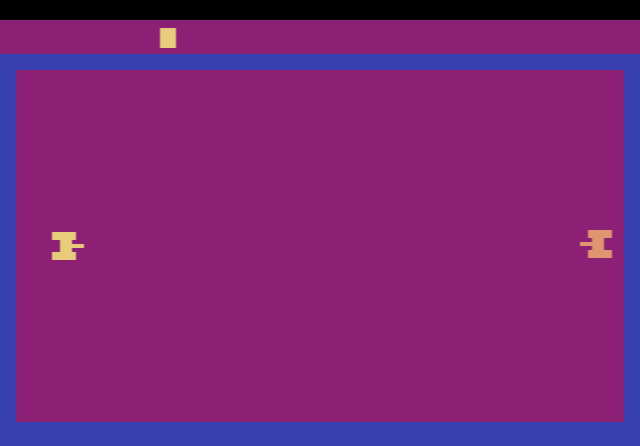
Combat came in the box with most 2600 consoles until 1982, and it is still the purest two-player game on the machine. Tanks, biplanes or jets, 27 variations, and whoever lands more hits in 2 minutes 16 seconds wins. The Tank-Pong games, where shots bounce off walls, are the ones people remember. There is no computer opponent, so you need a friend. The difficulty switches shorten one player’s missiles, a fair handicap if one of you is much better.
Outlaw (Atari, 1978)
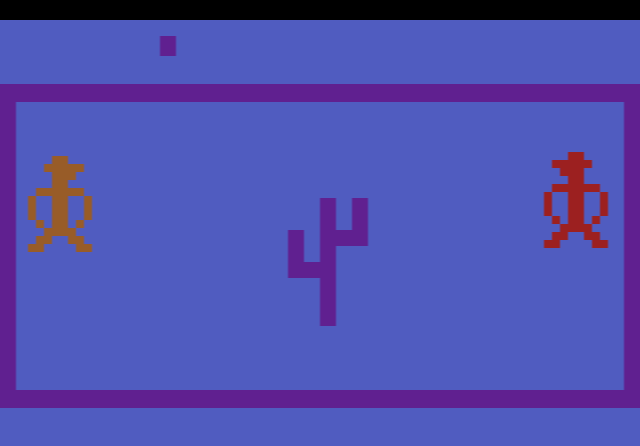
David Crane’s Outlaw is a western shootout with a cactus, a wall or a stagecoach between two cowboys. Hold the button to raise your gun, tilt it up or down, and let go to fire; angled shots bounce off the top and bottom of the screen, which is how you hit someone hiding behind cover. First to 10 hits wins. Games 1 to 12 are the two-player duels. Creative Computing wrote that two-player sessions caused “convulsive laughter”, and that has not changed.
Surround (Atari, 1977)
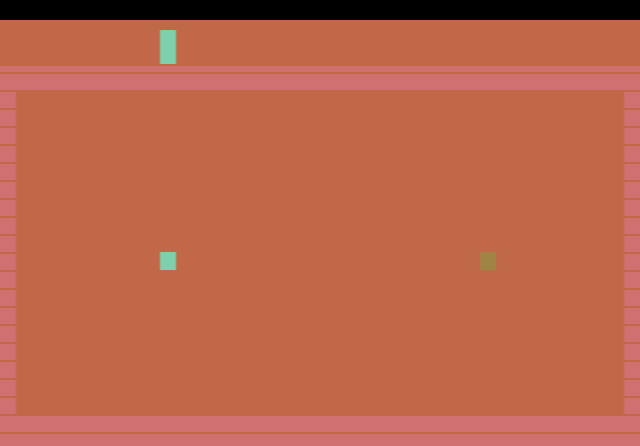
Surround is the game many people now know as “snake” or light cycles. Each player leaves a solid trail behind them, and whoever crashes into a wall or a trail first loses the point. First to 10 wins. The later variations speed things up and allow diagonal moves, and those are the most competitive. Games 13 and 14 are Video Graffiti, a drawing mode, if you need a break.
Slot Racers (Atari, 1978)
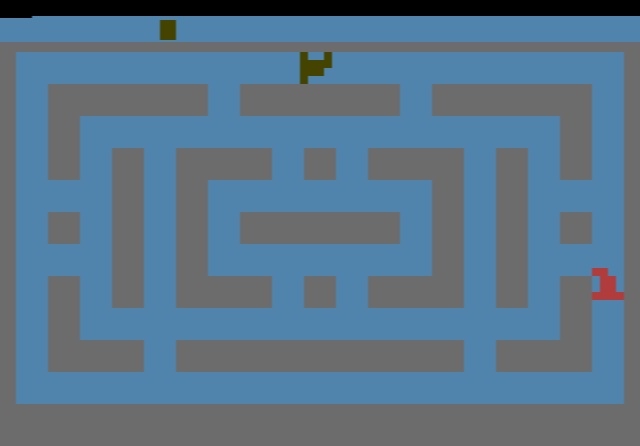
Warren Robinett made Slot Racers just before he made Adventure. Two cars drive around a maze, and the missiles they fire turn every corner by themselves (except in games 8 and 9), so a shot can chase you around the block. Each hit is a point, and the first to 25 wins. It is for two players only, and it rewards knowing the maze better than your opponent does.
Boxing (Activision, 1980)
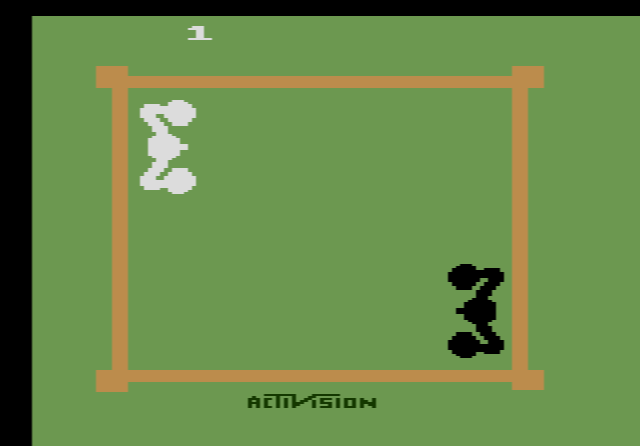
Bob Whitehead’s Boxing shows the ring from above. A long jab scores 1 point, a punch up close scores 2, and 100 points is a knockout; otherwise the higher score after two minutes wins. Choose Game 2 with F11 for two players. The trick is to drive your opponent onto the ropes with jabs, then move in close.
Two paddles, one screen
Warlords (Atari, 1981)
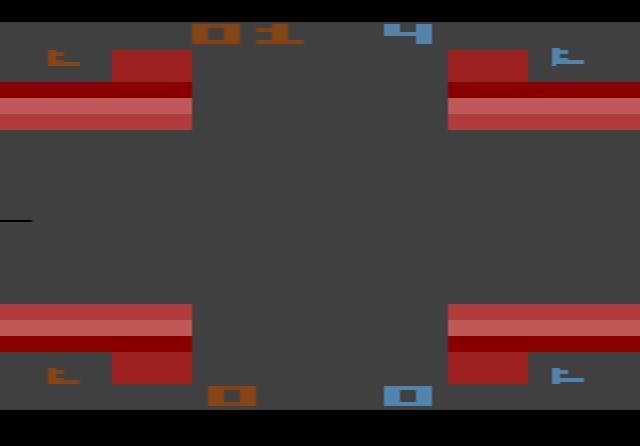
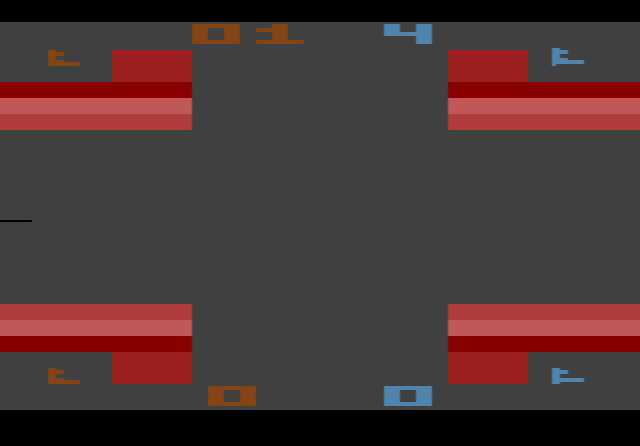
Warlords is the best party game on the console. Four castles sit in the four corners, each guarded by a shield, and a fireball smashes through their walls. It was designed for four players with two pairs of paddles. The emulator handles one pair, but the manual says the computer runs any shield without a human player, so two of you play against two computer warlords. The last warlord standing wins the battle, and five battles win the war. It won “Best Pong Variant” at the 1982 Arkie Awards.
Video Olympics (Atari, 1977)
Video Olympics packs 50 Pong-style games onto one cartridge: Pong itself, hockey, soccer, volleyball, basketball and more. The paddle button adds special moves, such as a speed-up or a catch, depending on the game. Skip the four-player games, which need a second pair of paddles, and the one-player Robot Pong games 1 and 2; everything else is a two-player match to 21 points. Set a difficulty switch to A to give the stronger player a half-size paddle.
Play together, or against each other
Joust (Atari, 1983)
The arcade Joust was designed as a two-player game, and the 2600 version keeps that. One knight rides an ostrich, the other a stork, and when two riders collide the higher one wins. The game keeps asking whether you are a team: a Team wave pays 3,000 points to both players if neither unseats the other, while a Gladiator wave pays 3,000 to whoever unseats the other first. Choose a two-player game with F11. Player 2 flaps with A and steers with F and H.
Mario Bros. (Atari, 1983)
In Mario Bros. both brothers are on screen at once, clearing pests out of the pipes by punching the floor under them and kicking them away. You can help each other, or you can punch a flipped turtle back onto its feet just before your brother kicks it. Even-numbered games are the two-player ones; Game 4 gives five lives and no fireballs, the gentlest start.
Wizard of Wor (CBS Electronics, 1982)
In Wizard of Wor two Worriors walk through the same dungeon mazes at the same time, shooting monsters. You can clear the dungeon as a team, but the manual also pays 1,000 points for shooting the other player, so trust is part of the game. It is at its best with two players.
Dark Chambers (Atari, 1988)
Dark Chambers is the 2600’s answer to Gauntlet: a fully co-operative dungeon crawl through 26 levels, lettered A to Z. Neither player can walk off the screen without the other, so you have to move as a pair. If one hero falls, the keys pass to the survivor and the fallen partner comes back on the next level.
Space Invaders (Atari, 1980)
Space Invaders has an unusual set of two-player modes among its 112 variations. You can take turns, or play at the same time and compete for the same invaders. There are also team games in which both players share one cannon: in one, each player can only move it in one direction; in another, one steers while the other fires. The shared-cannon games are the ones to try.
Races and contests
- Freeway (Activision, 1981): two chickens race across ten lanes of traffic, and the most crossings in 2 minutes 16 seconds wins. Each player has their own difficulty switch, so a stronger player can take the setting that knocks them all the way back to the curb. Player 2 only needs T and G.
- Fishing Derby (Activision, 1980): two anglers on opposite piers, the first to 99 pounds of fish wins. The biggest fish swim deepest, and a shark snaps up any catch that touches it. When both of you have a fish on the line, only the one who hooked first can reel in, so timing matters. Game 2 is the two-player game.
- Dragster (Activision, 1980): a side-by-side drag race. Space is the gas pedal, the left arrow is the clutch, and you shift up through four gears without blowing the engine. The left joystick drives the top car and the right joystick the bottom one. A race takes a few seconds, which makes it perfect for “best of ten”.
- Frogs and Flies (M Network, 1982): two frogs on lily pads leap for flies until night falls, about three minutes. Relaxed, and a good pick for players of very different ages.
- Sky Diver (Atari, 1979): two planes cross the screen in opposite directions, and you jump, open your parachute as late as you dare and try to land on the pad. It needs two players.
- Dodge ‘Em (Atari, 1980): in Game 3 one player collects dots while the other drives the crash car, and the roles swap after every crash.
Sports for two
These sports cartridges all have a computer opponent too, but they are at their best against a person:
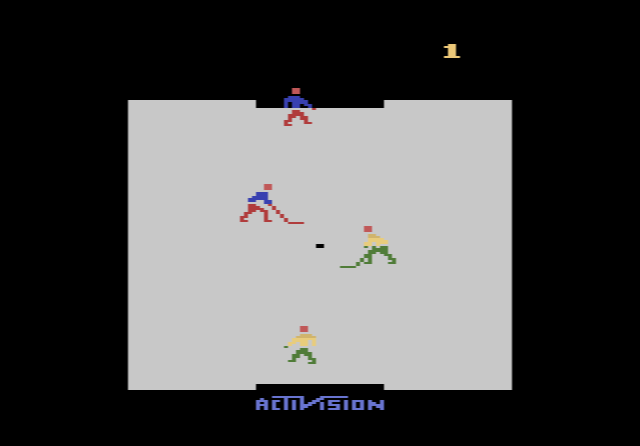
- Ice Hockey (Activision, 1981): two-on-two, and you always control the skater nearest the puck. Games 2 and 4 are for two players. Fast and noisy, in a good way.
- Tennis (Activision, 1981): real tennis scoring and no swing button; where the ball meets the racket decides the angle. Games 2 and 4 are two-player, and Game 4 is in slow motion for beginners.
- RealSports Volleyball (Atari, 1982): two-on-two beach volleyball, first to 15 with a two-point lead. Games 2 and 4 are for two players.
- Basketball (Atari, 1978): one-on-one with a four-minute clock. Game 1 is the two-player game.
- Football (Atari, 1978): two players only. Both of you secretly pick a play before each snap, so it is as much a guessing game as an action game.
- Pelé’s Soccer (Atari): four players a side; games 1 to 27 are the two-player ones.
Taking turns
These games are for one player at a time, but they have proper two-player modes where you alternate and compare scores. They are good when only one of you wants to hold the controls at a time:
- Kaboom! (Activision, 1981): Game 2 is two players taking turns against the Mad Bomber. It is a paddle game, so Player 2 catches bombs with F and H.
- Human Cannonball (Atari): set the angle and speed, fire, and hope the performer lands in the water tower. First to 7 points wins.
- Crackpots (Activision, 1983): push flowerpots off a rooftop ledge onto bugs climbing the building. Game 2 is for two players taking turns.
Where to start
For a quick first game, try Combat’s first tank variation: nothing to learn, two minutes long, and it tests whether your keyboard copes with two players at once. If you want to play on the same side, start Joust or Mario Bros. And if there are more of you, Warlords with two humans against two computer castles is the closest you get to the original four-player chaos. Everything here runs in your browser; open a game, pick the two-player variation with F11, press F12, and play.