
Browse the archive for a while and you will find pairs like Klax (NTSC) and Klax (PAL), or Astrowar (USA) and Astrowar (Europe). They are not duplicates. In the 1970s and 1980s televisions in America and Europe worked differently, and a 2600 cartridge had to be written for one system or the other. This article explains what really changes between the two versions, why some games only came out in one of them, and which one to pick when you play here.
Two TV systems, one console
Three colour TV standards shared the world when the 2600 was on sale:
- NTSC: 525 lines and 60 Hz, used in North and Central America, Japan, South Korea and the Philippines
- PAL: 625 lines and 50 Hz, used in most of Europe
- SECAM: the same line count and frequency as PAL but a different way of sending colour, used in France
Most consoles can hide some of this from the programmer. The 2600 cannot. It has no screen memory, so the game itself has to build every frame line by line, timing each line as the TV beam sweeps across the screen. That means the game code, not just the console, decides what kind of signal comes out. An NTSC game draws 262 lines per frame, 60 times a second; a PAL game draws 312 lines, 50 times a second. Inside the console, the only chip that differs between NTSC and PAL machines is the TIA, the graphics and sound chip. SECAM consoles used an extra adapter board to convert the output.
What actually changes between the versions
| NTSC | PAL | |
|---|---|---|
| Frames per second | 60 | 50 |
| Lines per frame drawn by the game | 262 | 312 |
| Typical visible game area | 192 lines | 228 lines |
| Colours available | 128 | 104 |
Speed
Many 2600 games count time in frames: a sprite moves a pixel per frame, a note lasts ten frames, a timer ticks every sixty frames. Run the same logic on a PAL console and there are only 50 frames each second, so everything moves, plays and counts at five-sixths of the speed, about 17% slower. Programmers could avoid this by adjusting movement and timers for PAL, and how carefully they did so varied from game to game. Music is where you notice it first, because a tune that is tied to the frame count simply plays slower.
Colours
The 2600 picks colours by number, and the same number produces a different colour on a PAL TV than on an NTSC one. NTSC gives 128 colours, PAL 104, and SECAM only 8. A proper PAL conversion therefore has to go through the game and choose new colour values so that the sky is still blue and the grass still green. Norbert Landsteiner, who documented his own 2600 project, gives an example: a border colour stored as $64 in his NTSC build had to become $C4 in the PAL build to look the same. This is also why plugging a cartridge into the wrong console gives wrong or missing colours, and often a picture that rolls because the TV cannot lock on to the signal.
Screen layout
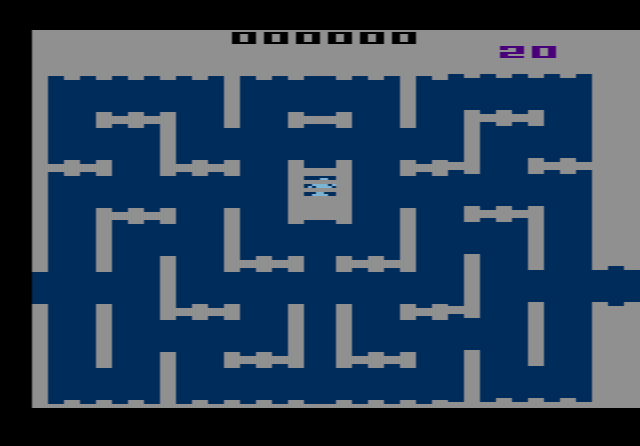
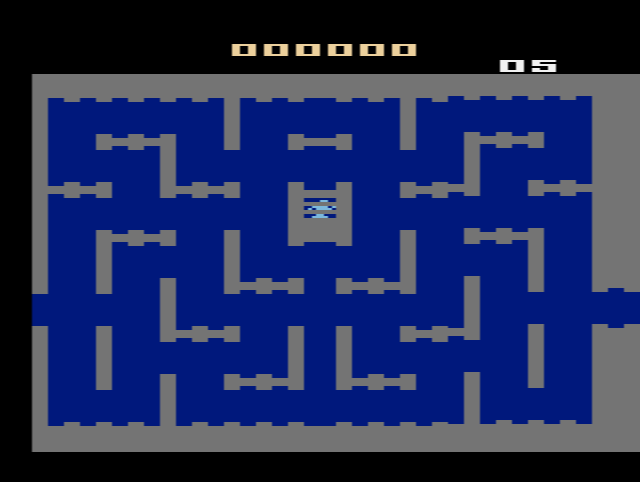
PAL frames have 50 more lines, which gives a converted game extra room or, if nobody adjusts it, empty bands at the top and bottom. Sometimes the extra room was used. Night Stalker, the PAL release by Telegames of M Network’s Dark Cavern, moves the score, lives and bullet counters above the maze instead of inside it, according to AtariMania.
Why some games exist in two versions on this site
The version pages on AtariOnline.org fall into a few groups.
Late games that only came out in Europe
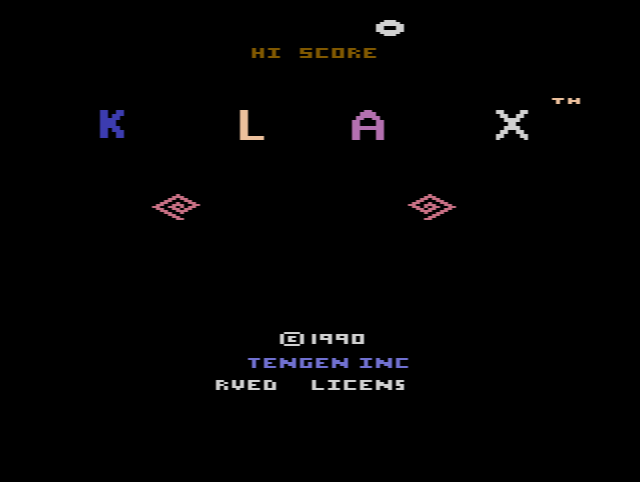
The 2600 stayed on sale in Europe after the American market had moved on, so some of the last official games were PAL-only. Klax, Atari’s conversion of the 1990 falling-tiles puzzle game programmed by Steve DeFrisco, was released in the UK in mid-1990 in PAL format only. It is often called the last 2600 game Atari developed and released. AtariProtos reports that Best Electronics later found nine NTSC prototypes of the finished game, which shows an American release was planned before the market made Atari change its mind. That is why the site has both builds.
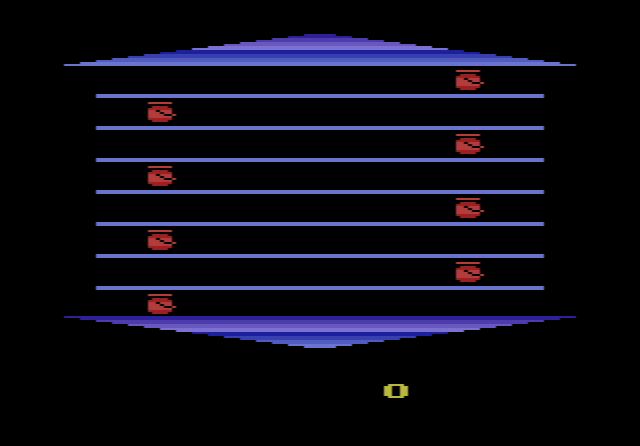
Fatal Run, Steve Aguirre’s post-apocalyptic driving game, is the same story: it was only released in Europe, in 1990, and it was Atari’s only 32K game for the 2600. A single NTSC prototype is known to exist. Ghostbusters II went further. Activision cancelled its 2600 version, and the British publisher Salu released it in Europe only, in 1992.
Same game, new name for Europe
Some conversions changed more than the colours. An American licence meant little in Europe, so the game was re-dressed with a character European buyers knew:
- Asterix is Steve Woita’s Taz with new graphics, made for Europe, where the French comic was popular. AtariProtos notes that Taz came out only in NTSC and Asterix in PAL, with just a limited NTSC run of Asterix.
- Action Force is the European release of Parker Brothers’ G.I. Joe: Cobra Strike, renamed after the Action Force toy line for the British market.
- Super Baumeister is listed on the site as the PAL release of Spectravision’s Master Builder.
- Night Stalker and Dark Cavern, described above.
Budget labels with separate NTSC and PAL releases
Taiwanese and European budget publishers often put out the same game under different names in different regions. Bit Corporation’s Phantom Tank, for example, is on the site both as Phantom Panzer, the PAL release sold by the German mail-order company Quelle, and as Tank Brigade, Panda’s NTSC release. Pairs marked USA and Europe, such as Mission 3000 A.D. and Mr. Postman, belong to the same world of small regional releases.
Homebrews built for every TV
Modern homebrew developers often ship one build per TV standard, so the whole community can play. The site has Lady Bug (NTSC) and Lady Bug (PAL) by John W. Champeau, both builds of K.O. Cruiser, Mean Santa and Squish ‘Em, and three builds of Walaber’s Wall Jump Ninja: NTSC, PAL and PAL60.
PAL60 is a compromise for PAL TVs that can also handle a 60 Hz signal, as most later sets can: PAL colours with NTSC timing. The game keeps its original 60 frames per second, so nothing slows down, while the colours still come out right on a PAL set.
NTSC and PAL in the browser emulator
Your monitor does not care about TV standards, so both versions play here. The emulator (Javatari) works out the standard on its own: after you load a game it counts how many lines each frame has, and a count around 262 means NTSC while a count around 312 means PAL. A short message such as “AUTO: PAL” appears on screen when it switches. It then uses the right palette and runs the game at the right pace, so a PAL game really runs at 50 frames per second, just like on a European console.
- Change the standard yourself: Alt + Q cycles from automatic to NTSC, to PAL and back to automatic.
- Not the same as F2: F2 is the console’s TV Type switch, colour or black-and-white. It does not change NTSC or PAL.
- Compare the two: open a PAL game, press Alt + Q until it says NTSC, and watch the colours change. Press it again to go back.
Which version should you play?
- For an American game with a later PAL conversion, play the NTSC version. It runs at the speed the designer tested.
- For a game that was only sold in Europe, such as Klax, Fatal Run or Ghostbusters II, the PAL version is the one people actually bought. Klax (NTSC) is interesting too, as the American release that never happened.
- For a renamed version, try both. Asterix and Taz play the same, so pick the character you prefer.
- For homebrews, the NTSC build is the safe choice in the browser. A PAL60 build runs at 60 frames per second, so automatic detection will most likely treat it as NTSC, and its colours may look slightly off.
A good first comparison is Dark Cavern and Night Stalker: the same maze game from two regions, where the different screen layout is visible straight away.