
Browse the AtariOnline.org archive for long enough and you will hit some odd titles: Farmer Dan, Busy Police, Dishaster, Phantom-Panzer. Many of them have only a line or two of text on their page, and some of them look very familiar once the game starts. That is because a large part of the Atari 2600 library was sold more than once, under different names, by different companies, in different countries. This guide sorts out which cartridge on the site is which, what each one is really based on, and which version you should play first.
Three kinds of “same game, different name”
It helps to separate three situations, because they are often lumped together as “bootlegs”:
- Licensed or official rebrands. A game made by one company and sold by another, often a retailer or a regional distributor, with a new title and label. The German mail-order giant Quelle, for example, sold Bit Corporation games with German titles.
- Regional releases. The same game converted between the PAL television standard used in most of Europe and the NTSC standard used in North America. A PAL cartridge and an NTSC cartridge need different ROMs, so each one is a separate dump and a separate page here.
- Unlicensed copies. Someone took another company’s ROM, changed the title screen or copyright text (sometimes not even that), printed a new label and sold it without permission. Many of these came from small Taiwanese manufacturers, and Brazil had a whole industry of them.
AtariMania’s database is the best tool for untangling this. Each entry lists “other versions with a different title”, and for copied games it often credits the original programmer, which is a strong clue that the code was not written from scratch. Most of the connections below come from those entries.
Bit Corporation: Taiwanese originals that travelled the world
Not every company in this story was a pirate. Bit Corporation was founded in Taipei in 1980 and made its own Atari 2600 games, sold under its own name and the Puzzy brand. Later it built console clones and the Gamate handheld, before closing in 1992. Its 2600 games were original designs, but they were licensed, relabelled and copied so often that one game can have more than twenty names.
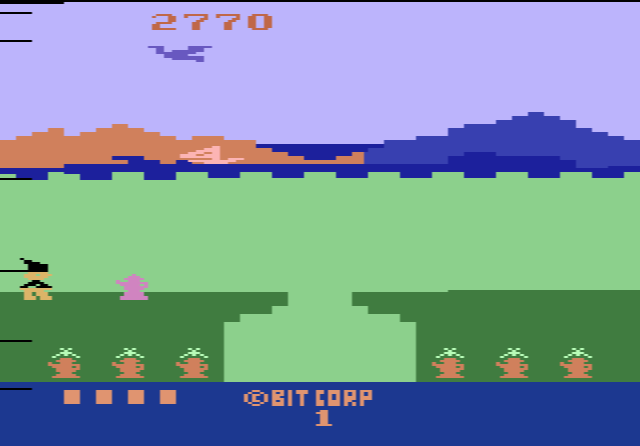
The best known is Bobby Is Going Home, a cheerful side-scrolling walk home that many players compare to Pitfall!. AtariMania lists 23 releases under that title alone, most of them Brazilian, plus 26 more under other names. The site also has the German Bobby geht Heim. Other Bit Corporation games and their aliases on the site:
- Open Sesame, an Ali Baba platformer with a digitised “Open, Sesame!” voice sample, became I Want My Mommy in North America and also appears on the site as Apples and Dolles. Home Vision sold it as Teddy Apple.
- Dancing Plate, a plate-spinning juggling game, is the same game as Dishaster. Other names include Mr. Chin, Plate Mania and Tanzende Teller.
- Space Tunnel, a vertical shooter, was sold as Cosmic Corridor, as Weltraumtunnel in Germany and as Le Tunnel de L’Estace for French-speaking buyers.
- Phantom Tank, in which enemy tanks fade in and out of view, has the most aliases of all. On the site you can play it as Tanks But No Tanks, Tank Brigade and Phantom-Panzer.
- Snail Against Squirrel is the PAL release. In NTSC form it was called Squirrel, and in Germany Schnecke gegen Eichhörnchen.
The site also has two versions each of Mr. Postman and Mission 3000 A.D.: one European (PAL), one American (NTSC). They are the same game, built for a different TV standard.
Zimag, Panda and Quelle: new labels for other people’s games
Bit Corporation’s games reached North America through Zimag, which sold them in NTSC format with new, more American-sounding titles. Everything Zimag released on the site maps back to a Bit Corporation original: Cosmic Corridor is Space Tunnel, Dishaster is Dancing Plate, I Want My Mommy is Open Sesame and Tanks But No Tanks is Phantom Tank. In Germany, Quelle sold the same games through its catalogue: Phantom-Panzer and Weltraumtunnel are both Quelle releases.
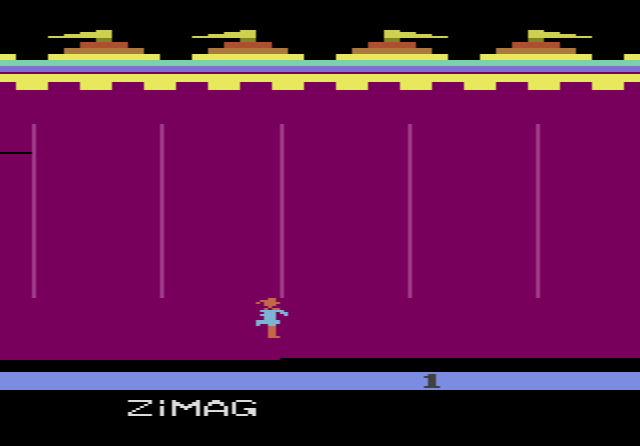
Panda did the same for Sancho, another Taiwanese company, whose own releases were PAL. Panda’s Stunt Man is an NTSC release of Sancho’s Nightmare, and Panda’s Tank Brigade is Phantom Tank again. According to a note on AtariMania, Panda’s version has redrawn graphics, while the Bit Corporation and Zimag versions differ only in their copyright message. That is exactly why these are separate pages on the site: each cartridge contains a slightly different ROM, even when the game is the same.
Sancho’s underwater game Skindiver had a similar afterlife. It turns up as Sea Hunt from Froggo, and in Brazil as Fisher Price from CCE, which has nothing to do with the toy company. Sancho’s horizontal shooter Exocet is also known as Cruise Missile, and it went round the same circuit.
Zellers: pirate carts in a Canadian department store
Zellers was a Canadian discount department store chain, and in the 1980s its shelves carried Atari 2600 cartridges that had not been licensed from the companies that wrote them. They were made in Taiwan and usually renamed. AtariMania files them under “Zellers / Taiwan – 2600 Compatible” and credits the original programmers, which makes the copies easy to trace. For most of them, the original is also on the site:
| Zellers title | Actually is | Original publisher |
|---|---|---|
| Farmer Dan | Gopher | US Games |
| Busy Police | Keystone Kapers | Activision |
| Dragon Treasure | Dragonfire | Imagic |
| Ocean City Defender | Atlantis | Imagic |
| Laser Volley | Laser Gates | Imagic |
| Space Adventure | Flash Gordon | 20th Century Fox |
| Earth Attack | Defender | Atari |
| Radar | Exocet / Cruise Missile | Sancho (1982 PAL release), later others |
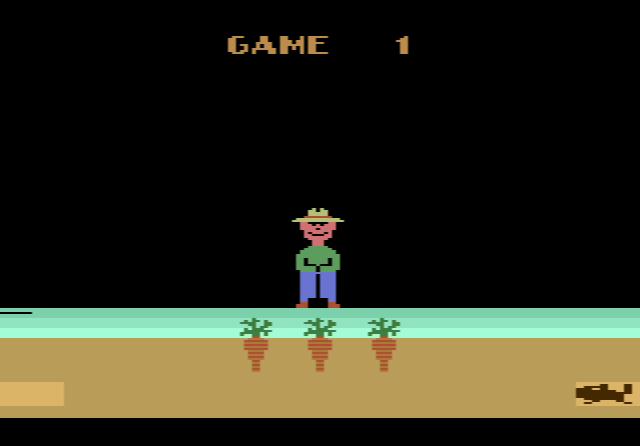
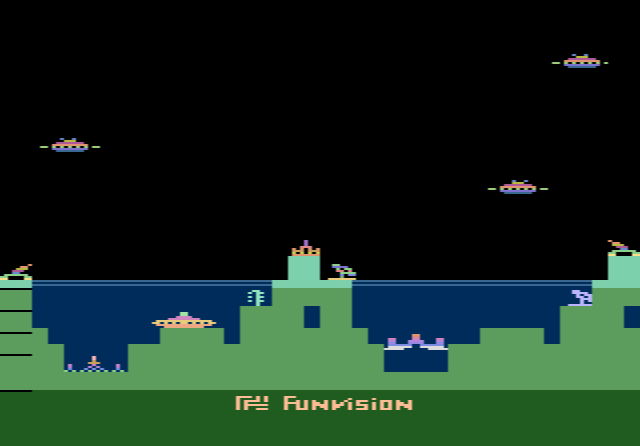
The changes are usually small. Collectors on AtariMania point out that Busy Police reused the artwork from the Keystone Kapers box for its label, and that Ocean City Defender replaces the Imagic logo at the bottom of the screen with a Funvision one and turns the enemy ships into round UFOs. If you want to see a copy side by side with its source, open Atlantis in one tab and Ocean City Defender in another.
Funvision’s own games under many labels
The Zellers name above also appears on Inca Gold, and this one is different: it was not copied from an American publisher. AtariMania marks Funvision’s 1982 PAL cartridge as the original release of Inca Gold, a single-screen platform game. The same game then came out as Spider Maze from K-Tel Vision and as Pac Kong, a title that promises two famous characters and delivers neither.
A second family works the same way. Condor Attack from Ultravision, Vulture Attack from K-Tel Vision and The Year 1999 from Rainbow Vision are all one game, a shooter in the Space Invaders mould. AtariMania even records K-Tel Vision Vulture Attack cartridges with an Ultravision Condor Attack label hidden under the top label, a nice piece of physical evidence that the same stock was sold under more than one name.
Rainbow Vision, Suntek and the German department stores
Rainbow Vision and Suntek share much of the same catalogue. One of their titles, Bermuda, is a hack of Activision’s River Raid: AtariMania credits Carol Shaw, River Raid’s designer, as its programmer, and lists it among nearly thirty renamed versions of her game. Bermuda was also sold in Germany by Quelle and by the Hertie department store chain. Panda’s Harbor Escape belongs to the same River Raid family.
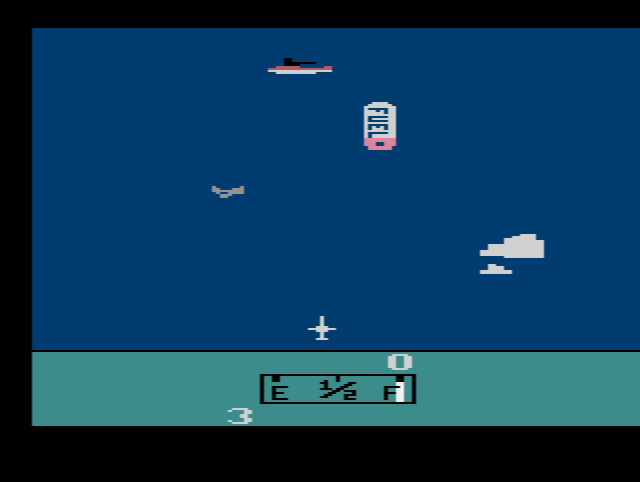
Suntek’s Walker is a rarer case: it was also released as Guignol and in Germany as Schussel, der Polizistenschreck, and AtariMania rates the Suntek cartridge as one of the hardest to find.
Home Vision and Bomb
Home Vision (Gem International Corporation) sold a large PAL catalogue in Europe, and several of its games also exist under the Bomb label. Sky Alien is the same game as Bomb’s Assault, and Wall Break is the same as Bomb’s Wall-Defender. Go Go Home Monster, a maze game about a stranded alien, is also on the site as Alien’s Return. Home Vision also put out Bit Corporation games under its own names, such as Teddy Apple (Open Sesame) and Plate Mania (Dancing Plate).
Brazil: CCE and a clone industry
Brazil deserves its own chapter. From 1977 the country had a “market reserve” policy, made law in 1984, that blocked imports of computer equipment to protect local manufacturers. Atari’s official launch there, through Gradiente’s Polyvox brand, only came in October 1983. In the meantime local companies filled the gap with their own consoles and cartridges, often with the original programmers’ and publishers’ names replaced by their own. CCE was one of the biggest: it built its own Supergame console and released a long list of 2600 games, from its own Bobby Is Going Home cartridge to Fisher Price (Skindiver) and a Brazilian Dragon Treasure.
Brazil also produced a real oddity: MegaBoy from Dynacom, a 64K educational quiz cartridge that came packed with a handheld console of the same name. The site’s page describes it as the only known 64K Atari 2600 game.
Why the site keeps all these versions
You might ask why AtariOnline.org has a page for Farmer Dan when Gopher is right there. The answer is that each of these is a different cartridge with its own ROM, its own label and its own place in history. Some differences are cosmetic (a new title screen, a different logo), some are technical (PAL timing and colours versus NTSC), and a few, like Bermuda or Panda’s Tank Brigade, change how the game looks or feels. Keeping them lets you see exactly what a Canadian discount-store shopper or a German catalogue customer actually played. It also explains why many of these pages are short: often the only thing to say is where the game came from, which is what this guide is for.
Where to start
- Play the original first. If a rebrand has an original on the site (Gopher, Keystone Kapers, Atlantis, Dragonfire, River Raid), start there, then try the copy and look for the changes.
- Try the Taiwanese originals. Bobby Is Going Home, Open Sesame and Dancing Plate are real games in their own right, not copies, and they are the reason so many aliases exist.
- Mind the TV standard. PAL releases such as Snail Against Squirrel or the European Mr. Postman run at 50 Hz, so they can feel slightly slower than their NTSC twins. F2 switches between colour and black-and-white if a game’s colours look off.
- Save before hard screens. Many of these games have no variations to lower the difficulty, so use Ctrl+0–9 to save a state and Alt+0–9 to load it.
The world of clone cartridges is messy, and collectors are still sorting out who made what. If you know more about one of these releases, the game pages are the place to look it up again, and to play it right away in your browser.